
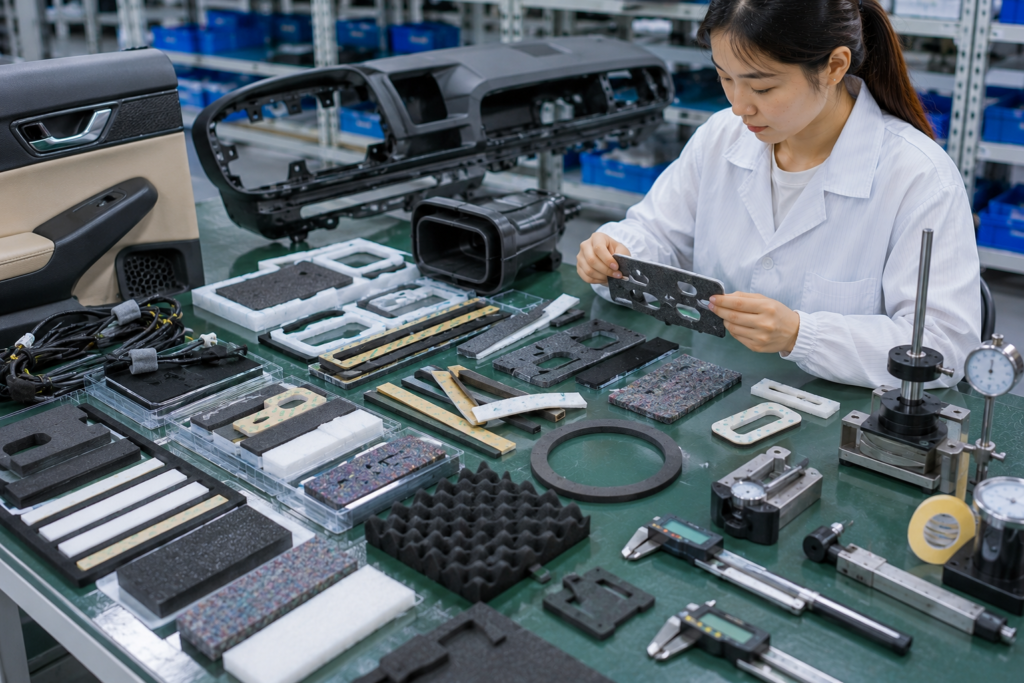
OEM buyers often need to decide whether to purchase foam gasket sheets for in-house cutting or order finished custom die-cut foam gaskets from a converter. Both options can work, but they support different production volumes, quality requirements, and assembly methods.
Foam sheets offer flexibility for prototypes and low-volume work. Custom die-cut gaskets provide greater dimensional consistency, faster installation, and more predictable mass production. The better choice depends on the drawing, tolerance, labor cost, annual demand, sealing function, and risk of assembly variation.
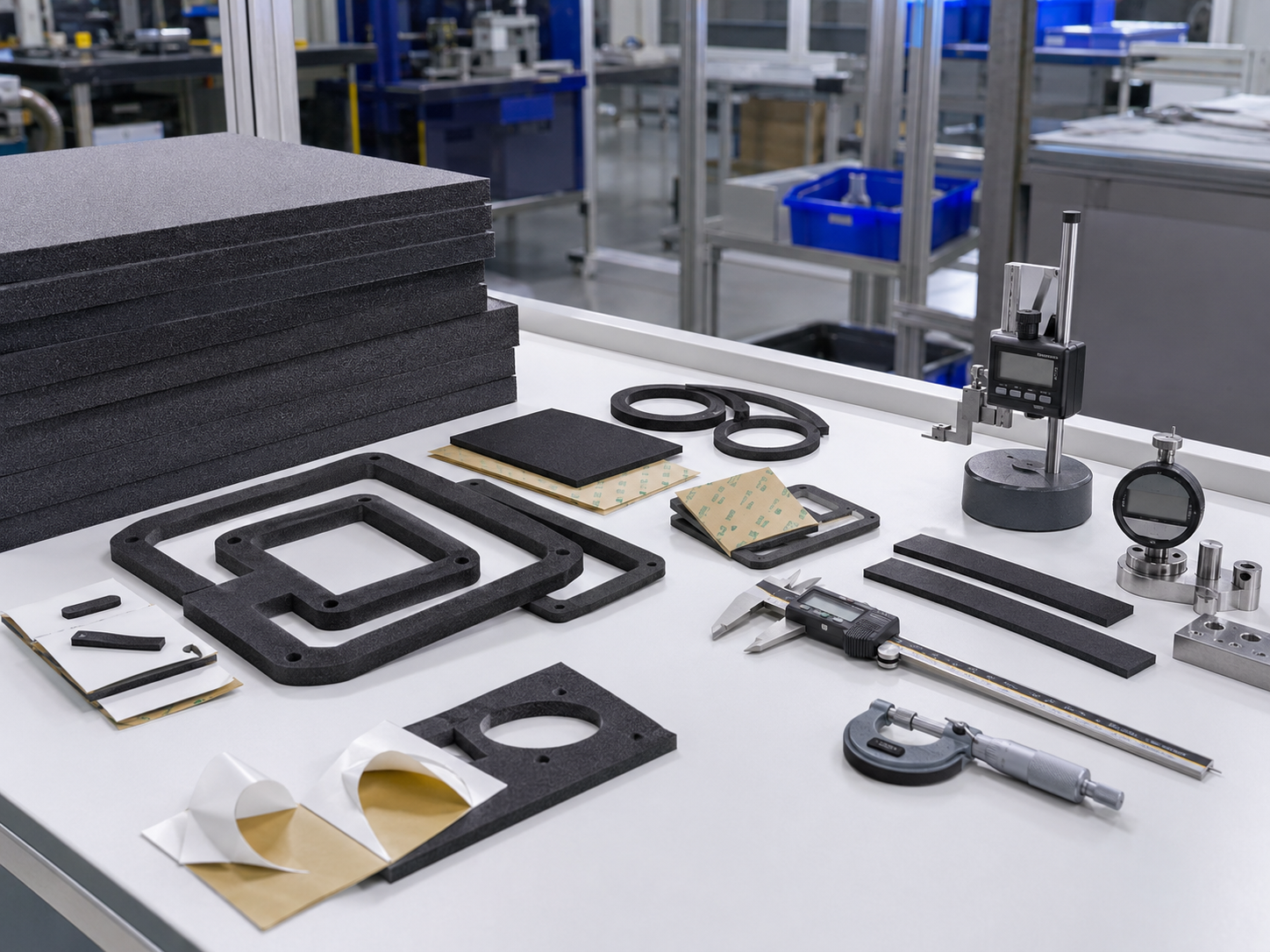
Foam Gasket Sheets Provide Flexibility for Simple Work
Foam gasket sheets are flat sheets or rolls of foam supplied without the final component shape. The buyer cuts, trims, or punches the material internally according to the application.
This option can be practical when the project involves:
- Early prototypes
- Maintenance and repair work
- Very low annual volumes
- Simple rectangular or circular shapes
- Frequent design changes
- Non-critical sealing positions
Foam sheets allow engineers to make quick changes without waiting for dedicated tooling. A technician can cut a sample by hand, use a plotter, or apply a simple punch to confirm fit during early product development.
However, the apparent flexibility can hide additional work. The OEM must manage cutting labor, dimensional inspection, waste disposal, adhesive application, storage, and part identification. These activities may not be significant for ten samples, but they become difficult to control when production reaches thousands of units.
| Foam Sheet Advantage | Practical Limitation |
|---|---|
| Low initial commitment | Requires in-house cutting labor |
| Easy to modify | Part dimensions may vary |
| Useful for prototypes | More material waste |
| No dedicated production tool | Difficult to control complex shapes |
| Suitable for simple repairs | Adhesive may require a separate step |
Foam gasket sheets are therefore most useful when flexibility is more important than repeatability.
Custom Die-Cut Gaskets Improve Dimensional Consistency
A custom die-cut foam gasket is produced to the final drawing before delivery. The converter cuts the foam into the required outline, holes, slots, frames, rings, or irregular profiles.
The finished component may also include:
- Pressure-sensitive adhesive
- Release liners
- Pull tabs
- Split liners
- PET carriers
- Multiple laminated foam layers
- Sheet or roll presentation
Precision converting helps maintain the same gasket shape across repeated production batches. This is important when the component must align with screws, clips, openings, display frames, covers, housings, or other assembly features.
A gasket that is slightly too large may wrinkle or interfere with assembly. A gasket that is too small may leave an incomplete sealing path. Hole-position variation can slow installation or prevent the part from fitting correctly.
Custom foam gaskets and sealing components are usually the better option when dimensional consistency affects product performance or production efficiency.
Cost Should Be Evaluated Beyond the Material Price
Foam sheets often appear less expensive because the buyer is purchasing raw or semi-finished material. Custom die-cut parts include converting, tooling, waste removal, inspection, and packaging, so their unit price may look higher during an initial comparison.
The total cost is different.
OEM buyers should consider:
| Cost Factor | Foam Gasket Sheet | Custom Die-Cut Gasket |
|---|---|---|
| Material purchase | Usually lower | Includes converted part |
| Cutting labor | Managed by OEM | Included by supplier |
| Scrap and waste | Managed by OEM | Controlled during converting |
| Dimensional inspection | OEM responsibility | Supplier inspection |
| Adhesive application | Separate process | Can be pre-laminated |
| Assembly speed | Usually slower | Usually faster |
| Tooling investment | Low initially | May require tooling |
| Production consistency | Operator dependent | Process controlled |
For a small prototype run, purchasing finished tooling may not be economical. For a recurring OEM program, labor and quality costs can quickly exceed the initial savings of buying sheets.
The lowest material price does not always create the lowest assembled-part cost. Buyers should calculate the complete process from incoming material to final installation.
Assembly Volume Often Determines the Better Choice
Production volume is one of the clearest factors in the decision.
Foam sheets may be sufficient when only a few parts are needed each month. They become less practical as volume increases because every unit requires internal cutting, handling, and inspection.
Custom die-cut gaskets are easier to standardize for:
- Repeated production runs
- Multiple assembly lines
- High annual demand
- Global manufacturing programs
- Automated or semi-automated installation
- Products with controlled quality requirements
The exact volume at which custom die cutting becomes more economical depends on part size, geometry, labor rates, material waste, tooling cost, and installation time. A simple square pad may remain practical to cut internally for longer than a complex perimeter gasket with multiple holes.
OEM buyers should also consider demand stability. A project with uncertain geometry may stay with foam sheets during prototype development and move to custom die cutting after the drawing is frozen.
This staged approach reduces early tooling risk while preparing the component for stable production.
Adhesive-Backed Gaskets Reduce Installation Steps
Many foam gaskets require adhesive to keep them in position before the final assembly is closed or fastened.
When an OEM purchases foam sheets, adhesive may need to be applied separately. This can involve spraying adhesive, laminating double-sided tape, or manually placing tape strips. Each additional step creates opportunities for contamination, misalignment, uneven coverage, and longer cycle times.
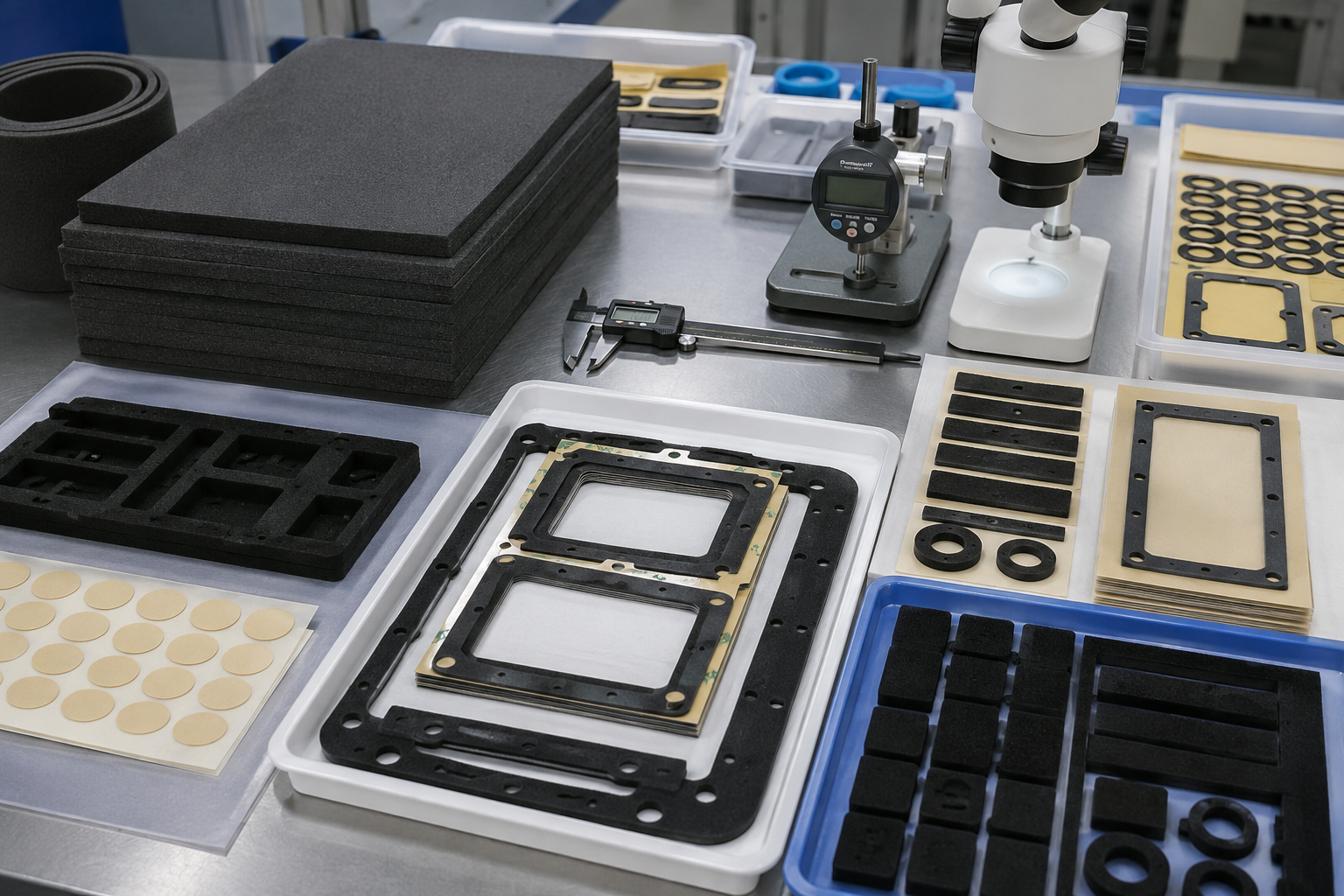
A custom gasket can be supplied with adhesive already laminated to one or both sides.
Benefits include:
- Consistent adhesive coverage
- Faster part placement
- Reduced operator handling
- Better position control
- Cleaner assembly
- Compatibility with kiss-cut liners
- Easier supply to automated stations
The adhesive should be selected according to the bonding surface. Painted metal, molded plastic, glass, coated panels, PET film, and rubber can require different adhesive characteristics.
Release-liner design also matters. Large frame gaskets may be easier to install with a split liner, while small repeated pads can be supplied kiss cut on a sheet or roll.
Custom adhesive-backed die cut components help OEM teams combine the foam and bonding layer into one assembly-ready part.
Complex Geometry Favors Custom Die Cutting
Simple foam pads can often be cut from sheets without major difficulty. Complex gaskets are much harder to produce consistently in-house.
Features that support custom converting include:
- Narrow gasket walls
- Multiple internal openings
- Closely spaced holes
- Irregular outer profiles
- Rounded corners
- Adhesive setback requirements
- Tight hole-to-edge tolerances
- Large perimeter frames
- Multilayer constructions
Hand cutting is especially risky for sealing frames. Small width changes can affect compression and contact pressure around the perimeter. Sharp corners may tear, while inconsistent joints can create possible leak paths.
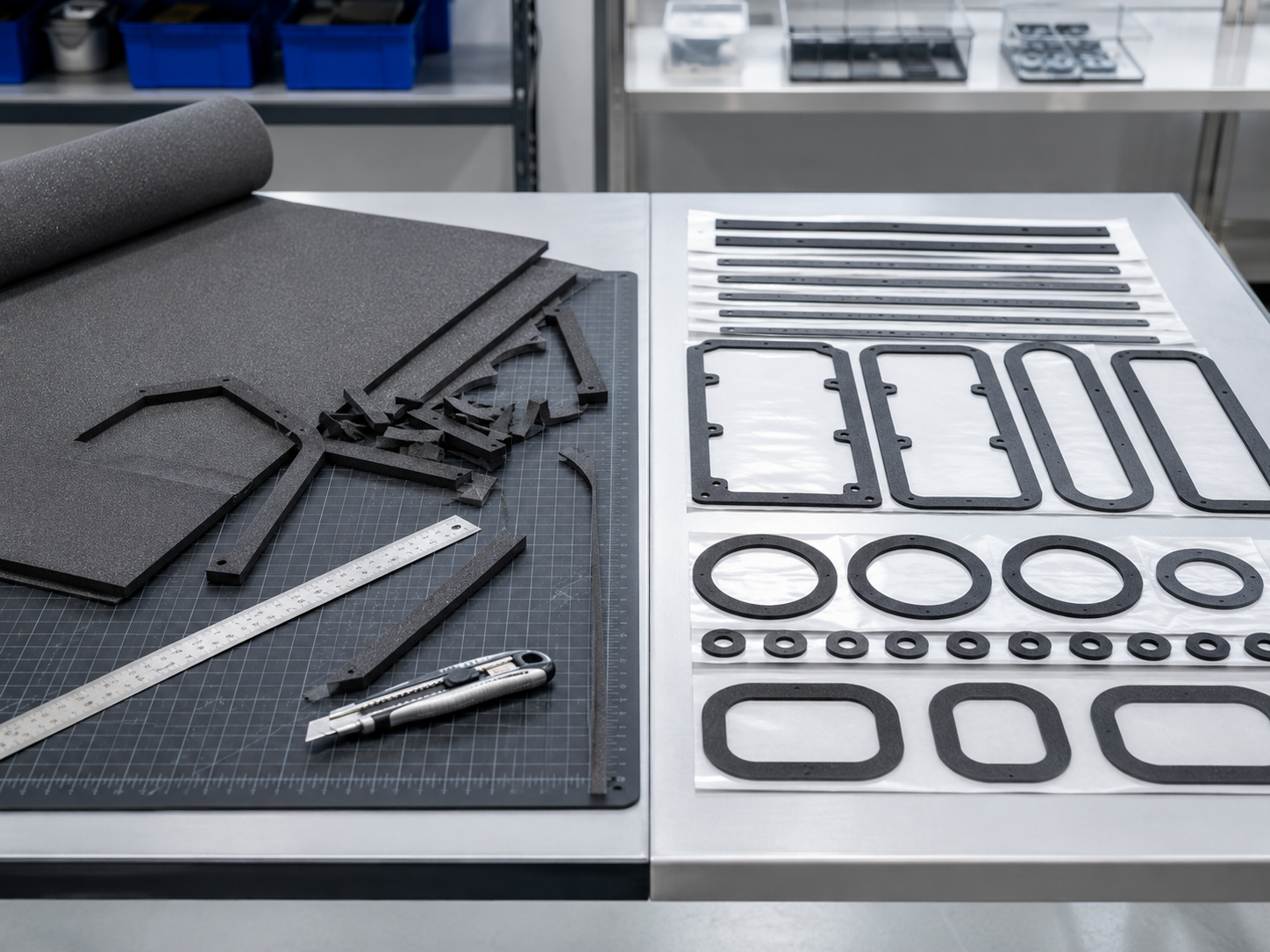
Custom tooling allows the converter to control the complete profile in one process. Kiss cutting can also leave adhesive-backed gaskets on the release liner, which prevents stretching and keeps parts organized.
Design still affects manufacturing stability. Extremely narrow sections, sharp internal corners, and unnecessarily tight tolerances can increase waste or reduce yield even with professional tooling.
Early drawing review through precision die cutting services helps identify geometry that should be adjusted before production.
Material Selection Matters in Both Supply Formats
Whether the buyer chooses sheets or finished gaskets, the foam must suit the application.
Common materials include EVA, PE, PU, EPDM, and silicone foam. Their compression, density, moisture resistance, temperature performance, and recovery characteristics differ.
| Foam Material | Typical Strength | Common Gasket Function |
|---|---|---|
| EVA foam | Flexible and economical | General cushioning and light sealing |
| PE foam | Lightweight and moisture resistant | Spacing and protective pads |
| PU foam | Soft and conformable | Low-pressure gap filling |
| EPDM foam | Durable and weather resistant | Environmental sealing and vibration control |
| Silicone foam | Temperature resistant | More demanding sealing areas |
A foam sheet gives the OEM control over how the material is cut, but it does not solve an incorrect material choice. A professionally die-cut gasket will also fail if the foam is too soft, too firm, too thick, or unable to recover after compression.
Buyers should define:
- Minimum and maximum gap
- Target compression
- Operating temperature
- Moisture exposure
- Required service life
- Bonding substrate
- Thickness tolerance
- Environmental and regulatory requirements
The material and gasket geometry should be reviewed together rather than approved separately.
Custom Parts Simplify Quality Control and Traceability
Foam sheets transfer more process responsibility to the OEM. The customer must control storage, cutting, dimensional inspection, adhesive application, part handling, and waste.
Finished die-cut gaskets allow more of these controls to be completed before delivery.
A supplier can inspect:
- Material grade and thickness
- Outer dimensions
- Hole and slot positions
- Gasket width
- Adhesive alignment
- Kiss-cut depth
- Liner condition
- Part appearance
- Packaging orientation
This is valuable for projects with approved drawings, quality plans, batch traceability, or supplier documentation requirements.
Packaging can also be designed around the assembly line. Gaskets may be supplied in sheets, rolls, trays, bags, or kits. The most suitable format depends on part size, adhesive structure, installation sequence, and volume.
The guide on how die cut parts are supplied in sheets, rolls, or kits explains how presentation format can affect handling and production efficiency.
How Sanken Supports Foam Gasket Projects
Sanken converts EVA, PE, PU, EPDM, and silicone foam into custom gaskets, pads, rings, frames, and adhesive-backed components for OEM applications. We support laminating, kiss cutting, through cutting, prototype production, dimensional inspection, and sheet, roll, or kit delivery.
Before mass production, we review the drawing, foam thickness, compression requirement, adhesive structure, critical dimensions, release liner, and assembly method. This helps determine whether a simple prototype, low-volume solution, or dedicated production process is most appropriate.
You May Also Be Interested In
- How to Choose the Right Custom-Cut Foam for Product Protection
- From Foam Rolls to Finished Parts: How Die Cutting Works
- How Die Cut Parts Are Supplied in Sheets, Rolls, or Kits
- How to Avoid Costly Mistakes in Custom Die Cut Parts
- How to Choose the Right Die Cutting Manufacturer for Your OEM Project
Conclusion
Foam gasket sheets are most suitable for prototypes, repairs, simple shapes, uncertain designs, and very low production volumes. They provide flexibility and avoid early tooling investment, but they require the OEM to manage cutting, inspection, waste, adhesive application, and assembly variation.
Custom die-cut foam gaskets are usually the better choice for stable drawings, complex geometry, adhesive-backed parts, repeated production, and applications where fit or sealing consistency matters. They reduce internal processing, improve installation efficiency, and provide more predictable quality.
Many OEM programs use both approaches at different stages. Foam sheets support early trials, while custom die-cut gaskets support validated production. The final decision should be based on total manufacturing cost, part complexity, annual volume, quality risk, and the requirements of the finished assembly.