
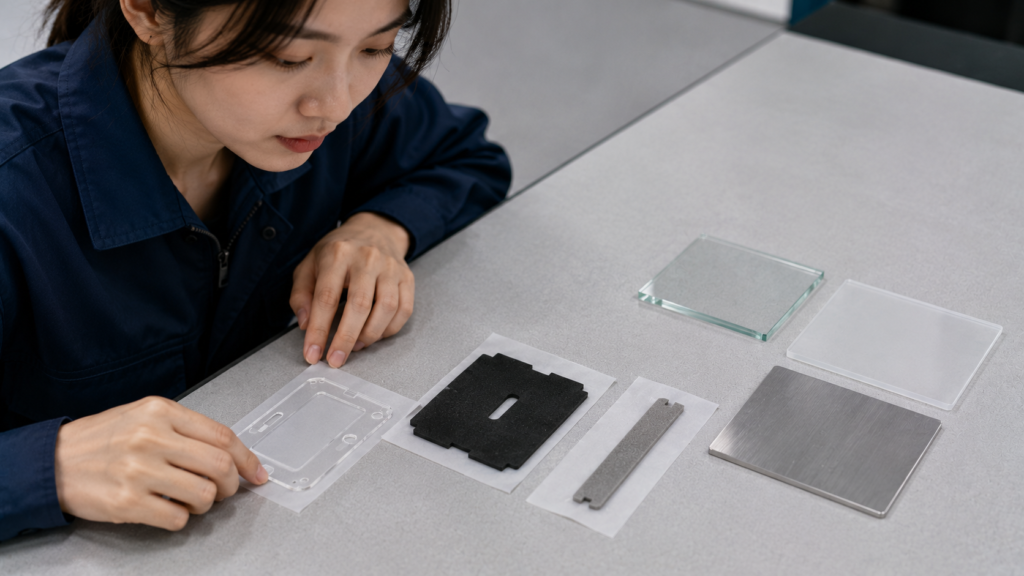
There is no single 3M VHB tape that is best for every die-cut application.
The correct starting point depends on the two bonding substrates, their surface energy, required tape thickness, visibility, operating environment and assembly method. After that, the proposed VHB tape must also be evaluated as a die-cut component—not only as roll material.
At Sanken, we provide precision die cutting and adhesive tape converting for customer-specified VHB tapes. We review whether the selected material can be converted into stable frames, pads, strips or rings and supplied in a format that supports the customer’s assembly process.
This article compares several common VHB tape families as initial selection directions. Final approval should follow the latest technical data for the exact tape grade and testing on the actual production substrates.
Start With the Two Bonding Surfaces
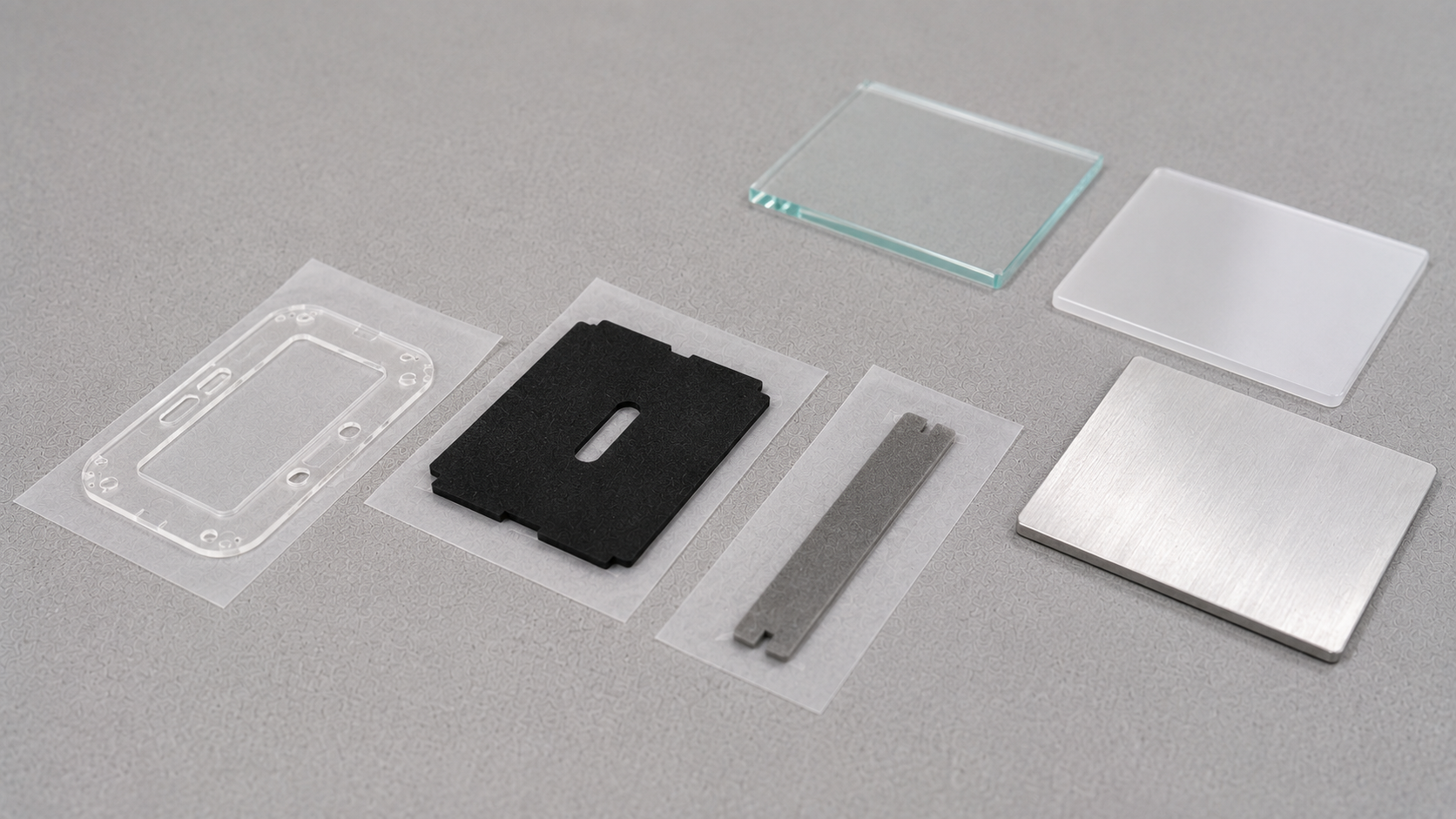
A VHB tape creates a permanent bond between two surfaces. Both surfaces must therefore be identified before selecting a tape family.
Typical substrates include:
- Aluminum
- Stainless steel
- Glass
- Acrylic
- Polycarbonate
- ABS
- Polypropylene
- TPO or TPE
- Painted metal
- Powder-coated surfaces
- Fiber-reinforced composites
Surface energy affects how easily the adhesive can spread across the substrate and develop contact. Smooth glass and clean metal generally behave differently from textured polypropylene, powder-coated paint or plastic containing migrating additives.
The following details should be confirmed:
| Substrate detail | Why it matters |
|---|---|
| Exact material | Determines the initial adhesive direction |
| Coating or paint | The tape bonds to the coating, not the material below it |
| Surface texture | Rough surfaces reduce the actual contact area |
| Cleanliness | Oil, dust and release agents can interfere with bonding |
| Flatness | Surface variation may require greater conformability |
| Surface treatment | Plasma, primer or another treatment may change adhesion |
| Curvature | The tape may remain under continuous peel stress |
Selecting a tape only by color or perceived strength can therefore lead to weak bonding, edge lifting or failure after environmental exposure.
For a broader explanation of pressure-sensitive bonding, see How Does 3M Tape Work?.
Common 3M VHB Tape Families to Compare
The following table provides an initial comparison of common VHB tape families. It is not a substitute for the current technical data sheet or application testing.
| VHB family | Initial application direction | Important die-cut consideration |
|---|---|---|
| 4910 family | Clear bonding involving glass, acrylic, polycarbonate, metal and other higher-surface-energy substrates | Dust, bubbles, edge visibility and placement accuracy |
| 4941 family | General-purpose gray, conformable bonding on many metal, glass and medium- to high-surface-energy applications | Thickness, liner handling and dimensional stability |
| 5952 family | Black, highly conformable construction for many painted surfaces, powder coatings and selected plastics | Adhesive softness, edge flow, waste removal and surface validation |
| LSE series | Difficult-to-bond plastics such as PP, TPO and TPE, subject to exact-grade confirmation | High initial tack, liner release and part deformation during peeling |
| GPH family | Applications involving elevated-temperature processing or higher-temperature exposure | Actual thermal cycle, part stress and post-process validation |
4910 Family: Clear Bonding
The 4910 family is commonly considered when a clear bond line is preferred and the substrates include glass, acrylic, polycarbonate or metal.
For die-cut parts, transparency makes contamination and conversion defects more visible. Important controls include:
- Surface cleanliness
- Bubble prevention
- Accurate frame alignment
- Clean cut edges
- Protective handling
- Packaging that limits dust exposure
Clear appearance does not automatically make this family suitable for every transparent plastic. The exact plastic grade, coating and stress condition must still be evaluated.
According to 3M’s information for VHB Tape 4910, it is designed primarily for clear bonding and higher-surface-energy substrates.
4941 Family: Conformable General-Purpose Bonding
The 4941 family uses a conformable acrylic foam construction and may be considered for many metal, glass, painted and medium- to high-surface-energy applications.
It is a practical comparison direction when the assembly requires:
- Conformability
- A gray bond line
- Panel or trim attachment
- Contact with slightly irregular surfaces
- Stress distribution between rigid components
The exact tape grade within the family must still be selected according to thickness, adhesive construction and application environment.
A thicker tape may improve contact on small surface variations, but excessive thickness can affect assembly height or create visible gaps. Thickness should therefore be selected from the joint design rather than treated as an independent preference.
5952 Family: Painted Surfaces and Selected Plastics
The 5952 family uses a modified acrylic adhesive and a highly conformable foam core. It is often evaluated for painted surfaces, powder coatings and a range of plastic substrates.
This family may be a useful starting point when the surface is more difficult than clean metal or glass, but the exact paint and plastic must be tested.
Painted surfaces require special attention because the VHB tape bonds to the paint layer. A strong adhesive cannot compensate for paint that is insufficiently cured, contaminated or poorly attached to the underlying material.
For die cutting, the soft and conformable construction may also create:
- Edge deformation
- Tape stretching
- Adhesive flow
- Difficult waste removal
- Dimensional change during peeling
The cutting tool, part spacing, liner release and waste-removal direction should be reviewed together.
LSE Series: Low-Surface-Energy Plastics
The VHB LSE series is intended for difficult-to-bond materials such as PP, TPO, TPE and some composites.
This series may reduce or eliminate the need for primer in certain applications, but this should not be treated as a universal result. The exact substrate, surface condition and tape grade must be validated.
LSE tapes can also have high initial tack. For narrow die-cut frames and small parts, high tack may increase the risk of:
- Stretching during waste removal
- Parts lifting with the waste matrix
- Difficult repositioning
- Deformation during liner peeling
- Misalignment during manual assembly
3M provides several LSE thicknesses, so the final choice should consider both bonding compatibility and assembly stack height. 3M’s LSE series information identifies PP, TPO, TPE and selected composites as relevant substrate directions.
GPH Family: Elevated-Temperature Processing
The GPH family may be considered when a bonded assembly will experience elevated-temperature manufacturing processes or higher service temperatures.
The project should confirm:
- Maximum temperature
- Exposure duration
- Repeated or one-time heating
- Load applied during heating
- Substrate expansion
- Paint or coating process
- Required bond area
A high-temperature tape should not be selected solely from a maximum temperature value. Short-term exposure, continuous operating temperature and loaded bond performance are different conditions.
Choose Thickness From the Joint Design
Tape thickness affects more than the finished part height.
A thinner construction may suit a compact, flat assembly but provide limited accommodation for surface variation. A thicker acrylic foam tape may improve contact on slightly uneven surfaces but can change the assembly gap and allow more movement under load.
Evaluate:
- Available stack height
- Surface flatness
- Gap variation
- Required bond area
- Static and dynamic load
- Thermal expansion between substrates
- Edge visibility
- Compression during assembly
VHB tape should not automatically replace a functional foam gasket. If the main requirement is controlled compression, cushioning, sealing or anti-rattle performance, foam gaskets and sealing components may be more appropriate.
VHB tape is primarily selected to bond two substrates. A gasket is primarily designed to work under controlled compression. Some assemblies may use both, but their functions should remain clear.
Design the VHB Part for Cutting and Assembly
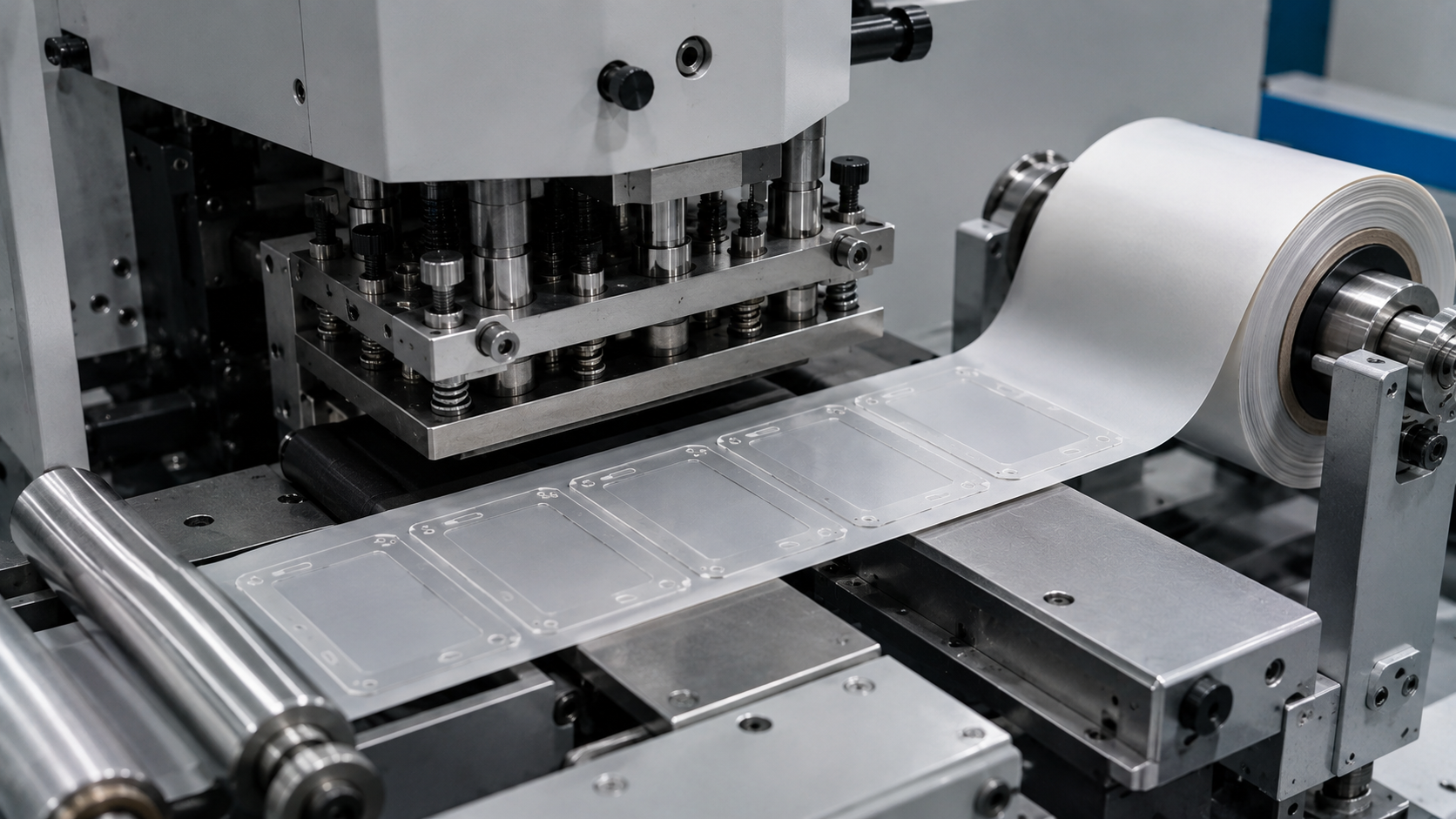
A suitable VHB tape can still perform poorly if the die-cut geometry is difficult to manufacture or apply.
Review the following factors before tooling:
| Design factor | Possible risk |
|---|---|
| Very narrow frame width | Stretching, tearing or insufficient bond area |
| Sharp corners | Stress concentration and possible edge lifting |
| Small internal holes | Incomplete waste removal |
| Limited hole-to-edge distance | Weak geometry and cutting instability |
| Large unsupported shape | Deformation during peeling |
| Tight liner release | Part stretching or lifting |
| No peel tab | Slow or inaccurate manual application |
| Poor part spacing | Difficult picking and waste removal |
Corner radii should be considered where the product design permits them. Rounded transitions can improve cutting stability and reduce localized peeling stress.
However, no universal minimum width or corner radius applies to every project. Feasibility depends on tape thickness, foam firmness, adhesive tack, liner, tooling method and required tolerance.
Sanken reviews the drawing together with the selected material so the part can be cut, stripped, peeled, positioned and pressed without unnecessary deformation.
Select the Liner and Delivery Format Early
The original VHB liner may be appropriate for roll material but not necessarily for the final die-cut geometry or assembly process.
Some projects require:
- Replacement release liner
- Extended liner
- Split liner
- Pull tab
- Kiss-cut parts on sheets
- Kiss-cut parts on rolls
- Individual pieces
- Additional handling support
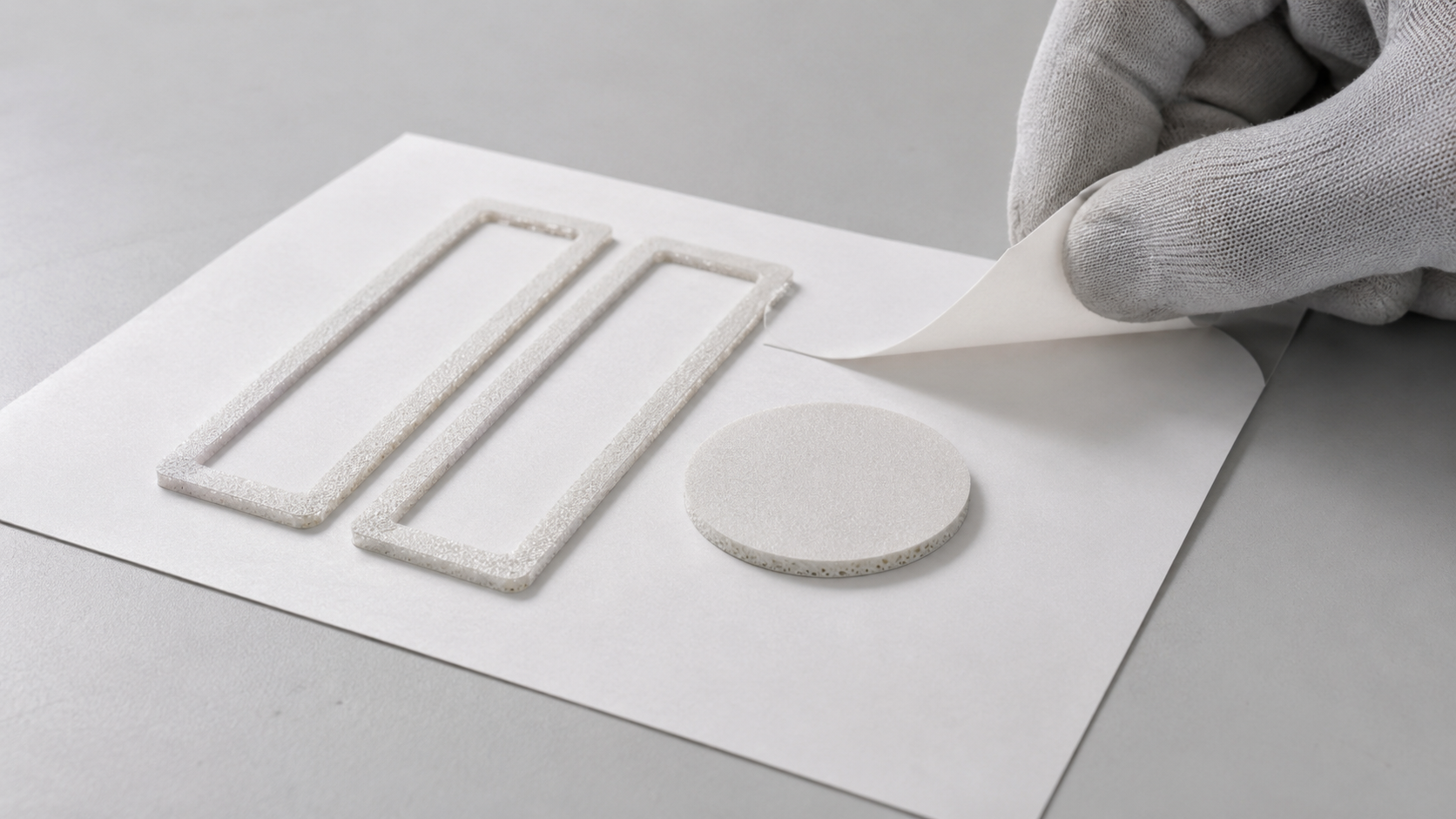
For kiss cutting, the VHB construction is cut while the supporting liner remains intact. The cutting depth must be controlled carefully.
A cut that is too shallow may prevent clean waste removal. A cut that is too deep may weaken the liner and cause tearing during assembly.
The required delivery format should be confirmed before tooling because liner width, part spacing, peel direction and roll orientation can affect the die layout. See Die Cut vs Kiss Cut: What Buyers Should Know for Adhesive Parts and Protective Films for a detailed comparison.
Validate the Assembly Process
A VHB tape does not reach its intended performance simply because the part has been placed on the surface.
The production process should control:
- Surface cleaning and preparation
- Tape application temperature
- Part alignment
- Pressure across the complete bonding area
- Time before the assembly is loaded
- Packaging and handling after bonding
3M explains that firm pressure improves adhesive contact and that bond strength develops as the adhesive wets the substrate over time. The exact requirements must be checked against the applicable tape data and the customer’s assembly conditions. See 3M’s VHB application guidance.
Narrow frames are particularly sensitive to uneven pressure. An unpressed corner or edge can become the starting point for peeling.
Fixtures or rollers may provide more consistent pressure than manual finger application, especially in higher-volume production.
Common Problems in Die-Cut VHB Parts
| Problem | Possible cause | What to review |
|---|---|---|
| Weak bonding | Incompatible substrate or contamination | Surface identification and cleaning |
| Edge lifting | Poor wet-out, sharp corners or continuous peel stress | Geometry, pressure and joint design |
| Tape stretching | Narrow shape or tight liner release | Frame width and liner construction |
| Adhesive flow at the edge | Soft adhesive, heat or converting pressure | Tape grade and cutting process |
| Liner tearing | Excessive cutting depth | Kiss-cut control and liner strength |
| Difficult peeling | Unsuitable release force or no pull tab | Liner and delivery format |
| Part misalignment | Unstable geometry or poor handling support | Liner layout and assembly fixture |
| Failure after aging | Unvalidated heat, humidity or load | Environmental and joint testing |
These problems should be evaluated as a complete system rather than attributed only to the tape brand. Additional causes are explained in Why Do Die-Cut Adhesive Parts Fail After Assembly?.
What Information Should Buyers Provide?
Before confirming a VHB tape for a die-cut component, provide:
- Exact tape grade, if already specified
- First and second bonding substrates
- Paint, coating and surface texture
- Drawing and critical dimensions
- Required total thickness
- Operating temperature
- Humidity, UV or chemical exposure
- Expected static and dynamic load
- Manual or automated application
- Pressing method
- Liner and pull-tab requirements
- Sheet, roll or individual-piece delivery
- Prototype and annual quantities
- Validation requirements
If the tape has not been specified, application details are more useful than a request for “the strongest VHB tape.”
A complete project description allows the material supplier, customer and converter to evaluate the adhesive family, exact grade and die-cut structure separately. Buyers can use the checklist in What Information Should You Provide for a Custom Adhesive Tape Die-Cut Part Quotation?.
How Sanken Supports Customer-Specified VHB Converting
Sanken converts customer-specified industrial adhesive tapes into custom frames, pads, strips, rings and liner-supported components.
Our relevant support includes:
- Adhesive tape lamination
- Flatbed and rotary die cutting
- Kiss cutting
- Release-liner configuration
- Pull-tab structures
- Waste-matrix removal
- Prototype sampling
- Dimensional inspection
- Sheet and roll presentation
Our role is to review whether the specified tape and part design can be converted consistently and supplied in a format that supports assembly.
Tape selection remains subject to the current manufacturer’s technical data and customer validation on the actual substrates.
Conclusion
The appropriate 3M VHB tape for a die-cut application cannot be selected by color, thickness or strength alone.
The 4910 family may provide a starting point for clear bonding on glass and higher-surface-energy substrates. The 4941 family may suit conformable general-purpose bonding. The 5952 family may be considered for many painted surfaces and selected plastics. The LSE series is designed for more difficult low-surface-energy plastics, while the GPH family may be evaluated for elevated-temperature processes.
These are initial selection directions, not final specifications.
Before production, confirm the exact tape grade, both bonding substrates, joint geometry, environmental conditions, die-cut design, liner, application pressure and delivery format. Final approval should be based on current technical data and testing under representative assembly conditions.
3M and VHB are trademarks of 3M Company. References in this article are provided for general technical information. Sanken is not presented in this article as an authorized 3M distributor or approved converter. Material selection should be confirmed with the applicable manufacturer documentation and actual application testing.
Related Articles
- How Does 3M Tape Work in Die-Cut Applications?
- How Double-Sided Tape Works for Die-Cut OEM Parts
- Why Do Die-Cut Adhesive Parts Fail After Assembly?
- Die Cut vs Kiss Cut: What Buyers Should Know for Adhesive Parts and Protective Films
- What Information Should You Provide for a Custom Adhesive Tape Die-Cut Part Quotation?