
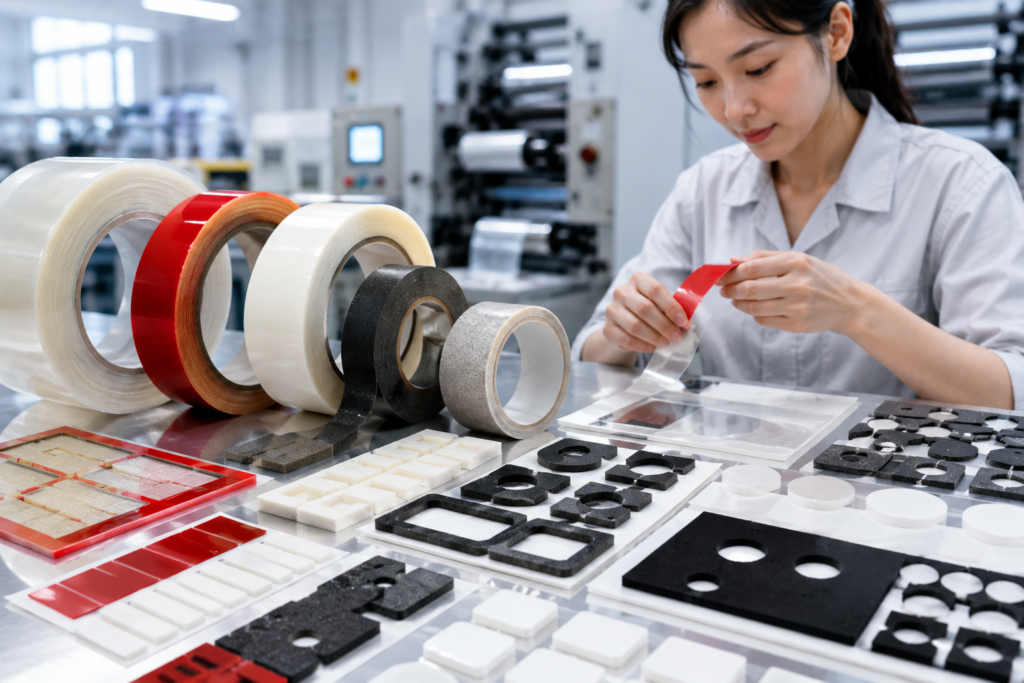
Custom adhesive tape parts are used in electronics, automotive interiors, appliances, displays, sensors, housings, control panels, and industrial products.
They help bond parts together.
They also help seal gaps, position components, protect surfaces, reduce vibration, insulate areas, and simplify assembly.
At Sanken, we use precision die cutting and material converting to manufacture custom adhesive tape frames, foam tape gaskets, PET-backed adhesive parts, transfer adhesive films, protective films with pull tabs, and laminated adhesive components for OEM production.
A well-designed adhesive tape part should be easy to peel, easy to place, stable after bonding, and suitable for mass production.
A poorly designed one may lift, shift, stretch, overflow glue, slow down workers, or fail after assembly.
Start With the Assembly Function
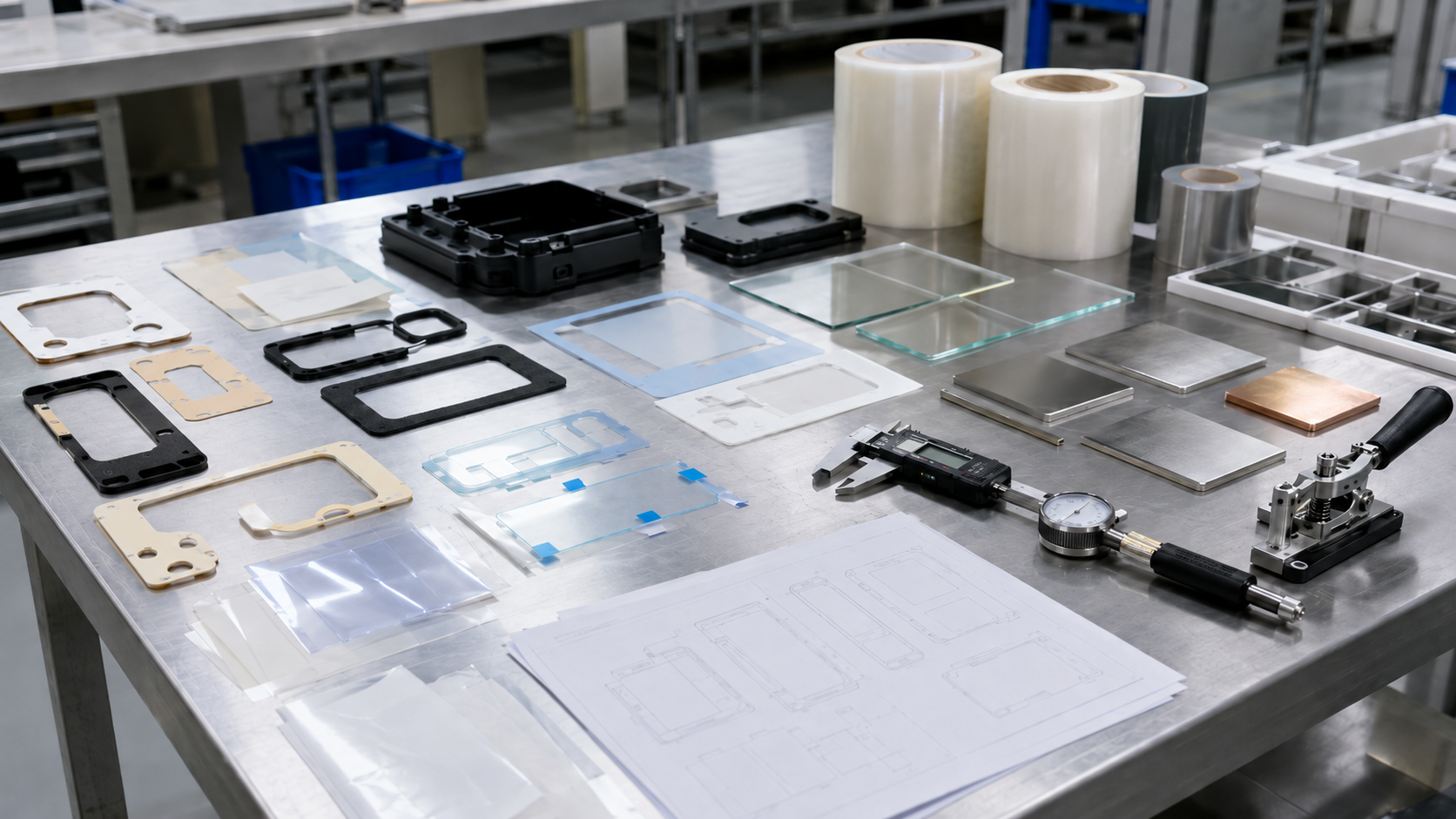
Before choosing tape material or drawing the final shape, define what the adhesive part needs to do.
Different functions need different adhesive structures.
| Assembly Function | Common Adhesive Tape Part |
|---|---|
| Bonding | Double-sided tape frames, transfer adhesive parts |
| Sealing | Adhesive foam gaskets, foam tape strips |
| Cushioning | Foam tape pads, adhesive-backed foam parts |
| Insulation | PET-backed adhesive films, adhesive PET films |
| Surface protection | Protective films with pull tabs |
| Light blocking | Black PET adhesive frames |
| Positioning | Kiss-cut adhesive pads on liner |
| Vibration control | Adhesive-backed foam or rubber pads |
For OEM projects, custom die cut parts should be designed around the real assembly function.
The shape matters.
But the function decides the structure.
A tape part that only looks correct may still fail if it does not match the bonding surface, pressure, temperature, and handling method.
Match the Adhesive to the Bonding Surface
Adhesive performance starts with the surface.
Plastic, metal, glass, rubber, foam, painted surfaces, coated parts, and textured materials do not bond the same way.
Before choosing adhesive tape, confirm:
| Bonding Surface Detail | Why It Matters |
|---|---|
| Material type | Different surfaces need different adhesives |
| Surface texture | Rough or curved surfaces reduce contact area |
| Surface energy | Low-surface-energy plastics may need special adhesive |
| Cleanliness | Dust, oil, or release agents can cause failure |
| Coating or paint | Surface coating may affect adhesion |
| Assembly pressure | Adhesive needs proper contact to bond |
| Working environment | Heat, humidity, vibration, or aging may affect bonding |
If the customer only says “plastic,” the information is not enough.
ABS, PC, PP, PE, and painted plastic can behave very differently.
The adhesive needs the full story.
Choose the Right Tape Structure
Custom adhesive parts can use many different tape structures.
The best choice depends on the function, thickness limit, surface condition, and assembly method.
| Tape Structure | Best Used For |
|---|---|
| Double-sided tape | General bonding and mounting |
| Transfer adhesive | Thin bonding with minimal thickness |
| Foam tape | Bonding with cushioning and gap filling |
| Acrylic foam tape | Strong bonding and gap compensation |
| PET-backed adhesive tape | Better shape stability and handling |
| Adhesive-backed foam | Sealing, cushioning, and positioning |
| Protective film with adhesive | Temporary surface protection |
| Laminated adhesive structure | Combined bonding, insulation, and protection |
For high-volume adhesive-backed parts, roll-to-roll die cutting can improve part spacing, liner control, waste removal, and production efficiency.
The tape structure should support the assembly process.
Not fight it.
Design for Easy Peeling
One of the most common problems with die cut adhesive parts is difficult peeling.
If operators struggle to remove the part from the liner, the tape may stretch, curl, deform, or collect dust from fingers.
Good peeling design can improve assembly speed and reduce defects.
Useful design choices include:
- Add pull tabs when manual peeling is required
- Avoid extremely small handling areas
- Leave enough spacing between parts on the liner
- Use suitable release liner force
- Choose film liner when better flatness is needed
- Control kiss-cut depth carefully
- Avoid shapes that tear during peeling
For adhesive frames, foam tape gaskets, and protective films, kiss cutting is often the best format.
The part is cut while the release liner remains intact.
This keeps parts organized and makes assembly easier.
For more detail, buyers can review Die Cut vs Kiss Cut: What OEM Buyers Should Know for Adhesive Parts and Protective Films.
Use Rounded Corners to Reduce Edge Lift
Sharp corners may look clean in a CAD drawing.
In adhesive tape parts, they often create risk.
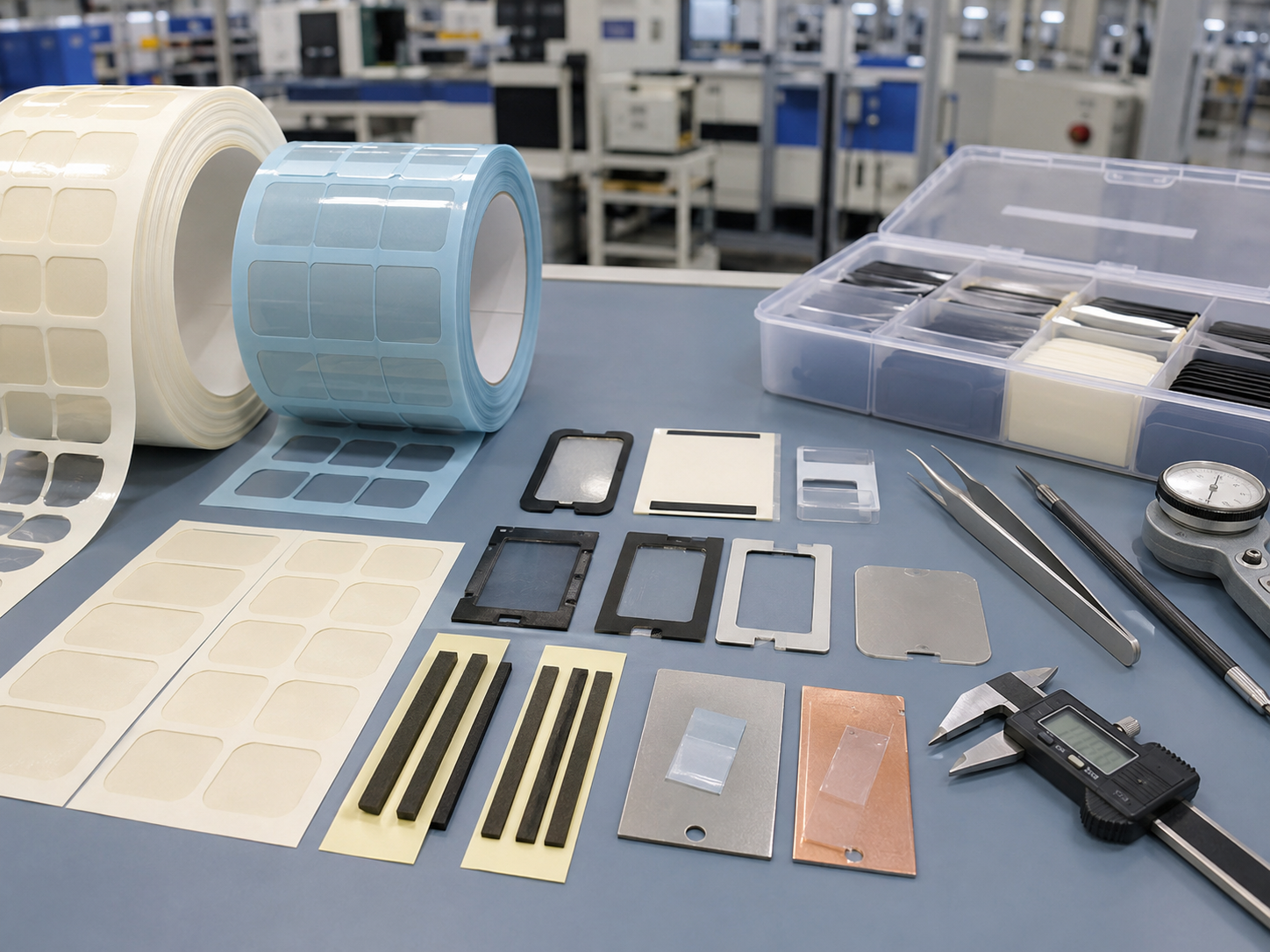
Sharp corners can become the first place where the tape lifts, stretches, tears, or collects stress during peeling and bonding.
Rounded corners are usually better for:
| Design Area | Benefit of Rounded Corners |
|---|---|
| Tape frames | Reduces edge lifting |
| Foam tape gaskets | Reduces tearing during waste removal |
| Protective films | Improves peeling stability |
| PET-backed adhesive parts | Reduces corner stress |
| Narrow adhesive strips | Improves handling and bonding reliability |
A small radius can make a big difference.
Very small feature.
Very large attitude.
Control Tape Width and Minimum Wall Size
Narrow adhesive walls can be difficult to cut, peel, and apply.
If the tape frame is too narrow, it may deform during waste removal or stretch during peeling.
If the adhesive area is too small, bonding strength may not be enough.
Important design points include:
| Design Point | Why It Matters |
|---|---|
| Minimum tape width | Prevents tearing and weak bonding |
| Inner frame width | Affects waste removal and dimensional stability |
| Hole-to-edge distance | Reduces deformation risk |
| Part spacing | Improves peeling and liner handling |
| Adhesive area | Supports stable bonding strength |
| Pull tab position | Improves operator handling |
For foam tape parts, minimum width is especially important because foam can compress and deform.
For transfer adhesive, narrow walls may stretch.
For PET-backed tape, dimensional stability is usually better, but edge quality still matters.
Prevent Glue Overflow During Design
Glue overflow happens when adhesive moves beyond the edge of the die cut part.
It can contaminate displays, housings, optical films, decorative surfaces, sensors, liners, and packaging.
Common causes include:
- Adhesive layer too thick
- Adhesive too soft
- Excessive assembly pressure
- High temperature exposure
- Narrow tape wall design
- Poor die cutting edge control
- Incorrect waste removal direction
- Wrong packaging pressure
To reduce glue overflow, review the adhesive thickness, backing material, die cutting method, liner type, part width, and assembly pressure.
For sensitive applications, PET-backed adhesive tape may provide better edge stability than unsupported transfer adhesive.
For display or optical parts, adhesive overflow must be controlled carefully because it may become visible.
Extra glue is not extra quality.
It is usually extra trouble.
Plan the Liner and Release Structure Early
The release liner affects how the part is handled before assembly.
It should not be treated as an afterthought.
Common liner design choices include:
| Liner Choice | Typical Benefit |
|---|---|
| Paper liner | Common and cost-effective for many tape parts |
| Film liner | Better flatness and cleaner handling in selected uses |
| Easy-release liner | Faster manual peeling |
| Tight-release liner | Better part stability during transport |
| Single liner | Simple adhesive-backed structure |
| Double liner | Useful for double-sided adhesive structures |
| Pull-tab liner | Easier placement and removal |
Liner release must match the part size, adhesive strength, and assembly method.
If release is too tight, the part may stretch during peeling.
If release is too loose, the part may shift before use.
The best liner is boring.
It releases when needed and stays stable before that.
Consider Assembly Method: Manual or Automated
The same adhesive part may need a different design depending on the assembly method.
Manual assembly usually needs easy peeling, good part spacing, and clear handling areas.
Automated assembly may require roll format, stable pitch, liner strength, and consistent release behavior.
| Assembly Method | Design Focus |
|---|---|
| Manual application | Pull tabs, sheets, easy peeling, larger handling area |
| Fixture-assisted assembly | Stable shape, accurate positioning holes |
| Automated application | Roll format, controlled spacing, stable liner |
| High-volume production | Waste control, repeatability, packaging efficiency |
| Clean assembly | Surface protection, dust control, clean trays or bags |
For manual assembly, die cut parts supplied in sheets can make picking and placement easier.
For automated assembly, rolls or kiss-cut formats may improve speed and consistency.
This guide on die cut parts supplied in sheets, rolls, or kits explains how delivery format affects production handling.
Design for Real Working Conditions
A tape part should not only pass a quick sample test.
It should survive the actual working environment.
Important conditions include:
- Temperature range
- Humidity exposure
- Vibration
- Compression
- Surface movement
- Aging time
- Indoor or outdoor use
- Chemical or oil contact
- Storage condition before assembly
For automotive die cut components, adhesive parts may need to resist heat, vibration, and long-term interior aging.
For electronics and display parts, cleanliness, flatness, and liner release may be more important.
For appliance and industrial products, sealing, dust protection, and bonding durability may be the main concerns.
Design should always follow the application.
Manufacturing Process for Custom Adhesive Tape Parts
Custom adhesive tape parts are usually made through material selection, lamination, die cutting, kiss cutting, waste removal, inspection, and packaging.
A typical process includes:
| Process Step | Purpose |
|---|---|
| Application review | Confirm bonding surface, function, and assembly method |
| Material selection | Choose adhesive, carrier, foam, film, and liner |
| Lamination | Combine tape, foam, film, liner, or protective layer |
| Tooling design | Control shape, radius, spacing, and cutting depth |
| Die cutting | Cut tape frames, pads, strips, films, or gaskets |
| Kiss cutting | Keep adhesive parts on release liner |
| Waste removal | Remove extra tape cleanly |
| Inspection | Check size, edge, adhesive position, and liner release |
| Packaging | Prevent dust, deformation, sticking, and scratches |
For adhesive tape projects, die cutting control is not only about the outer shape.
It also controls edge quality, adhesive stability, liner condition, and handling performance.
Quality Checks Before Mass Production
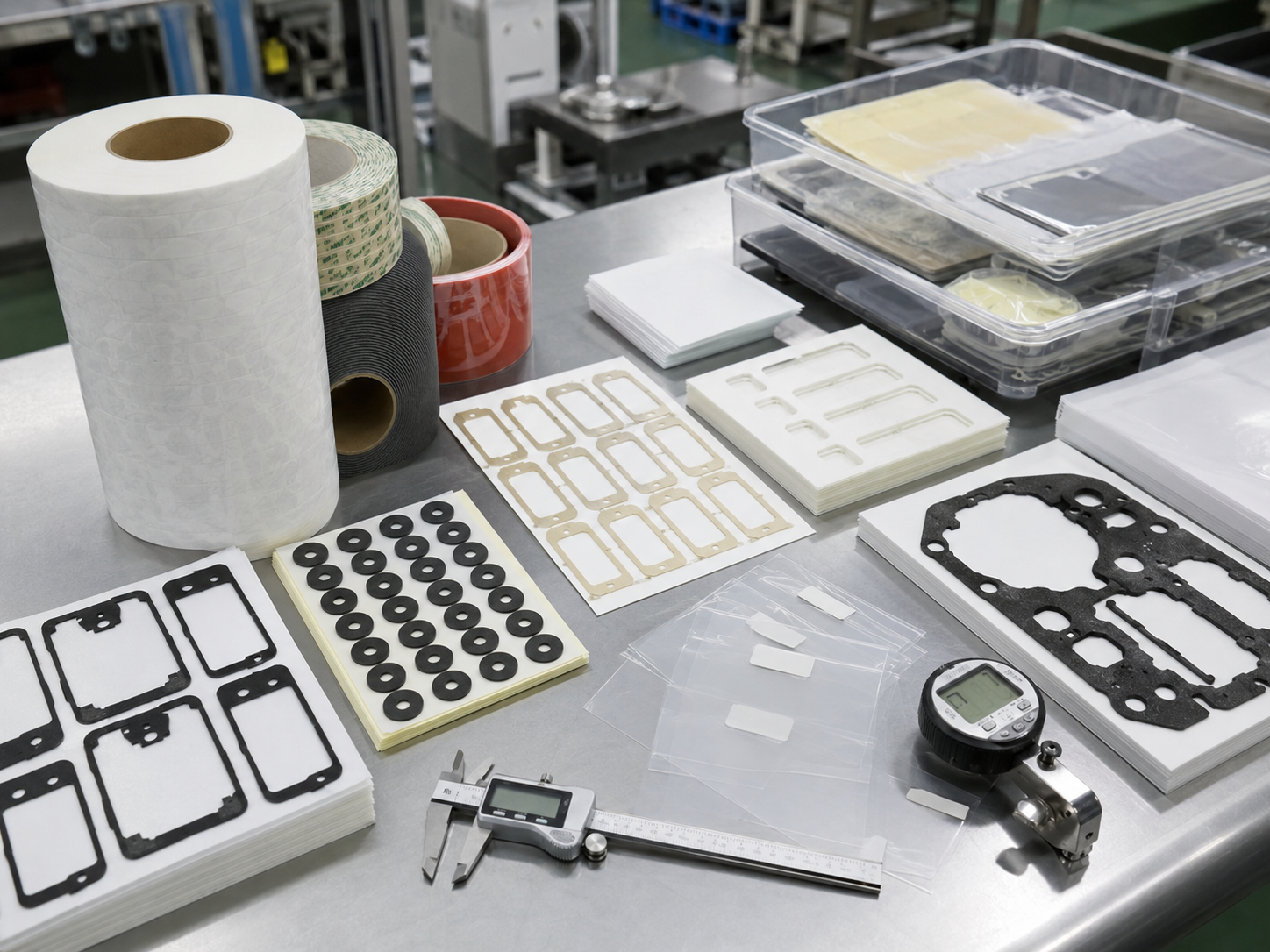
A good adhesive tape design must be repeatable in production.
Important inspection points include:
| Inspection Item | Why It Matters |
|---|---|
| Dimensions | Ensures correct fit |
| Tape thickness | Controls stack height |
| Adhesive position | Prevents shifting or poor bonding |
| Edge quality | Reduces glue overflow and burrs |
| Liner release | Improves assembly speed |
| Peel strength | Confirms bonding performance |
| Surface cleanliness | Prevents contamination |
| Flatness | Improves placement accuracy |
| Packaging condition | Prevents deformation before use |
For adhesive-backed foam parts, compression and recovery may also need checking.
For protective films, residue and easy removal may be important.
For optical-related adhesive parts, scratches and particles must be controlled carefully.
Buyer Checklist for Adhesive Tape Part Design
Before requesting samples or quotation, prepare the following information:
| Information | Why It Helps |
|---|---|
| Drawing or sample | Confirms shape, size, holes, and tolerance |
| Application location | Defines function and risk |
| Bonding surface | Helps select adhesive |
| Tape material preference | Speeds up quotation |
| Thickness requirement | Controls fit and assembly height |
| Adhesive strength need | Supports bonding reliability |
| Liner requirement | Improves peeling and handling |
| Pull tab requirement | Helps manual assembly |
| Assembly method | Determines sheets, rolls, or kits |
| Annual volume | Supports process planning |
| Packaging preference | Prevents deformation and contamination |
If the tape material is not confirmed, Sanken can help compare double-sided tape, transfer adhesive, foam tape, acrylic foam tape, PET-backed adhesive tape, protective film, release liner, and laminated structures.
For supplier selection, buyers can also review how to choose the right die cutting manufacturer before moving from sampling to mass production.
Need Custom Adhesive Tape Parts for Easier OEM Assembly?
Custom adhesive tape parts can make OEM assembly faster, cleaner, and more reliable when they are designed correctly.
The best design considers adhesive selection, bonding surface, tape structure, corner radius, minimum width, liner release, pull tabs, delivery format, inspection, and packaging.
If you need adhesive tape frames, foam tape gaskets, PET-backed adhesive parts, transfer adhesive films, protective films with pull tabs, or laminated adhesive structures, send us your drawing, sample, bonding surface, material requirement, tolerance, annual volume, and packaging preference.
Sanken can help review adhesive selection, lamination structure, die cutting method, liner release, inspection points, and delivery format before mass production.
Related Articles
You may also find these articles helpful:
- What Is Pressure Sensitive Adhesive Tape and Where Is It Used in OEM Assembly?
- What Information Should You Provide for a Custom Adhesive Tape Die-Cut Part Quotation?
- How to Avoid Edge Lift, Glue Overflow, and Adhesive Failure in Die-Cut Tape Parts
- Why Do Die Cut Adhesive Parts Fail After Assembly?
- Why Your Die Cut Tape Parts Lift, Shift or Peel Off
- How to Prevent Adhesive Overflow in Custom Die Cut Tape Parts
- Die Cut vs Kiss Cut: What OEM Buyers Should Know for Adhesive Parts and Protective Films
Conclusion
Custom adhesive tape parts should be designed for both bonding performance and assembly efficiency. Good design controls the adhesive structure, bonding surface, corner radius, minimum width, liner release, pull tab, delivery format, and packaging. When these details are reviewed early, die cut tape parts can reduce assembly defects and improve OEM production stability.