
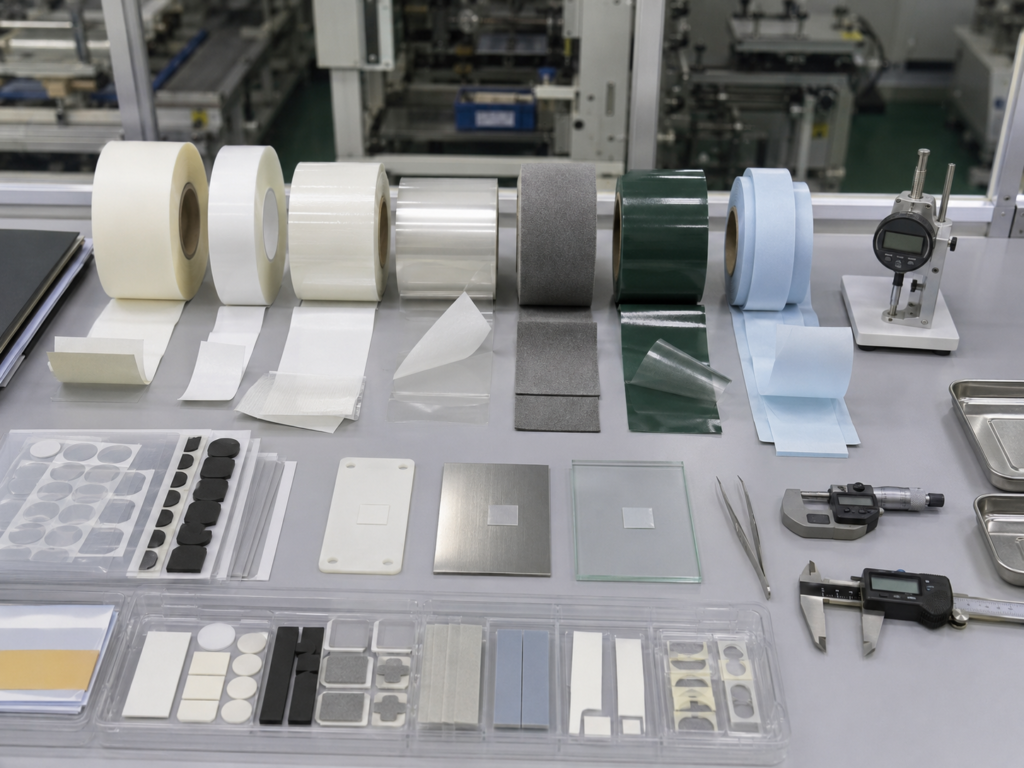
A custom adhesive tape die-cut part looks simple.
It may be a tape frame, foam tape gasket, PET-backed adhesive film, pull-tab protective film, or double-sided adhesive pad.
But before a supplier can quote it accurately, they need more than a part name.
At Sanken, we use precision die cutting and material converting to manufacture adhesive tape frames, foam tape parts, transfer adhesive parts, PET-backed adhesive parts, protective films with pull tabs, and laminated adhesive components for OEM assembly.
To quote correctly, we need to understand the drawing, material, adhesive structure, bonding surface, tolerance, delivery format, and production volume.
A better quotation request means fewer revisions, faster sampling, and fewer surprises during mass production.
1. Provide a Drawing or Sample
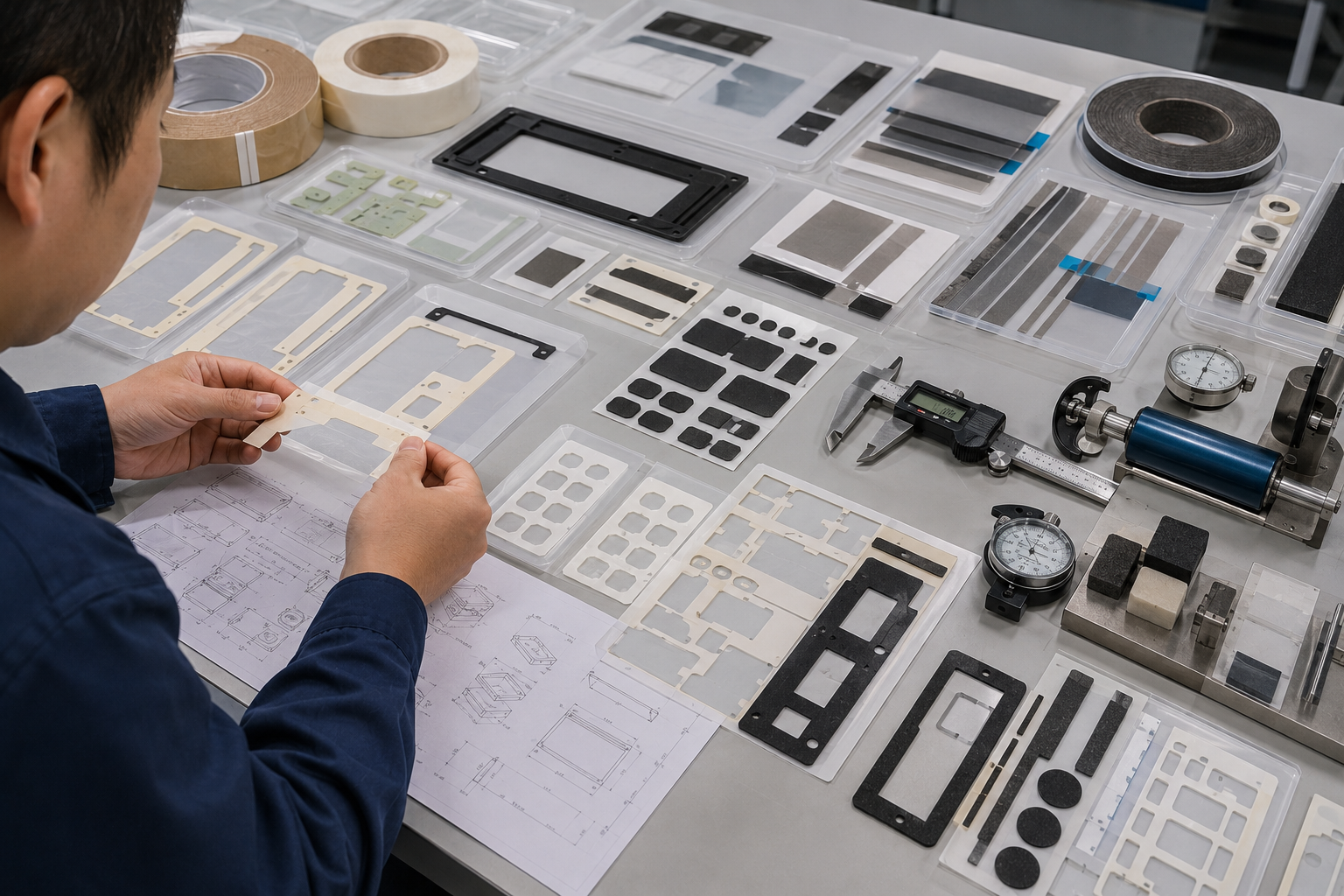
The most important information is the drawing or sample.
A clear drawing helps confirm shape, size, holes, slots, corner radius, tolerance, and special handling requirements.
Useful drawing details include:
| Drawing Information | Why It Matters |
|---|---|
| Outer dimensions | Confirms final part size |
| Inner cutouts | Controls frame shape and fitting |
| Hole positions | Supports assembly alignment |
| Corner radius | Reduces tearing and adhesive lifting |
| Tolerance | Defines inspection standard |
| Thickness | Confirms material and stack height |
| Part orientation | Avoids wrong placement |
| Pull tab position | Improves peeling and assembly |
If there is no drawing, a physical sample or clear photo can help start the review.
But for accurate production, a technical drawing is still preferred.
Small tape parts are not forgiving.
A 0.5 mm shift can become a production problem very quickly.
2. Tell Us the Application
The same adhesive tape part may be used for bonding, sealing, cushioning, insulation, protection, positioning, or light blocking.
Each function needs a different material structure.
Common applications include:
| Application | Common Adhesive Die-Cut Part |
|---|---|
| Display bonding | Double-sided tape frames |
| Surface protection | Protective films with pull tabs |
| Sealing | Adhesive foam gaskets |
| Cushioning | Foam tape pads |
| Insulation | PET-backed adhesive films |
| Positioning | Adhesive pads or tape strips |
| Light blocking | Black PET adhesive frames |
| Assembly support | Kiss-cut adhesive parts on liner |
For OEM projects, custom die cut parts should be designed around the real assembly function, not only the shape.
When we understand the application, we can better recommend material, adhesive, liner, and delivery format.
3. Confirm the Adhesive Tape Material
If you already have a specified tape material, provide the material name, brand, model, thickness, and structure.
If you do not have a specified material, provide the application requirements so we can help compare options.
Common adhesive materials include:
- Double-sided tape
- Transfer adhesive
- Foam tape
- Acrylic foam tape
- PET-backed adhesive tape
- Protective film with adhesive
- Adhesive-backed foam
- Adhesive-backed PET film
- Laminated film and tape structures
The material choice affects bonding strength, thickness, flexibility, liner release, cutting performance, and cost.
If the customer only says “double-sided tape,” the quotation may be inaccurate.
Double-sided tape can mean many different things.
The tape has a personality.
We need its full name.
4. Describe the Bonding Surface
Adhesive performance depends heavily on the surface it bonds to.
Plastic, glass, metal, rubber, foam, painted parts, coated surfaces, and textured materials do not bond the same way.
Please provide:
| Bonding Detail | Example |
|---|---|
| Surface material | ABS, PC, PET, glass, aluminum, painted metal |
| Surface texture | Smooth, rough, matte, coated, curved |
| Surface cleanliness | Clean, oily, dusty, treated |
| Assembly pressure | Manual pressing, fixture pressing, roller pressing |
| Working environment | Heat, humidity, vibration, indoor, outdoor |
| Peel strength requirement | Temporary, removable, permanent bonding |
This information helps avoid adhesive lifting, poor bonding, edge peeling, and assembly failure.
For adhesive selection problems, buyers can also review why die cut adhesive parts fail after assembly.
5. Specify Thickness and Tolerance
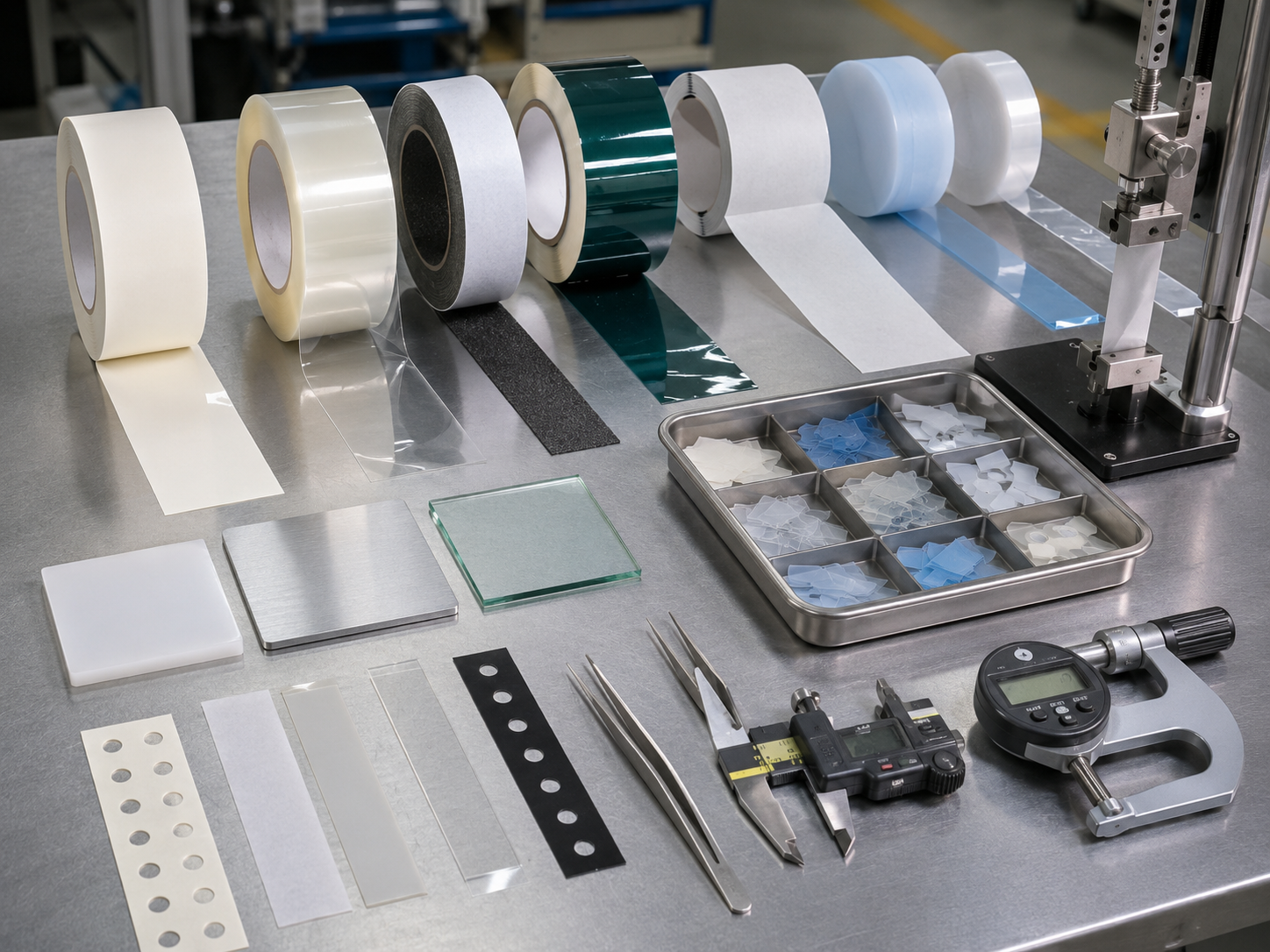
Thickness affects assembly fit, bonding pressure, compression, sealing, and appearance.
For adhesive foam parts, total thickness includes foam, adhesive, liner, and any laminated layer.
For film tape parts, thickness affects stack height and fitting accuracy.
Important thickness details include:
| Thickness Detail | Why It Matters |
|---|---|
| Tape thickness | Controls bonding layer height |
| Foam thickness | Controls compression and sealing |
| Film thickness | Controls insulation and spacing |
| Adhesive thickness | Affects total structure |
| Total part thickness | Affects final assembly fit |
| Tolerance | Defines acceptable production variation |
If thickness is flexible, tell us the acceptable range.
If thickness is fixed, confirm whether the tolerance applies to the raw material, finished part, or complete laminated structure.
6. Confirm Liner and Peeling Requirements
The release liner is very important for adhesive tape die-cut parts.
It affects peeling, handling, storage, and assembly speed.
Useful liner information includes:
- Single liner or double liner
- Paper liner or film liner
- Easy-release or tight-release requirement
- Pull tab requirement
- Kiss-cut on liner or fully cut pieces
- Part spacing on liner
- Direction of peeling
- Manual or automated application
For adhesive-backed parts, kiss cutting is often used.
The adhesive tape part is cut while the liner remains intact.
This makes it easier for operators to peel and apply the part.
If liner release is poor, operators lose time.
If the part stretches during peeling, placement accuracy suffers.
A good liner makes the production line happier.
7. Choose the Delivery Format
Adhesive die-cut parts can be supplied in several formats.
The right format depends on the assembly line.
| Delivery Format | Suitable Use |
|---|---|
| Individual pieces | Simple or low-volume assembly |
| Sheets | Manual picking and organized application |
| Rolls | Automated or high-volume application |
| Kiss-cut on liner | Adhesive frames, foam tape, film parts |
| Pull-tab format | Easier peeling and placement |
| Kits | Multi-part module assembly |
| Clean trays or bags | Parts needing deformation or dust protection |
For high-volume adhesive parts, roll-to-roll die cutting can improve consistency and production efficiency.
For assembly planning, buyers can also review how die cut parts are supplied in sheets, rolls, or kits.
Delivery format should be discussed before quotation.
It affects material usage, tooling, labor, packaging, and unit price.
8. Provide Annual Volume and Order Quantity
Quotation depends on quantity.
Sample quantity, trial order quantity, and mass production volume should be separated.
Useful volume information includes:
| Quantity Information | Why It Matters |
|---|---|
| Sample quantity | Supports prototype planning |
| Trial order quantity | Helps prepare pilot production |
| Annual volume | Affects process and material planning |
| Batch quantity | Affects unit price and delivery |
| Forecast | Helps material purchasing and scheduling |
Low-volume samples may use a different cost structure than mass production.
High-volume projects may need optimized tooling, roll processing, waste control, and custom packaging.
Without quantity, the quotation can only be rough.
Different adhesive tape parts require different inspection points.
For simple tape strips, dimension and adhesive position may be enough.
For display, electronics, automotive, or optical applications, cleanliness and liner control may be more important.
Common quality requirements include:
| Requirement | Why It Matters |
|---|---|
| Dimensional inspection | Confirms fit |
| Thickness inspection | Controls stack height |
| Adhesive position | Prevents bonding failure |
| Edge quality | Reduces burrs and particles |
| Liner release test | Improves assembly efficiency |
| Peel strength test | Confirms bonding performance |
| Surface cleanliness | Protects visible or electronic areas |
| Packaging inspection | Prevents deformation and sticking |
If the product has special standards, provide them before quotation.
This helps us include the correct inspection and packaging requirements from the beginning.
10. Provide Packaging and Labeling Requirements
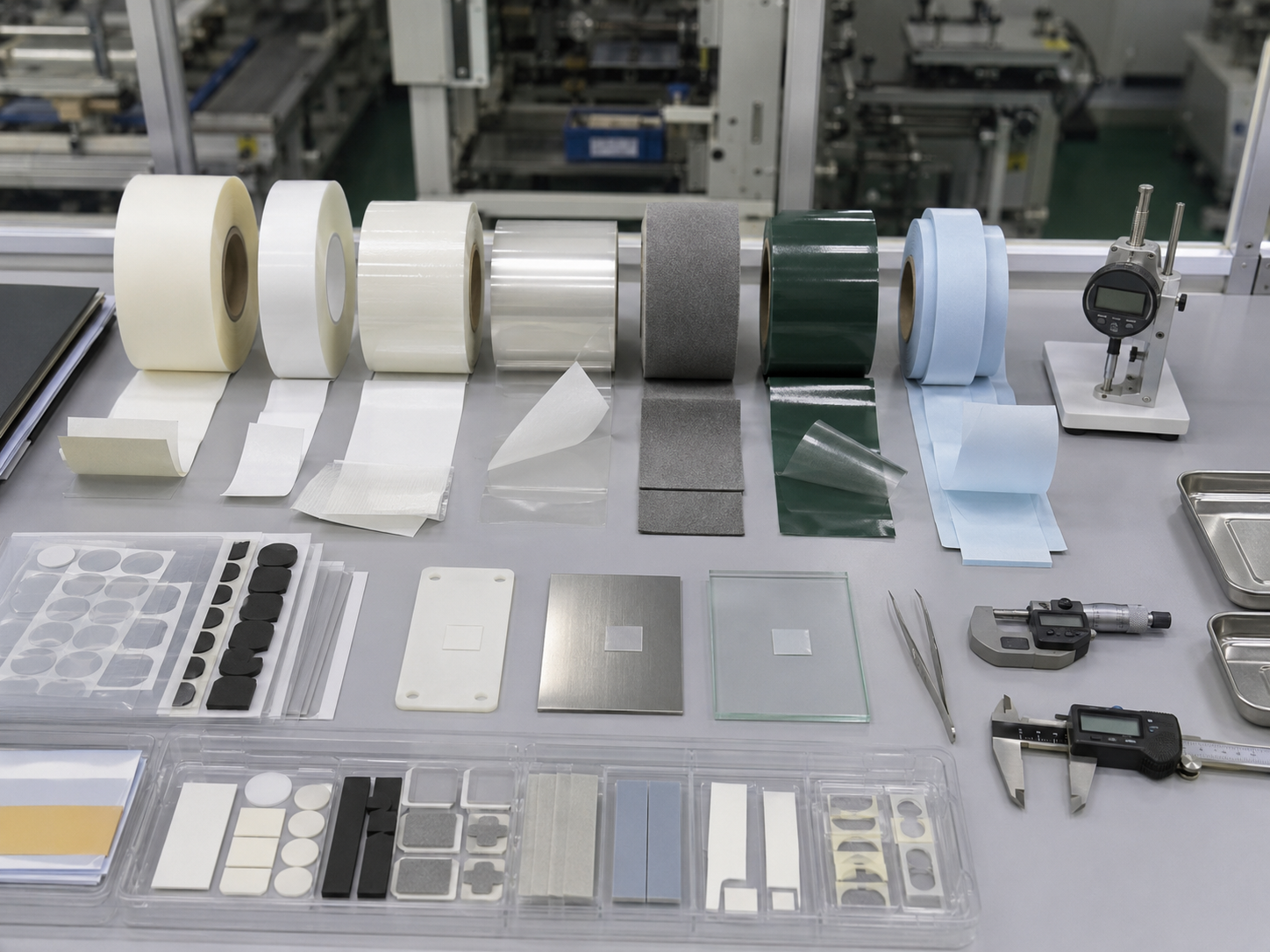
Packaging is part of product quality.
Adhesive tape parts can deform, stick together, collect dust, or become difficult to peel if packaging is not planned correctly.
Helpful packaging details include:
- Parts per sheet or roll
- Roll direction
- Core size
- Bag or tray requirement
- Clean packaging requirement
- Anti-static packaging requirement
- Label format
- Lot traceability requirement
- Shipping protection requirement
For thin films, protective films, and optical-related adhesive parts, packaging must prevent scratches, dust, curling, and liner damage.
For foam tape parts, packaging must prevent compression deformation.
Quotation Checklist for Custom Adhesive Tape Die-Cut Parts
Before requesting a quotation, prepare the following information:
| Information | Needed for Accurate Quotation |
|---|---|
| Drawing or sample | Shape, size, holes, tolerance |
| Application | Bonding, sealing, insulation, protection |
| Material | Tape type, thickness, brand or specification |
| Bonding surface | Plastic, metal, glass, rubber, painted surface |
| Adhesive requirement | Peel strength, temperature, removability |
| Liner requirement | Release force, pull tab, kiss-cut format |
| Thickness and tolerance | Fit, compression, assembly height |
| Delivery format | Sheets, rolls, pieces, kits |
| Quantity | Sample, trial, mass production volume |
| Quality requirement | Inspection and testing standard |
| Packaging | Roll, sheet, tray, bag, clean packaging |
The more complete the information, the faster the quotation can move forward.
Need a Quotation for Custom Adhesive Tape Die-Cut Parts?
Custom adhesive tape die-cut parts need careful control of material, adhesive, liner, tolerance, delivery format, and packaging.
If you need adhesive tape frames, foam tape gaskets, PET-backed adhesive parts, transfer adhesive films, protective films with pull tabs, or laminated adhesive structures, send us your drawing, sample, material requirement, bonding surface, tolerance, annual volume, and packaging preference.
Sanken can help review material selection, lamination structure, die cutting method, inspection points, and delivery format before mass production.
Related Articles
You may also find these articles helpful:
- Adhesive Backed Die Cut Components for OEM Assembly
- Why Do Die Cut Adhesive Parts Fail After Assembly?
- Why Your Die Cut Tape Parts Lift, Shift or Peel Off
- How to Prevent Adhesive Overflow in Custom Die Cut Tape Parts
- How to Prevent Adhesive Lifting in Die Cut Tape Components
- What Is the Best Adhesive for Die Cut Tape Parts?
- Die Cut vs Kiss Cut: What OEM Buyers Should Know for Adhesive Parts and Protective Films
Conclusion
For a custom adhesive tape die-cut part quotation, buyers should provide the drawing, application, material, bonding surface, thickness, tolerance, adhesive requirement, liner structure, quantity, delivery format, quality standard, and packaging needs. Complete information helps suppliers quote faster, sample more accurately, and reduce problems before mass production.