
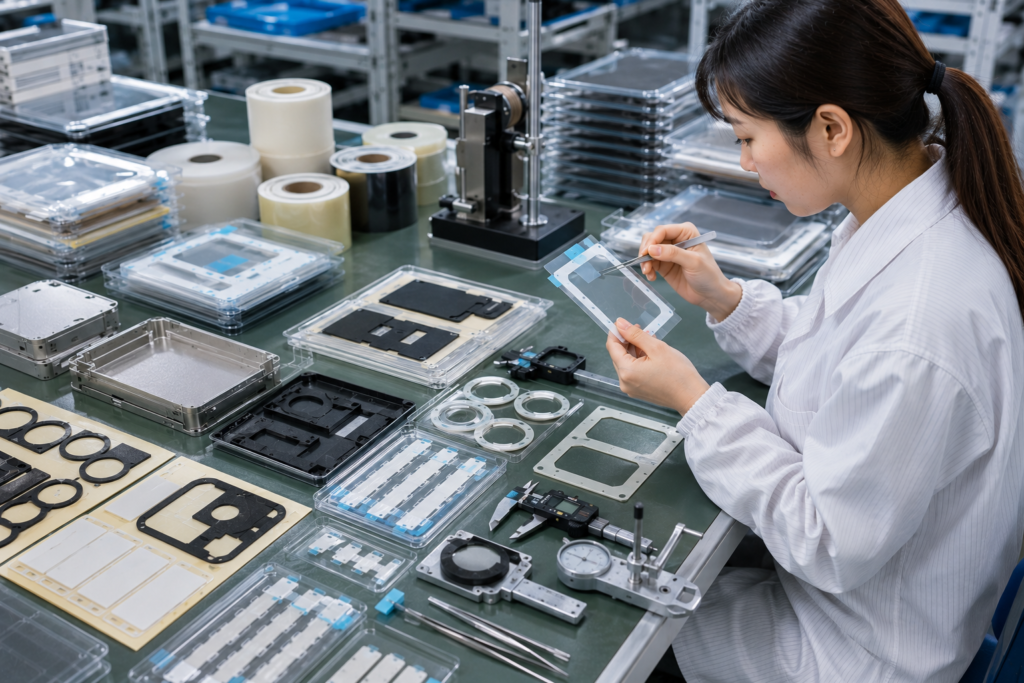
Many OEM adhesive parts start from roll materials.
A roll of adhesive tape may become a display bonding frame.
A foam tape roll may become a gasket.
A PET-backed adhesive roll may become an insulation part.
A protective film roll may become a pull-tab surface protection film.
This is where tape converting becomes important.
At Sanken, we use precision die cutting and adhesive material converting to turn customer-specified pressure-sensitive adhesive tapes, including 3M-brand or equivalent roll materials, into custom OEM adhesive parts.
These parts are used for bonding, sealing, cushioning, insulation, surface protection, light blocking, positioning, and assembly efficiency.
Note: 3M is a trademark of 3M Company. This article discusses adhesive tape converting for OEM manufacturing and does not imply brand ownership or official brand affiliation.
What Is 3M Tape Converting?
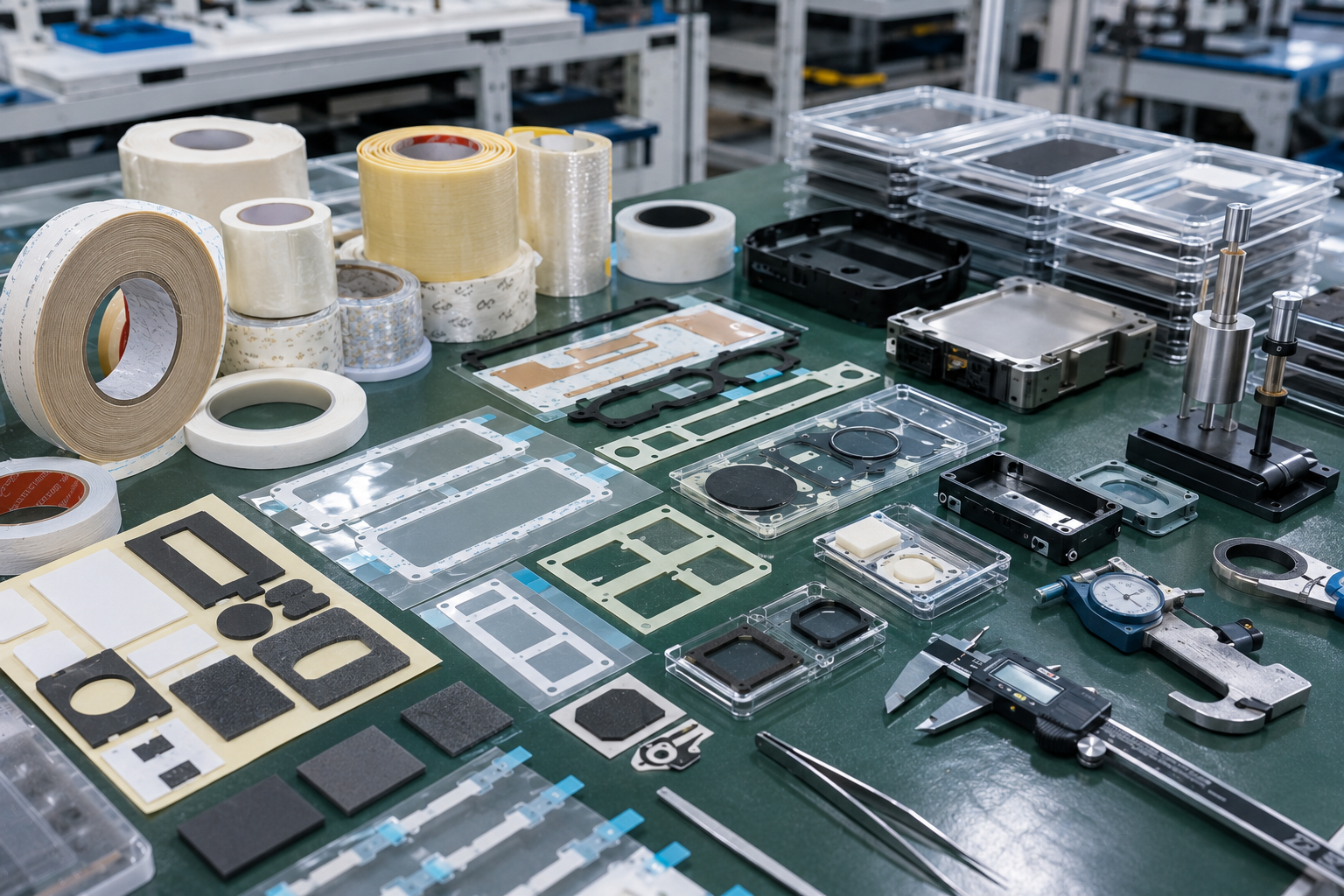
3M tape converting usually means processing 3M adhesive tape roll materials into custom shapes, sizes, layers, and delivery formats for OEM assembly.
The same converting principles also apply to other pressure-sensitive adhesive tape brands and equivalent adhesive materials.
Instead of applying tape manually from a roll, OEM manufacturers can use pre-cut adhesive parts that match the exact product design.
Common converted adhesive parts include:
| Converted Part | Common Function |
|---|---|
| Double-sided tape frames | Bonding panels, covers, displays, and housings |
| Foam tape gaskets | Sealing, cushioning, and gap filling |
| PET-backed adhesive parts | Stable bonding and positioning |
| Transfer adhesive films | Thin bonding applications |
| Adhesive-backed PET films | Insulation and placement support |
| Protective films with pull tabs | Surface protection and easy removal |
| Laminated adhesive structures | Combined bonding, sealing, insulation, and protection |
For OEM projects, custom die cut parts make adhesive materials easier to handle and more consistent in production.
The tape roll is raw material.
The converted part is the assembly-ready component.
Why OEMs Convert Tape Rolls into Custom Parts
Tape rolls are flexible, but manual application can create variation.
Operators may cut the tape differently.
The bonding area may shift.
The tape may stretch.
The liner may be difficult to remove.
The adhesive may overflow if the shape is not controlled.
Custom converting solves these problems by making the tape part match the product design before it reaches the assembly line.
Main benefits include:
- More accurate bonding area
- Faster assembly
- Cleaner handling
- Better repeatability
- Reduced manual cutting
- Easier peeling from release liner
- Less material waste
- Better support for automated or high-volume production
For OEM manufacturing, consistency is often more valuable than flexibility.
A tape roll can do many things.
A converted tape part does one thing accurately.
Common Roll Materials Used for Tape Converting
Different adhesive tape roll materials are selected based on the application.
Some need strong bonding.
Some need cushioning.
Some need insulation.
Some need clean removal.
| Roll Material Type | Common Converted Part |
|---|---|
| Double-sided adhesive tape | Tape frames, strips, bonding pads |
| Foam tape | Foam gaskets, cushioning pads, sealing strips |
| Acrylic foam tape | Strong bonding and gap compensation parts |
| Transfer adhesive | Thin adhesive films and bonding shapes |
| PET-backed adhesive tape | Stable adhesive parts and insulation support |
| Protective film | Pull-tab protection films |
| Adhesive-backed PET film | Insulation films and positioning parts |
| Black PET adhesive film | Light-blocking frames and strips |
Material selection should start with the application.
A tape for metal bonding may not work on low-surface-energy plastic.
A protective film adhesive should not behave like a permanent bonding adhesive.
A foam tape for cushioning may not be suitable for thin display bonding.
The adhesive needs context.
Step 1: Application Review
Before converting a tape roll, the application must be reviewed.
Important questions include:
| Question | Why It Matters |
|---|---|
| What is the tape part used for? | Defines material structure |
| What surface will it bond to? | Determines adhesive selection |
| Is the part permanent or removable? | Affects adhesive behavior |
| Does it need cushioning or sealing? | May require foam tape |
| Does it need insulation? | May require PET film |
| Will workers peel it manually? | Affects liner and pull-tab design |
| What tolerance is required? | Affects tooling and inspection |
| How will it be supplied? | Determines sheets, rolls, or kits |
This step prevents one common mistake: choosing tape only by brand or tape name.
The same roll material may behave differently depending on surface, pressure, temperature, shape, and assembly method.
Step 2: Slitting and Material Preparation
Many adhesive tape rolls are supplied in wide master rolls.
Before die cutting, they may need to be slit into narrower widths.
Slitting prepares the material for lamination, die cutting, kiss cutting, or roll-to-roll production.
Important points include:
- Roll width
- Edge quality
- Liner stability
- Adhesive cleanliness
- Roll tension
- Material flatness
- Storage condition
Poor slitting can create edge defects, liner problems, or material waste.
Tape converting begins before the die cutting tool touches the material.
Step 3: Lamination
Lamination combines adhesive tape with other materials.
This can create a multi-layer structure that performs several functions in one part.
Common laminated structures include:
| Laminated Structure | Function |
|---|---|
| Foam + adhesive + liner | Sealing, cushioning, easy placement |
| PET film + adhesive + liner | Insulation and positioning |
| Protective film + pull tab | Surface protection and easy removal |
| Black PET + adhesive | Light blocking and bonding |
| Foam + PET film + adhesive | Cushioning, support, and bonding |
| Felt + adhesive + liner | Anti-squeak and surface protection |
For sealing applications, foam gaskets and sealing components often use laminated foam and adhesive structures.
For electronic assemblies, PET-backed adhesive structures may support insulation, positioning, and clean handling.
Lamination must control alignment, bubbles, wrinkles, total thickness, and liner condition.
A small lamination defect can become a large assembly problem.
Step 4: Die Cutting and Kiss Cutting
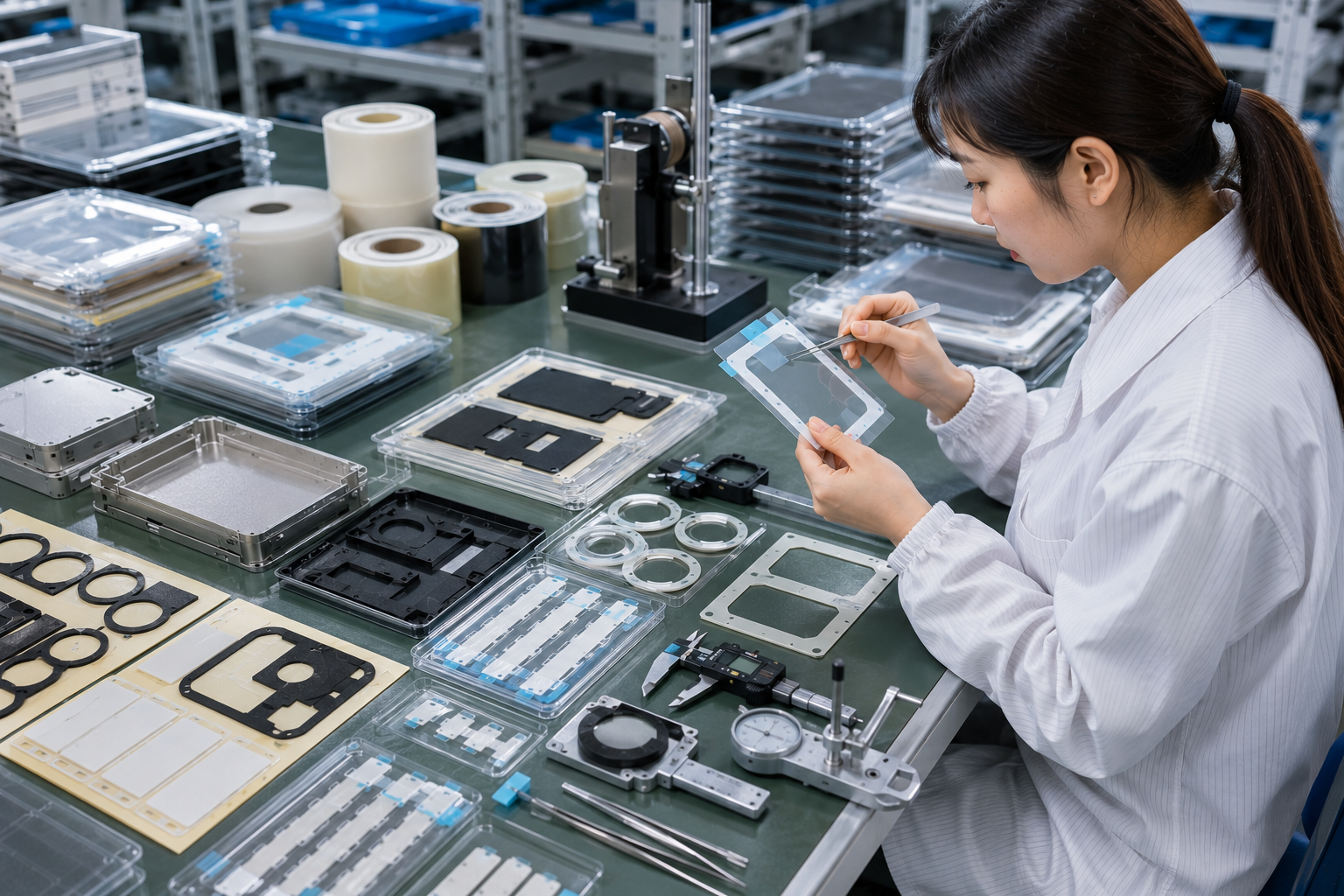
Die cutting creates the final adhesive part shape.
The part may be a frame, pad, strip, ring, gasket, film, or complex custom shape.
For adhesive-backed parts, kiss cutting is often used.
In kiss cutting, the adhesive part is cut while the release liner remains intact.
This keeps parts organized and easier to peel.
Kiss cutting is useful for:
- Double-sided tape frames
- Foam tape gaskets
- PET-backed adhesive parts
- Protective films
- Adhesive-backed PET films
- Small adhesive pads
- Pull-tab films
- Sheet or roll delivery
For process comparison, buyers can review Die Cut vs Kiss Cut: What OEM Buyers Should Know for Adhesive Parts and Protective Films.
Cutting depth must be controlled carefully.
If the cut is too shallow, the part may not release cleanly.
If the cut is too deep, the liner may break.
The liner is not just backing paper.
It is part of the assembly process.
Step 5: Waste Removal
After die cutting, unwanted tape material must be removed.
This is called waste removal or matrix removal.
It sounds simple.
It is not always simple.
Thin adhesive frames, soft foam tape, narrow walls, sharp corners, and unsupported transfer adhesive can make waste removal difficult.
Design factors that affect waste removal include:
| Design Factor | Risk |
|---|---|
| Narrow tape wall | Tearing or stretching |
| Sharp corner | Edge lift or difficult stripping |
| Small holes | Waste sticking inside the part |
| Soft adhesive | Glue stringing or overflow |
| Weak liner | Liner tearing |
| Tight part spacing | Difficult matrix removal |
Good tape converting design should consider production before tooling starts.
A shape that looks perfect in CAD may be difficult to convert from real adhesive material.
Step 6: Inspection
Converted adhesive tape parts must be checked before shipment.
Important inspection items include:
| Inspection Item | Why It Matters |
|---|---|
| Dimensions | Ensures correct fit |
| Tape thickness | Controls stack height |
| Adhesive position | Prevents shifting or overflow |
| Edge quality | Reduces lifting and contamination |
| Liner release | Improves peeling and placement |
| Peel behavior | Confirms bonding performance |
| Flatness | Supports accurate assembly |
| Surface cleanliness | Protects the final product |
| Packaging condition | Prevents deformation before use |
For adhesive parts, quality is not only about size.
The part must peel correctly, stay clean, remain flat, and bond as expected.
A tape component that cannot be peeled smoothly is not assembly-ready.
Step 7: Packaging and Delivery Format
Converted adhesive parts can be supplied in different formats based on how OEMs use them.
| Supply Format | Suitable Use |
|---|---|
| Individual pieces | Simple or low-volume assembly |
| Sheets | Manual picking and organized placement |
| Rolls | Automated or high-volume application |
| Kiss-cut on liner | Adhesive-backed parts and films |
| Pull-tab format | Easier manual peeling and removal |
| Kits | Multi-part module or product assembly |
| Clean trays or bags | Dust and deformation protection |
For assembly planning, buyers can review how die cut parts are supplied in sheets, rolls, or kits.
For high-volume adhesive parts, roll-to-roll die cutting can improve part spacing, liner control, waste removal, and production consistency.
Packaging should prevent dust, curling, sticking, compression marks, liner damage, and part deformation.
Packaging is part of the product experience.
Not the last-minute box.
Where Converted Adhesive Tape Parts Are Used
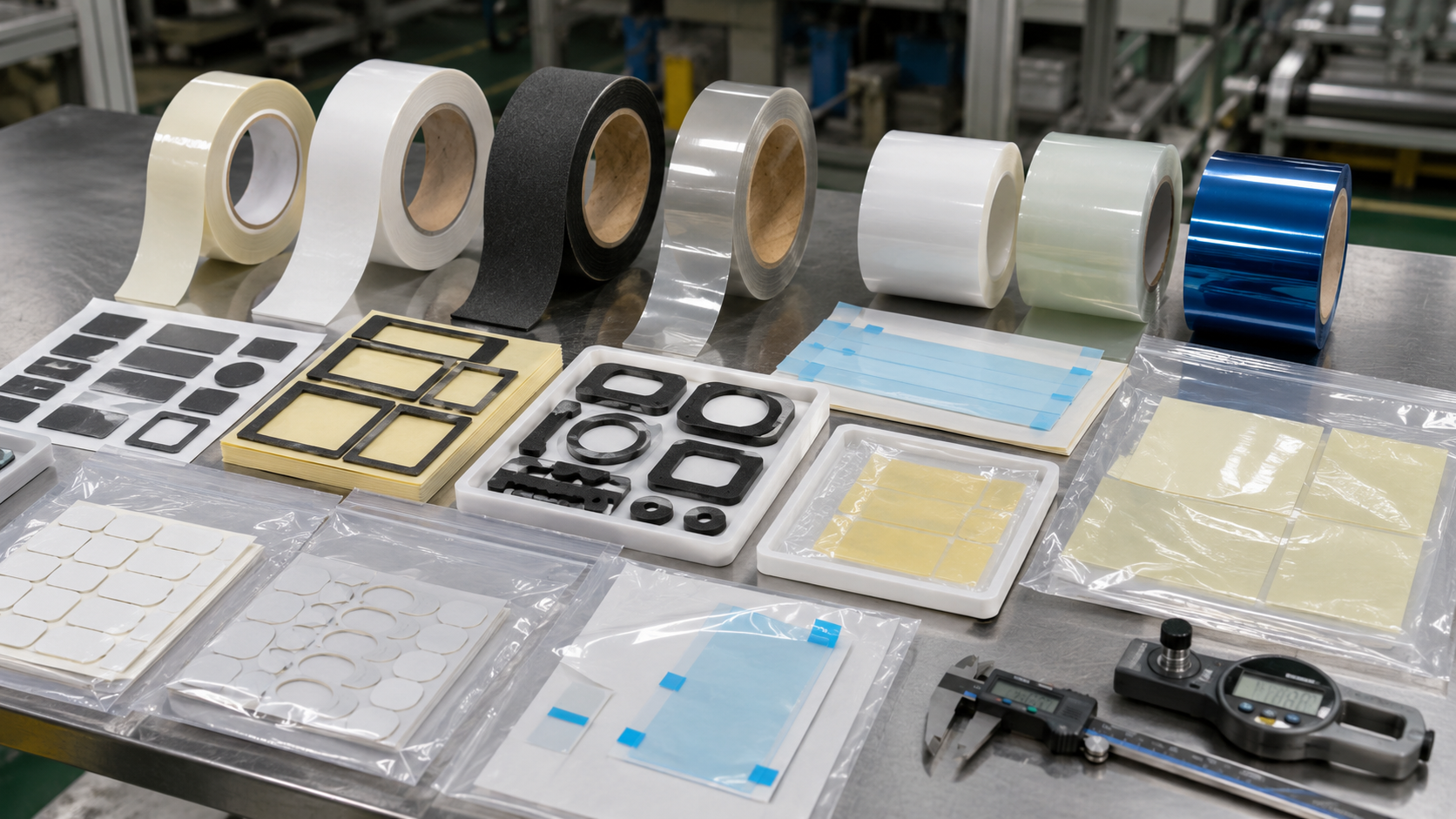
Converted adhesive tape parts are used across many OEM industries.
| Industry | Common Adhesive Tape Components |
|---|---|
| Electronics | PET-backed adhesive parts, protective films, tape frames |
| Automotive interiors | Foam tape pads, felt-backed adhesive parts, bonding frames |
| Appliances | Foam tape seals, control panel tape frames, protective films |
| Semiconductor equipment | Protective films, PET-backed adhesive parts, foam tape gaskets |
| Displays and sensors | Black PET films, adhesive frames, pull-tab films |
| Industrial equipment | Sealing strips, bonding pads, insulation films |
For adhesive tape applications, buyers can also review what pressure sensitive adhesive tape is and where it is used in OEM assembly.
Converted tape parts can support sealing, bonding, insulation, cushioning, light blocking, and surface protection depending on the material structure.
Design Tips for OEM Adhesive Tape Parts
Good adhesive tape converting starts with good part design.
Important design tips include:
| Design Tip | Why It Helps |
|---|---|
| Add corner radius | Reduces edge lifting and tearing |
| Avoid very narrow walls | Improves cutting and peeling stability |
| Confirm bonding surface | Helps select the correct adhesive |
| Add pull tabs when needed | Improves manual peeling |
| Choose the right liner | Controls release behavior |
| Consider part spacing | Improves picking and waste removal |
| Control total thickness | Prevents assembly stack-up issues |
| Plan packaging early | Prevents deformation and contamination |
For more design guidance, buyers can review how to design custom adhesive tape parts for easier assembly and better bonding.
The best adhesive part should be easy to peel, easy to place, stable after bonding, and repeatable in production.
What Buyers Should Provide Before Quotation
To recommend the right tape converting solution, we usually need clear project information.
Helpful details include:
- Drawing or sample
- Tape material requirement
- Brand or material specification if already selected
- Application location
- Main function
- Bonding surface
- Thickness and tolerance
- Adhesive strength requirement
- Liner requirement
- Pull tab requirement
- Manual or automated assembly
- Temperature exposure
- Cleanliness requirement
- Annual volume
- Delivery format
- Packaging preference
If the tape material is not confirmed, Sanken can help compare double-sided tape, transfer adhesive, foam tape, PET-backed adhesive tape, adhesive-backed PET film, protective film, black PET film, release liner, and laminated adhesive structures.
For supplier selection, buyers can also review how to choose the right die cutting manufacturer before moving from sampling to mass production.
Need 3M Tape Converting or Custom Adhesive Parts?
Tape converting turns adhesive roll materials into custom OEM parts for sealing, bonding, insulation, cushioning, light blocking, and protection.
But the final result depends on tape selection, bonding surface, lamination structure, die cutting accuracy, liner release, waste removal, inspection, packaging, and delivery format.
If you need double-sided tape frames, foam tape gaskets, PET-backed adhesive parts, transfer adhesive films, adhesive-backed PET films, protective films with pull tabs, black PET adhesive films, or laminated adhesive structures, send us your drawing, sample, material specification, bonding surface, tolerance, annual volume, and packaging preference.
Sanken can help review material structure, converting process, die cutting method, liner release, inspection points, and supply format before mass production.
Related Articles
You may also find these articles helpful:
- Adhesive Tape Converting for Sealing, Bonding, Insulation, Cushioning, and Protection
- What Is Pressure Sensitive Adhesive Tape and Where Is It Used in OEM Assembly?
- How to Design Custom Adhesive Tape Parts for Easier Assembly and Better Bonding
- What Information Should You Provide for a Custom Adhesive Tape Die-Cut Part Quotation?
- Adhesive Backed Die Cut Components for OEM Assembly
- Why Do Die Cut Adhesive Parts Fail After Assembly?
- Die Cut vs Kiss Cut: What OEM Buyers Should Know for Adhesive Parts and Protective Films
Conclusion
3M tape converting and adhesive tape converting turn roll materials into custom OEM adhesive parts that are easier to peel, place, bond, and inspect. The process may include slitting, lamination, die cutting, kiss cutting, waste removal, inspection, and packaging. The best result comes from matching the tape material, adhesive, liner, shape, delivery format, and bonding surface to the real OEM assembly process.