
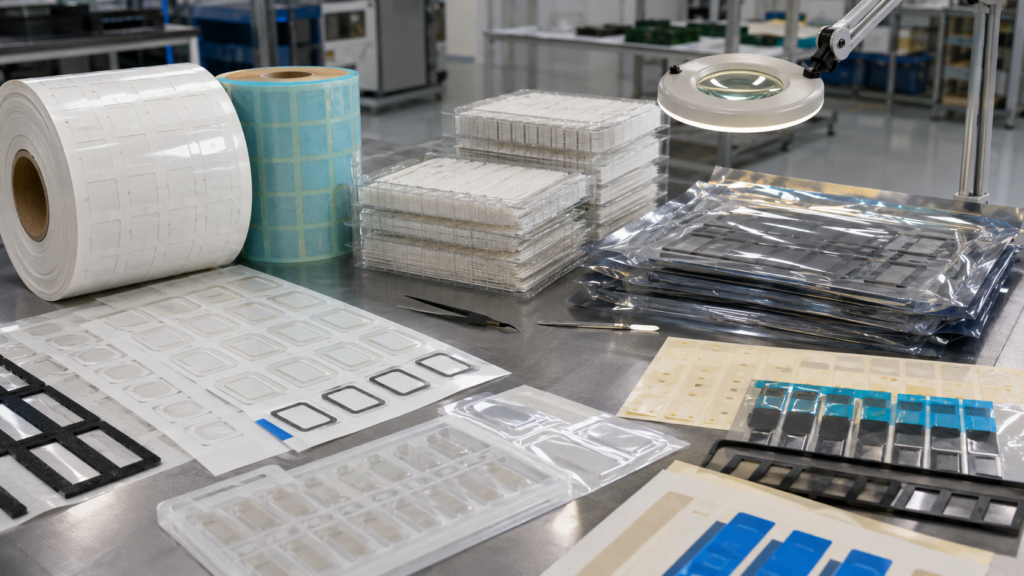
Pressure sensitive adhesive tape is used in many OEM products because it can bond, seal, cushion, mount, protect and simplify assembly.
But choosing tape is not only about stickiness.
At Sanken, we convert adhesive tapes, foam tapes, PET-backed tapes, protective films and laminated adhesive materials through precision die cutting for automotive, electronics, optical, appliance, medical and industrial applications.
A good PSA tape part should not only bond well.
It should also cut cleanly, peel smoothly, stay flat, match the assembly process and remain stable during long-term use.
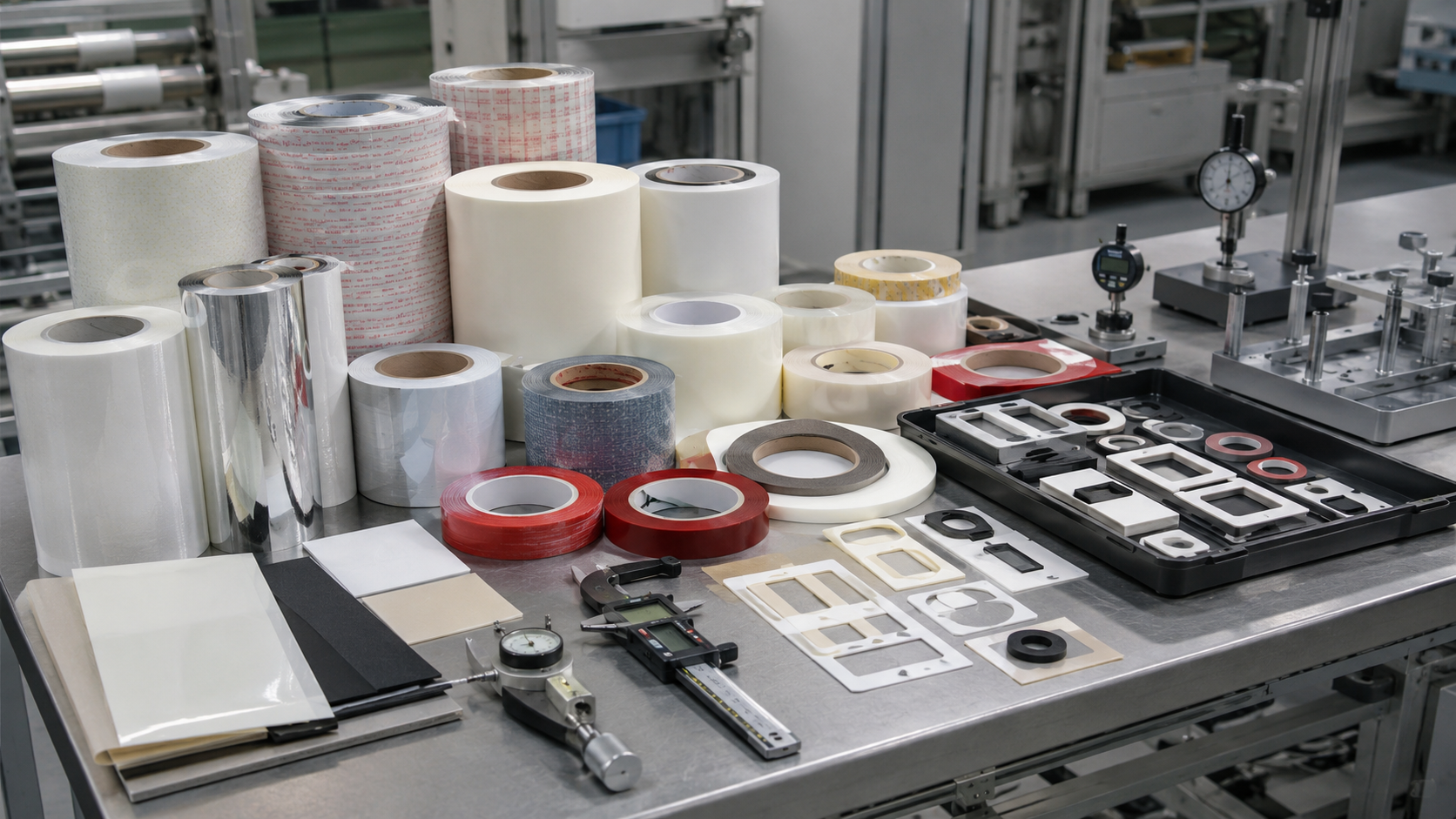
What Is Pressure Sensitive Adhesive Tape?
Pressure sensitive adhesive tape, often called PSA tape, bonds to a surface when pressure is applied.
It does not need heat, solvent or liquid glue during assembly.
This makes it useful for OEM production lines that need cleaner, faster and more repeatable bonding.
PSA tape can be die cut into many custom shapes, such as:
| Die Cut Tape Part | Common OEM Function |
|---|---|
| Double-sided tape frames | Bonding panels, displays and housings |
| Foam tape gaskets | Sealing, cushioning and bonding |
| Transfer adhesive parts | Thin bonding and lamination |
| PET-backed adhesive parts | Positioning, insulation and protection |
| Protective film parts | Surface protection during assembly |
| Pull-tab adhesive parts | Easier peeling and handling |
| Multilayer adhesive parts | Combined bonding, sealing and spacing |
For OEM projects, custom die cut parts often include adhesive tape because it helps reduce manual gluing, improve positioning and support cleaner assembly.
Where PSA Tape Is Used in OEM Applications
PSA tape is used wherever OEM products need stable bonding without messy liquid adhesive.
Common application areas include:
- Automotive interior trim
- EV battery insulation and protection
- Electronic housings
- Display modules
- Optical protective films
- Appliance control panels
- Medical equipment housings
- Industrial enclosures
- Sensor and camera modules
- Foam gaskets and seals
- Surface protection parts
- Wire harness protection
In automotive die cut components, PSA tape may be used for bonding, sealing, vibration reduction, protective film positioning and foam gasket attachment.
In optical and display products, optical film die cut components may use PSA tape for protective films, adhesive frames, light-blocking films and spacer structures.
The same tape can behave very differently depending on the surface, temperature, pressure and final use.
That is why application review comes before tape selection.
Main Types of Pressure Sensitive Adhesive Tape
Different PSA tapes are designed for different jobs.
Some tapes are thin and clean.
Some are thick and strong.
Some are soft and compressible.
Some are designed for temporary protection.
| Tape Type | Typical Use |
|---|---|
| Double-sided tape | General bonding and mounting |
| Acrylic foam tape | Strong bonding, vibration resistance and gap filling |
| Transfer adhesive | Thin bonding without carrier |
| PET-backed tape | Stable shape, positioning and insulation support |
| Foam tape | Sealing, cushioning and spacing |
| Protective film tape | Temporary surface protection |
| Conductive adhesive tape | EMI shielding or grounding support |
| High-temperature tape | Heat-resistant bonding or masking |
The best tape is not always the strongest tape.
The best tape is the one that matches the surface, function, thickness, environment and assembly method.
What Buyers Should Check Before Choosing PSA Tape
Before choosing pressure sensitive adhesive tape, buyers should answer a few practical questions.
| Buyer Question | Why It Matters |
|---|---|
| What surface will the tape bond to? | Different surfaces need different adhesive systems |
| Is the part for bonding, sealing or protection? | Function decides tape structure |
| What temperature will the part face? | Heat and cold affect adhesive performance |
| Does the part need cushioning? | Foam or acrylic foam tape may be better |
| Does it need clean removal? | Protective films need controlled adhesion |
| Will it be manually or automatically assembled? | Delivery format affects efficiency |
| Does the part need kiss cutting? | Liner and cut depth must be controlled |
| What is the annual volume? | Process choice affects cost and consistency |
Many tape failures happen because the tape was chosen by price or availability first.
That can be expensive later.
The cheapest tape is not cheap if it lifts, shifts or slows down your assembly line.
Bonding Surface Matters
The bonding surface is one of the most important details.
Plastic, metal, glass, rubber, painted surfaces and films do not behave the same way.
Even plastics are not all the same.
PP and PE are usually harder to bond than ABS, PC or PET because they have lower surface energy.
Common bonding surfaces include:
| Surface | Tape Selection Concern |
|---|---|
| ABS / PC plastic | Molding residue and surface cleanliness |
| PP / PE plastic | Low surface energy bonding |
| Metal | Oil, coating and corrosion concerns |
| Glass | Clean bonding and appearance |
| Painted surface | Coating compatibility |
| Rubber | Texture and chemical compatibility |
| PET / PI film | Thin material stability and liner release |
Before production, we usually ask for the real substrate or sample.
“Plastic surface” is too broad.
Plastic is not one material.
It is a whole family with different personalities.
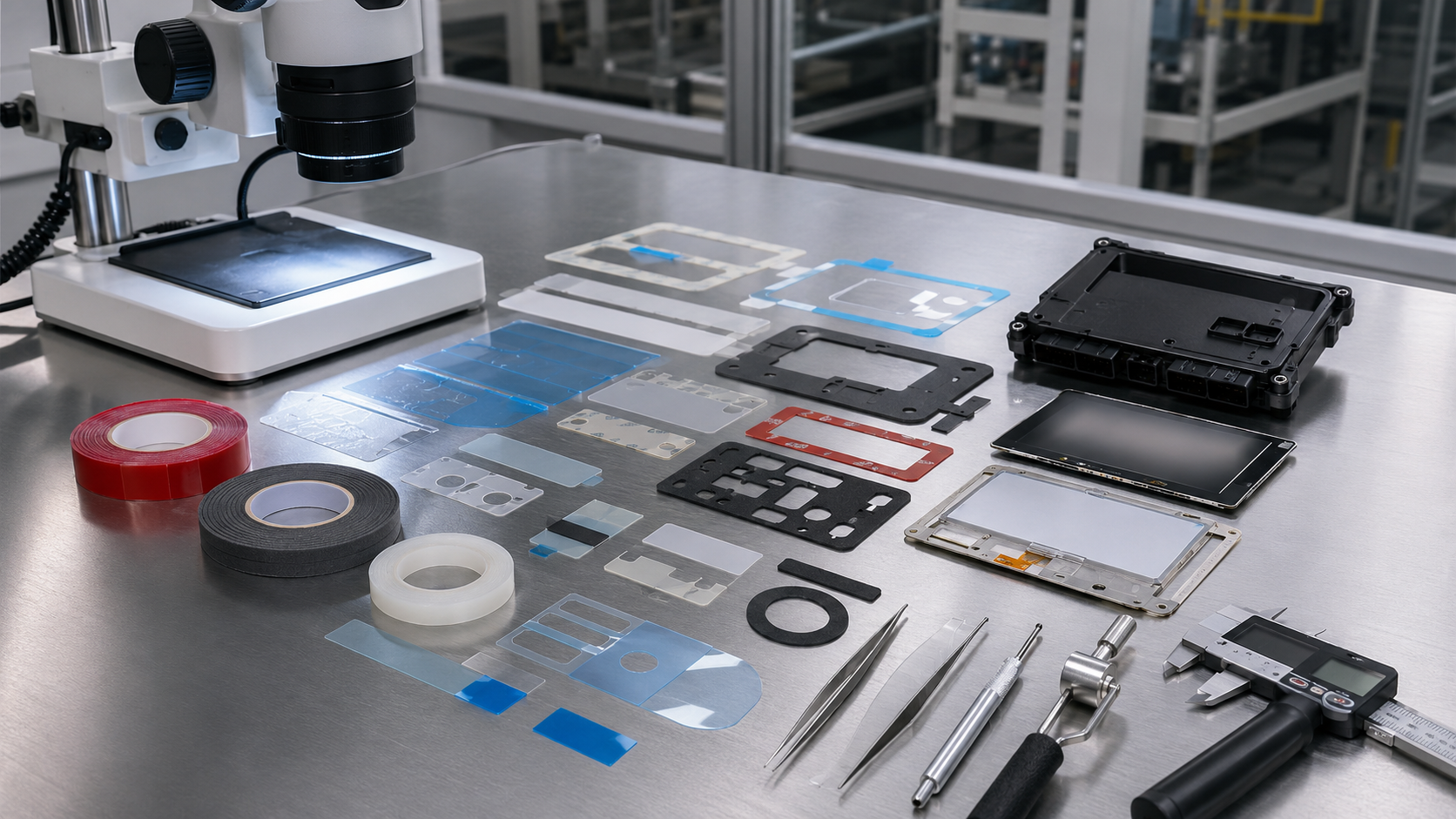
Adhesive Tape Must Match the Die Cutting Process
Some adhesive tapes bond well but convert poorly.
That means they may stretch, curl, stick to tooling, leave glue residue or become difficult to remove from the liner.
For die cut tape parts, we check both adhesive performance and converting performance.
Important process factors include:
| Process Factor | Why It Matters |
|---|---|
| Kiss cutting | Keeps release liner intact for easy peeling |
| Half cutting | Controls depth in multilayer structures |
| Lamination | Combines tape with foam, film or liner |
| Waste removal | Prevents adhesive residue and torn parts |
| Pull-tab design | Improves operator handling |
| Roll feeding | Supports high-volume production |
| Packaging | Prevents shifting, curling and contamination |
For high-volume tape converting, roll-to-roll die cutting can improve speed, spacing consistency and production efficiency.
For manual assembly, sheets may be easier.
For multi-part assembly, kits can reduce missing parts and operator errors.
Liner and Release Control Are Not Small Details
The liner is not part of the final product.
But it can decide whether the part is easy to use.
A poor liner may cause hard peeling, adhesive transfer, curled parts, liner tearing or slow assembly.
For PSA die cut parts, liner control is especially important when the part is small, thin, narrow or adhesive-rich.
We check:
- Liner material
- Liner thickness
- Release force
- Cut depth
- Pull-tab position
- Part spacing
- Peeling direction
- Packaging pressure
A tape part that sticks well but peels badly is still a bad production part.
OEM assembly does not need drama from a release liner.
Common OEM Problems Caused by Wrong PSA Tape
Wrong tape selection can create many production issues.
Common problems include:
| Problem | Possible Cause |
|---|---|
| Tape lifting | Wrong adhesive, dirty surface or low pressure |
| Tape shifting | Poor liner design or weak positioning |
| Adhesive overflow | Wrong thickness, pressure or cutting method |
| Difficult peeling | Poor liner release or no pull tab |
| Curling | Tape tension, material memory or packaging |
| Residue after removal | Adhesive mismatch or aging issue |
| Poor bonding after heat | Adhesive not suitable for temperature |
| Assembly slowdown | Bad delivery format or difficult handling |
Many of these problems can be prevented before mass production.
The right review saves time.
The wrong tape teaches the lesson later, usually at the worst possible moment.
Supply Format for OEM Assembly
PSA tape parts can be supplied in different formats.
The best format depends on the customer’s production line.
| Supply Format | Best For |
|---|---|
| Individual pieces | Simple low-volume assembly |
| Sheets | Manual picking and organized workstations |
| Rolls | Automated application and high-volume production |
| Kiss-cut on liner | Adhesive tape frames and protective films |
| Kits | Multi-part OEM assembly |
| Trays or bags | Parts needing protection from deformation |
For manual assembly, die cut parts supplied in sheets can make parts easier to pick and place.
For a deeper look at delivery formats, buyers can review how die cut parts are supplied in sheets, rolls, or kits for different OEM assembly needs.
Delivery format affects labor cost, assembly speed, defect rate and operator comfort.
Yes, operator comfort matters.
A part that is easy to use is less likely to become a production complaint.
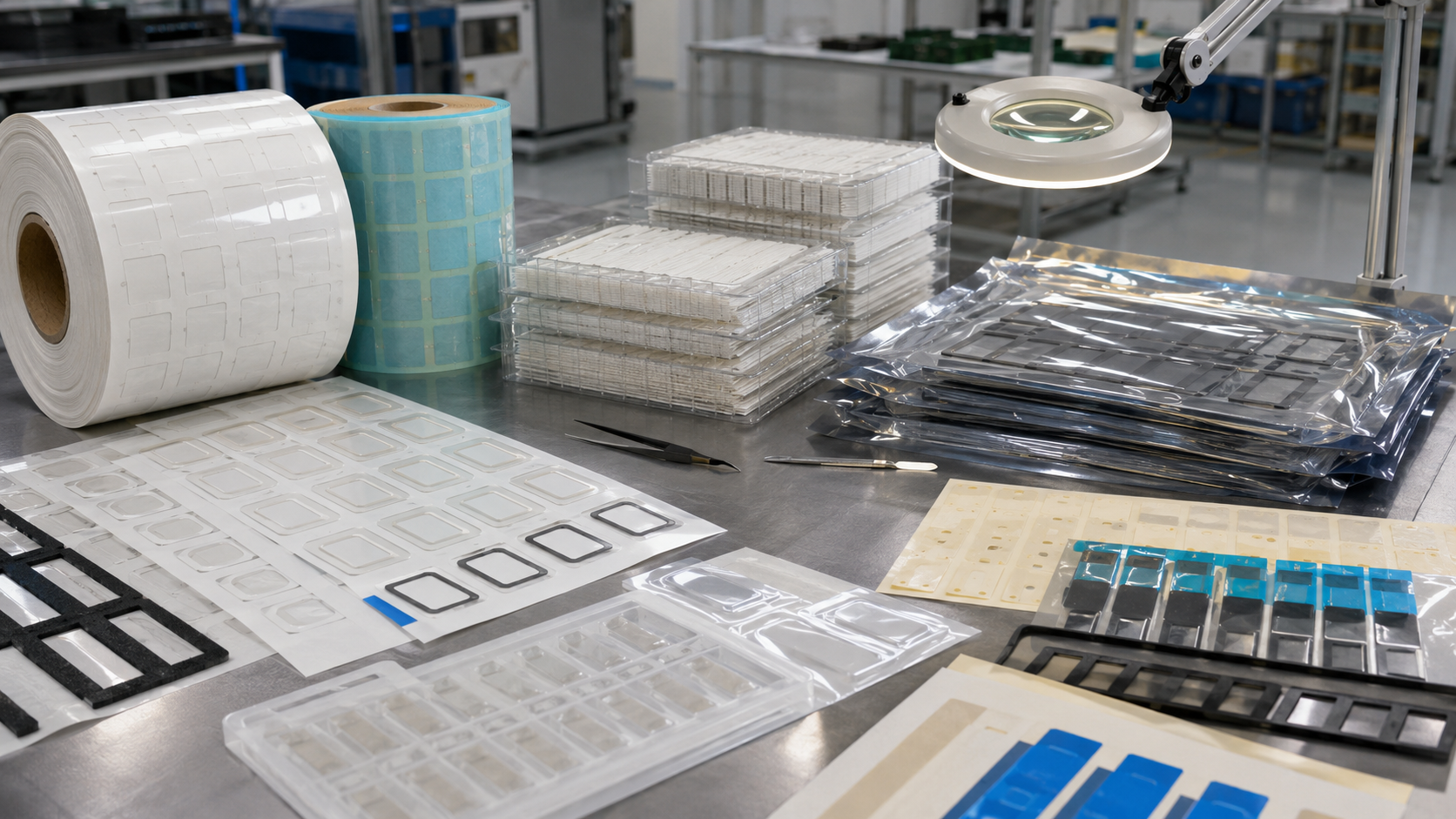
Quality Checks for PSA Die Cut Parts
For OEM projects, adhesive tape parts must be consistent from sample to mass production.
Important inspection points include:
| Inspection Item | Purpose |
|---|---|
| Dimensions | Ensures correct fit |
| Thickness | Controls spacing and bonding |
| Adhesive position | Prevents bonding failure |
| Edge quality | Reduces glue residue and particles |
| Liner release | Improves peeling and assembly |
| Surface cleanliness | Prevents contamination |
| Flatness | Supports accurate placement |
| Packaging condition | Prevents shifting and deformation |
The sample is only the beginning.
The real target is stable production.
That means tape material, lamination, tooling, cutting depth, waste removal, inspection and packaging must work together.
What Buyers Should Provide Before Quotation
To recommend the right PSA tape for OEM applications, we usually need more than size and quantity.
Helpful information includes:
- Drawing or sample
- Bonding surface
- Tape function
- Required thickness
- Adhesive strength requirement
- Temperature range
- Indoor or outdoor use
- Assembly method
- Liner preference
- Pull-tab requirement
- Tolerance
- Annual volume
- Delivery format
- Packaging preference
- Validation requirement
If the tape is not confirmed, we can help compare adhesive options, carrier structures, liner choices and die cutting formats before sampling.
Need Pressure Sensitive Adhesive Tape Parts for OEM Applications?
Pressure sensitive adhesive tape can support bonding, sealing, cushioning, protection, insulation and assembly efficiency.
But the right tape must match the substrate, environment, thickness, liner, die cutting process and delivery format.
If you need custom die cut parts for OEM assembly, send us your drawing, sample, material requirement, adhesive structure, bonding surface, tolerance, application location, annual volume and packaging preference.
Sanken can help review tape selection, lamination structure, die cutting method, liner design, inspection points and delivery format before mass production.
Related Articles
You may also find these articles helpful:
- Adhesive Backed Die Cut Components for OEM Assembly
- Why Do Die Cut Adhesive Parts Fail After Assembly?
- Why Your Die Cut Tape Parts Lift, Shift or Peel Off
- How to Prevent Adhesive Overflow in Custom Die Cut Tape Parts
- How to Prevent Adhesive Lifting in Die Cut Tape Components
- What Is the Best Adhesive for Die Cut Tape Parts?
- Die Cut vs Kiss Cut: What OEM Buyers Should Know for Adhesive Parts and Protective Films
Conclusion
Pressure sensitive adhesive tape is useful in OEM applications because it supports clean bonding, sealing, cushioning, protection and faster assembly. To choose the right tape, buyers should check the surface, function, thickness, environment, liner, die cutting method and delivery format before mass production.