
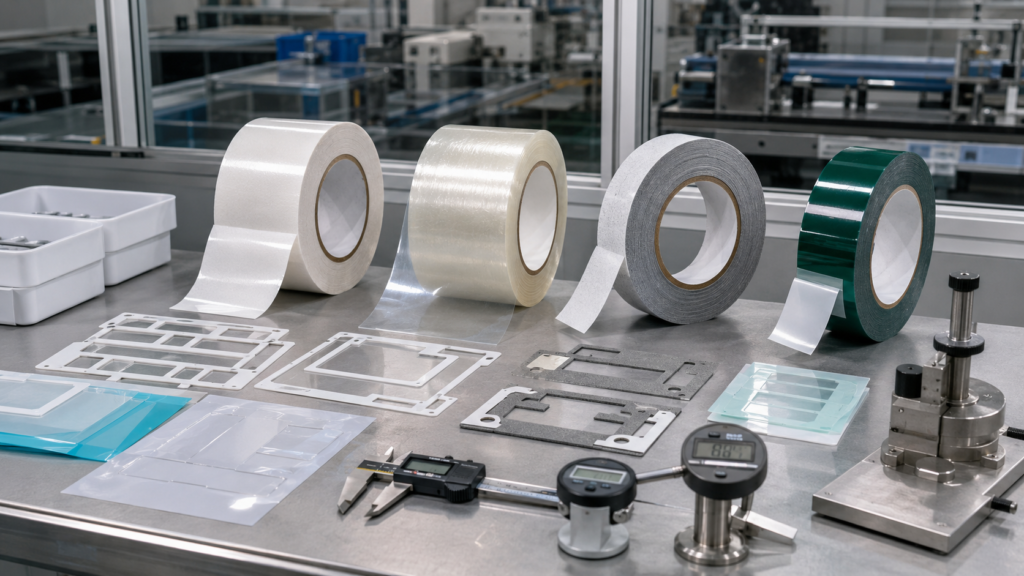
Pressure sensitive adhesive tape is one of the most useful materials in custom die-cut components.
It can bond, seal, cushion, mount, insulate, protect, and simplify OEM assembly.
But not every PSA tape works the same way.
At Sanken, we use precision die cutting and material converting to process adhesive tapes into custom parts for automotive, electronics, optical, appliance, medical, and industrial OEM projects.
The tape must match the surface.
It must match the function.
It must also match the die-cutting process.
A tape that sticks well but cuts poorly can still become a production problem.
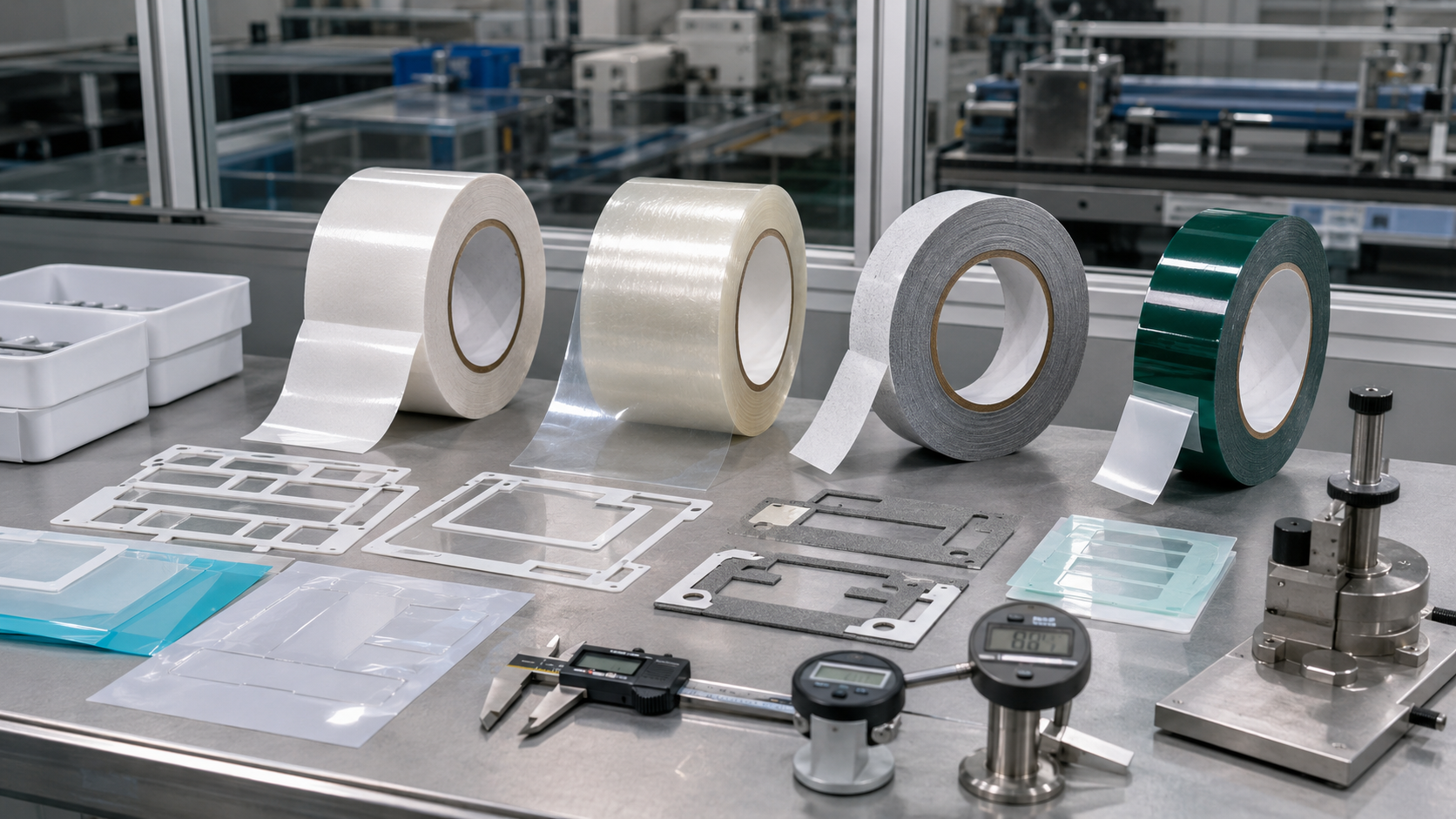
What Are Pressure Sensitive Adhesive Tapes?
Pressure sensitive adhesive tapes, also called PSA tapes, bond to a surface when pressure is applied.
They do not need heat, liquid glue, water, or solvent during assembly.
That is why OEM manufacturers use them for cleaner and faster production.
When converted into custom die cut parts, PSA tapes can become frames, pads, strips, rings, spacers, protective covers, sealing gaskets, pull-tab films, and multilayer laminated components.
Common PSA tape functions include:
| Function | Common Application |
|---|---|
| Bonding | Panels, displays, housings, decorative parts |
| Sealing | Foam gaskets, dust seals, air sealing parts |
| Cushioning | Anti-rattle pads, vibration control parts |
| Insulation | PET-backed or PI-related adhesive parts |
| Protection | Protective films, temporary surface covers |
| Positioning | Assembly aids, mounting pads, spacer parts |
For buyers, the key is not to ask only, “Is the tape strong?”
The better question is:
“Is this tape right for my surface, process, and working environment?”
Type 1: Double-Sided Adhesive Tape
Double-sided adhesive tape has adhesive on both sides.
It is one of the most common materials used in die-cut components.
It can bond two surfaces together without screws, clips, or liquid glue.
Common die-cut double-sided tape parts include:
- Adhesive tape frames
- Mounting pads
- Display bonding frames
- Panel attachment tapes
- Decorative trim bonding parts
- Plastic housing bonding components
- Sensor and camera module adhesive parts
Double-sided tape is useful when the customer needs clean bonding and fast assembly.
It can reduce manual gluing.
It can also improve part positioning.
But the bonding surface matters a lot.
Plastic, metal, glass, painted surfaces, and rubber do not behave the same way.
A tape that works well on metal may fail on low-surface-energy plastic.
Before recommending double-sided tape, we usually check surface material, bonding area, pressure, temperature range, peel strength requirement, and aging conditions.
For automotive die cut components, double-sided tape is often used in interior trim, display modules, sensors, lighting, and electronic housings.
Type 2: Transfer Adhesive Tape
Transfer adhesive tape is a thin adhesive layer without a carrier.
It is usually supplied on a release liner.
After application, only the adhesive layer remains between two surfaces.
This type of tape is useful when the part needs thin bonding and low thickness build-up.
Common applications include:
| Application | Why Transfer Adhesive Helps |
|---|---|
| Thin film bonding | Keeps total thickness low |
| Label or nameplate bonding | Provides clean adhesive layer |
| PET film lamination | Adds adhesive without thick carrier |
| Small adhesive parts | Supports thin and flexible bonding |
| Protective layer attachment | Keeps part lightweight |
Transfer adhesive is very useful.
But it can also be more difficult to convert.
Because there is no carrier, the adhesive layer may stretch, deform, or become difficult to remove cleanly during waste matrix removal.
For die cutting, we must control cut depth, liner release, waste removal, and part spacing.
If the release liner is wrong, the part may be hard to peel.
If the adhesive is too soft, the edges may deform.
If the part is too narrow, handling becomes difficult.
Transfer adhesive is a good choice when the design needs thin bonding.
It is not a good choice if the assembly needs strong gap filling or cushioning.
Type 3: Foam Adhesive Tape
Foam adhesive tape has a foam carrier with adhesive on one or both sides.
It can bond, seal, cushion, absorb vibration, and fill gaps.
This makes it very useful for OEM applications where two surfaces are not perfectly flat.
Common foam tape types include PE foam tape, EVA foam tape, PU foam tape, EPDM foam tape, silicone foam tape, and acrylic foam tape.
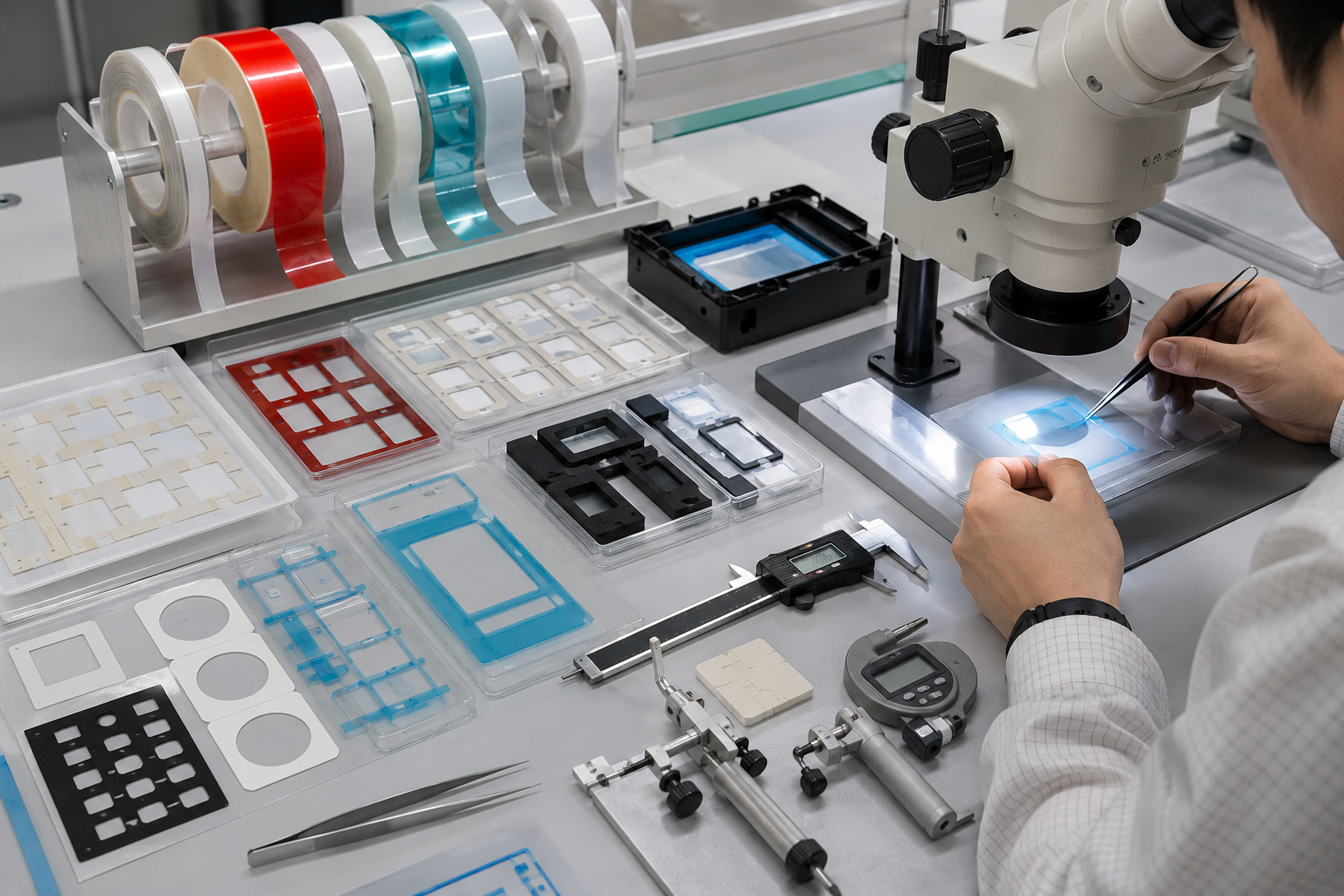
Foam adhesive tape is often converted into:
- Foam tape gaskets
- Cushioning pads
- Anti-rattle strips
- Sealing frames
- Gap-filling pads
- Vibration reduction components
- Adhesive-backed foam spacers
For sealing projects, foam gaskets and sealing components are often made from adhesive-backed foam tape.
Foam tape is especially useful when the part needs compression.
But foam tape selection needs care.
If the foam is too soft, it may collapse.
If it is too hard, it may not seal properly.
If the adhesive is not matched to the surface, it may lift after assembly.
If the thickness is unstable, the final product may not fit correctly.
For foam tape die-cut parts, we usually review foam density, thickness, compression recovery, adhesive type, bonding surface, working temperature, and delivery format.
Type 4: Film-Backed Adhesive Tape
Film-backed adhesive tape uses a film carrier such as PET, PI, PC, or other plastic film.
PET-backed adhesive tape is especially common in electronics, automotive, appliance, and optical applications.
Film-backed adhesive tape provides better dimensional stability than many soft tape structures.
It can support accurate die cutting and clean handling.
Common applications include:
| Film-Backed Tape Type | Common Use |
|---|---|
| PET-backed adhesive tape | Positioning, insulation, bonding |
| PI-related adhesive tape | Heat-resistant insulation support |
| Protective film with adhesive | Temporary surface protection |
| Black PET adhesive film | Light blocking and display support |
| Film spacer tape | Gap control and assembly spacing |
For optical and display projects, optical film die cut components often require clean edges, low particles, smooth peeling, and stable film handling.
Film-backed adhesive tape is also useful when the part needs thin structure and better shape stability.
But it still needs process control.
Film may curl.
Adhesive may shift.
Edges may leave residue.
Liner release may be unstable.
A clean-looking sample does not always mean stable mass production.
That is why we check both material performance and die-cutting behavior before confirming the structure.
Comparison of 4 PSA Tape Types
| Tape Type | Main Advantage | Common Die-Cut Use | Key Risk |
|---|---|---|---|
| Double-sided tape | Strong general bonding | Frames, pads, mounting parts | Surface mismatch |
| Transfer adhesive | Very thin bonding | Film bonding, labels, thin parts | Difficult handling and waste removal |
| Foam adhesive tape | Sealing, cushioning, gap filling | Foam gaskets, anti-rattle pads | Compression and thickness control |
| Film-backed adhesive tape | Dimensional stability | PET-backed parts, insulation, protection | Curling, residue, liner release |
There is no single best PSA tape.
The right tape depends on what the part must do.
A bonding part needs surface compatibility.
A sealing part needs compression.
A protective film needs clean removal.
An insulation part needs stable coverage and clean edges.
Why Die Cutting Method Matters
Adhesive tape parts are not only cut through.
Many PSA parts require kiss cutting, half cutting, liner cutting, lamination, waste removal, and pull-tab design.
For high-volume tape converting, roll-to-roll die cutting can improve efficiency and repeatability.
For manual assembly, die cut parts supplied in sheets may be easier for operators to pick and place.
For multi-part OEM projects, kits can reduce missing parts and improve assembly flow.
Common process choices include:
| Process | Why It Matters |
|---|---|
| Kiss cutting | Keeps liner intact for easy peeling |
| Half cutting | Controls depth in multilayer structures |
| Lamination | Combines tape with foam, film, or liner |
| Waste removal | Removes extra adhesive cleanly |
| Pull-tab design | Improves operator handling |
| Roll or sheet supply | Matches customer assembly method |
For more detail, buyers can review how die cut parts are supplied in sheets, rolls, or kits for different OEM assembly needs.
Quality Checks for Die-Cut PSA Tape Components
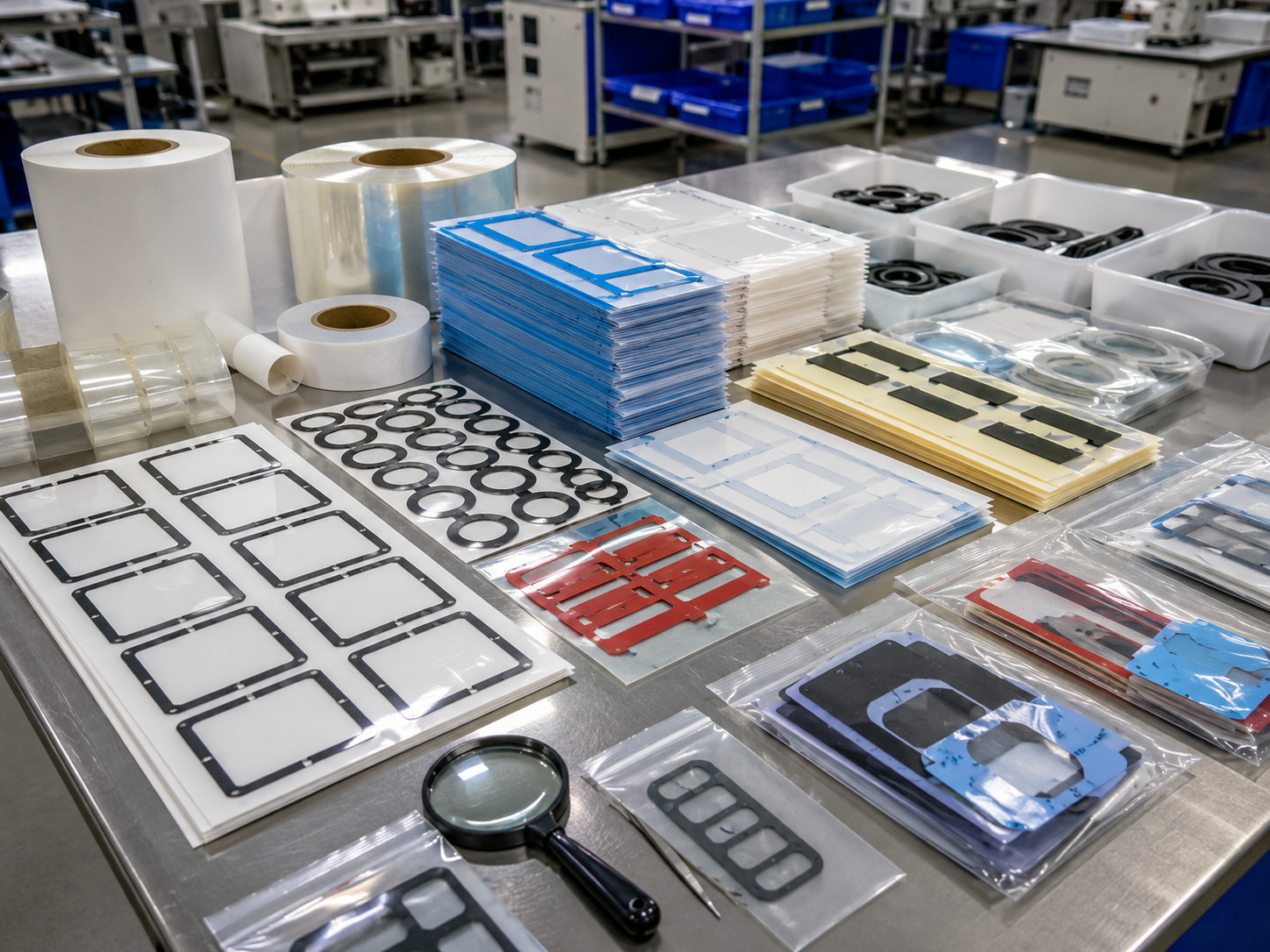
PSA tape parts need stable quality from sample to mass production.
Small defects can cause assembly problems.
Important inspection points include:
| Inspection Item | Purpose |
|---|---|
| Dimensions | Ensures part fit |
| Thickness | Controls spacing, bonding, and sealing |
| Adhesive position | Prevents bonding failure |
| Edge quality | Reduces glue residue and particles |
| Liner release | Improves peeling and assembly |
| Flatness | Helps accurate placement |
| Surface cleanliness | Reduces contamination risk |
| Packaging | Prevents shifting, curling, and deformation |
For OEM customers, the approved sample is only the beginning.
The real target is stable production.
That means tape, liner, lamination, die cutting, inspection, and packaging must work together.
What Buyers Should Provide Before Quotation
To choose the correct PSA tape, we usually need more than a drawing.
Helpful information includes:
- Tape function
- Bonding surface
- Required thickness
- Adhesive strength requirement
- Temperature range
- Indoor or outdoor use
- Compression or cushioning need
- Die-cut shape and tolerance
- Liner preference
- Pull-tab requirement
- Assembly method
- Annual volume
- Delivery format
- Packaging preference
If the tape is not confirmed, we can help compare different adhesive structures before sampling.
For new OEM projects, buyers can also review how to choose the right die cutting manufacturer before moving from sample approval to mass production.
Need PSA Tape Die-Cut Components?
The 4 common types of pressure sensitive adhesive tapes are double-sided tape, transfer adhesive, foam adhesive tape, and film-backed adhesive tape.
Each one has a different role in OEM assembly.
If you need custom die cut parts for OEM assembly, send us your drawing, sample, material requirement, adhesive structure, bonding surface, tolerance, application location, annual volume, and packaging preference.
Sanken can help review tape selection, lamination structure, die cutting method, liner design, inspection points, and delivery format before mass production.
Related Articles
You may also find these articles helpful:
- Adhesive Backed Die Cut Components for OEM Assembly
- Why Do Die Cut Adhesive Parts Fail After Assembly?
- Why Your Die Cut Tape Parts Lift, Shift or Peel Off
- How to Prevent Adhesive Overflow in Custom Die Cut Tape Parts
- How to Prevent Adhesive Lifting in Die Cut Tape Components
- What Is the Best Adhesive for Die Cut Tape Parts?
- Die Cut vs Kiss Cut: What OEM Buyers Should Know for Adhesive Parts and Protective Films
Conclusion
Pressure sensitive adhesive tapes can become reliable custom die-cut components when the tape type matches the surface, function, thickness, liner, die cutting method, and assembly process. Double-sided tape, transfer adhesive, foam tape, and film-backed tape each solve different OEM problems. Choosing correctly helps avoid lifting, shifting, residue, poor peeling, and production delays.