
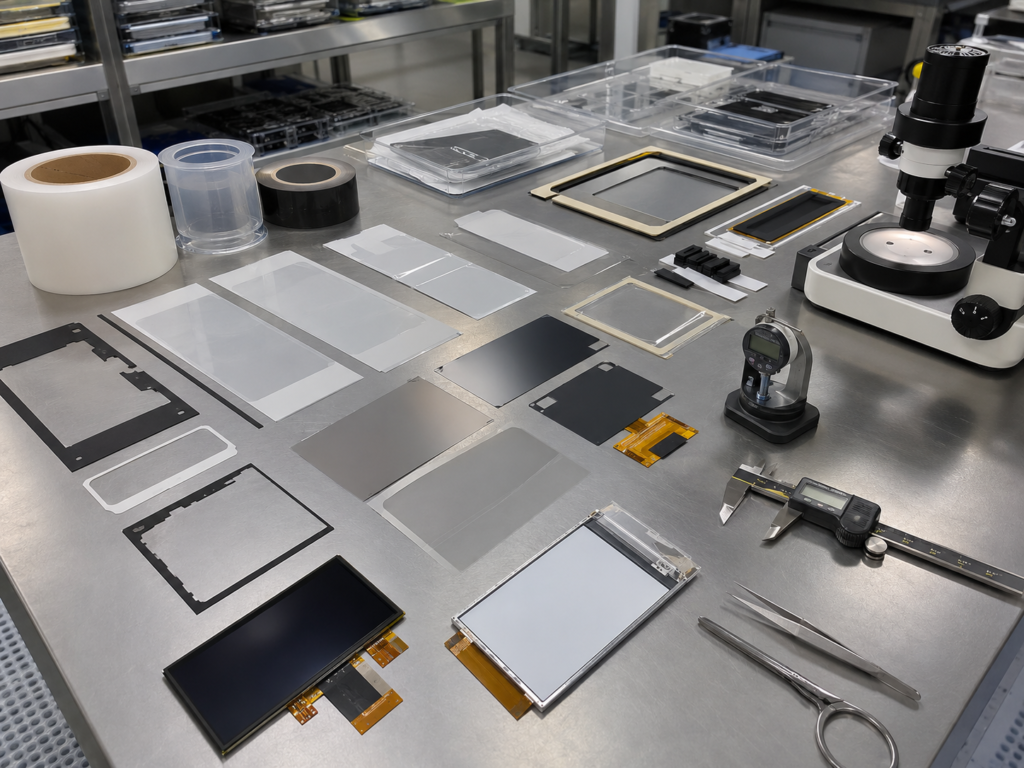
Modern display products look thin, bright, and clean from the outside.
Inside the module, many die cut optical films, protective films, adhesive frames, foam spacers, black films, PET insulation films, and release liners help control light, protect surfaces, support bonding, and improve assembly accuracy.
At Sanken, we use precision die cutting to convert optical films, PET films, protective films, adhesive tapes, black light-blocking films, foam materials, and laminated structures into custom parts for OEM display and electronic assembly.
These parts are usually thin.
But their quality has a direct impact on appearance, fit, handling, and final assembly yield.
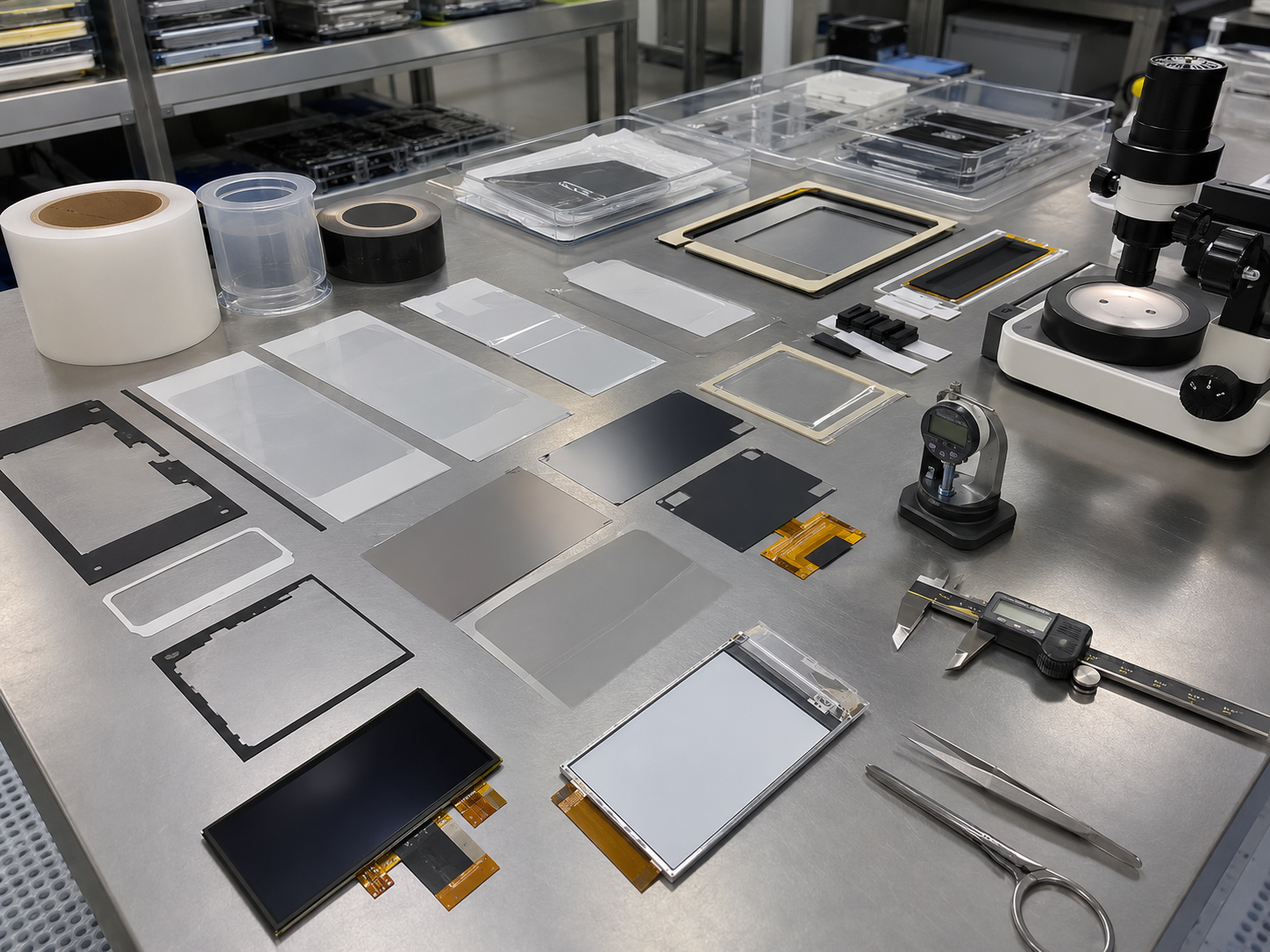
What Are Die Cut Optical Films?
Die cut optical films are thin functional film components converted into custom shapes for display modules, backlight structures, touch panels, control screens, sensors, and electronic interfaces.
They may be used for protection, light control, insulation, bonding, spacing, dust prevention, or assembly support.
Common die cut film parts include:
| Die Cut Film Part | Main Function |
|---|---|
| PET protective film | Surface protection during assembly |
| Black PET film | Light blocking and border control |
| Diffuser film parts | Light diffusion support |
| Reflective film parts | Backlight efficiency support |
| Adhesive tape frames | Bonding and positioning |
| PET insulation films | Electrical separation and protection |
| Foam spacers | Gap control and cushioning |
| Release liners | Handling support for adhesive parts |
For display-related OEM projects, optical film die cut components must be accurate, clean, flat, and easy to handle.
A small scratch or particle can become a very visible problem.
How Optical Films Support Backlight Modules
Backlight modules often require several thin layers working together.
These layers may guide, diffuse, reflect, block, or protect light.
Die cutting helps convert those materials into parts that fit the exact module design.
Typical backlight-related parts include:
- Reflective film parts
- Diffuser film parts
- Black PET light-blocking frames
- PET insulation films
- Protective films
- Adhesive tape frames
- Foam spacers
- Dust protection films
Backlight parts need accurate dimensions and clean edges.
If the film is misaligned, light distribution may be affected.
If the black film is inaccurate, light leakage may appear around the border.
If the spacer thickness is unstable, the display stack may not fit correctly.
In display assembly, small dimensional errors are not small for long.
They become visible.
Light Control: Blocking, Diffusing, Reflecting, and Positioning
Light control is one of the key reasons optical films need precision die cutting.
Different film materials support different light-control functions.
| Light-Control Need | Common Die Cut Material |
|---|---|
| Reduce light leakage | Black PET film, black adhesive frame |
| Support light diffusion | Diffuser film parts |
| Support reflection | Reflective film parts |
| Control spacing | Foam spacers, PET spacers |
| Protect surface | PET protective films |
| Position layers | Adhesive tape frames |
| Prevent dust entry | Foam gaskets, protective films |
For light-control parts, accuracy matters because the film edge often defines the optical boundary.
A poorly cut black film may expose unwanted light.
A film with burrs or dust may affect visual quality.
A warped film may create assembly difficulty.
The film is thin.
The tolerance is not relaxed.
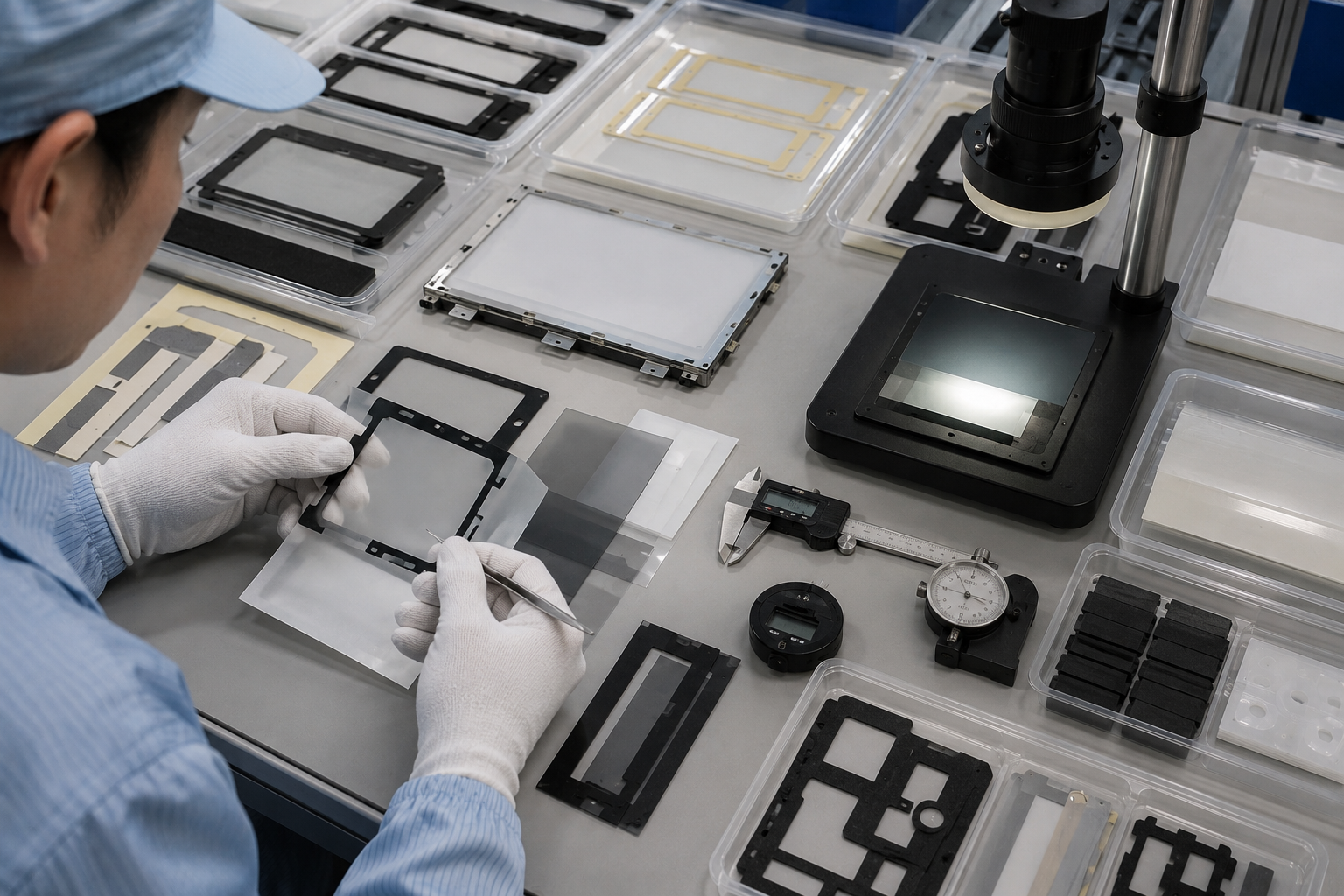
Adhesive Frames for Display Assembly
Adhesive die cut parts are widely used in display assembly.
They help bond layers, position components, support frame assembly, and reduce manual glue application.
Common adhesive parts include:
| Adhesive Part | Common Use |
|---|---|
| Double-sided tape frames | Display frame bonding |
| PET-backed adhesive frames | Stable adhesive positioning |
| Transfer adhesive parts | Thin bonding applications |
| Foam tape frames | Bonding with cushioning |
| Pull-tab protective films | Easier peeling and removal |
| Black adhesive frames | Bonding and light blocking |
Adhesive selection depends on the bonding surface.
Display modules may include glass, plastic, PET film, metal frames, coated surfaces, or textured parts.
These surfaces do not bond the same way.
A good adhesive film part should peel smoothly, stay flat, bond accurately, and avoid adhesive overflow.
If the operator fights the liner, the production line slows down.
If adhesive shifts, the module may fail later.
Protective Films for Surface Protection
Protective films are used to protect display surfaces, lenses, cover panels, touch panels, decorative parts, and optical layers during production, shipping, and final assembly.
Die cut protective films may include:
- Custom outer shapes
- Pull tabs
- Holes or windows
- Easy-peel liner structures
- Anti-static protection
- Cleanroom-style packaging when required
Protective film quality depends on surface cleanliness, adhesive stability, film flatness, and peeling behavior.
A protective film should protect the surface.
It should not leave residue, create scratches, trap particles, or curl during assembly.
That would be a very unhelpful kind of protection.
Foam Spacers and Gaskets in Display Modules
Foam is often used together with optical films and adhesive parts.
Foam spacers can control gaps, cushion surfaces, block dust, reduce contact stress, and support display module fit.
Common foam-related display parts include:
- Foam spacers
- Dustproof foam gaskets
- Foam tape frames
- Cushioning pads
- Light-blocking foam strips
- Display frame seals
For sealing and cushioning applications, foam gaskets and sealing components can support display housings, sensor windows, control panels, and electronic interfaces.
Foam selection depends on thickness, density, compression recovery, cleanliness, and adhesive compatibility.
If the foam is too thick, the module may not close properly.
If it is too soft, the spacer may lose function.
If the edge is dirty, particles may affect visual quality.
Manufacturing Process for Die Cut Optical Films
Optical film parts are usually made through material converting, lamination, die cutting, kiss cutting, waste removal, inspection, and packaging.
A typical process includes:
| Step | Purpose |
|---|---|
| Application review | Confirm function, stack structure, surface, and assembly method |
| Material selection | Choose optical film, PET film, adhesive, foam, or black film |
| Lamination | Add adhesive, liner, protective layer, or backing material |
| Tooling design | Prepare die cutting tool based on drawing |
| Die cutting | Cut films, frames, spacers, windows, holes, or tabs |
| Kiss cutting | Keep adhesive-backed parts on release liner |
| Waste removal | Remove unused film cleanly |
| Inspection | Check size, edge, surface, adhesive, and flatness |
| Packaging | Prevent dust, scratches, curling, and deformation |
For display and electronics projects, custom die cut parts often combine film, adhesive, foam, liner, and protective layers in one assembly-ready format.
For high-volume roll materials, roll-to-roll die cutting can improve consistency and production efficiency.
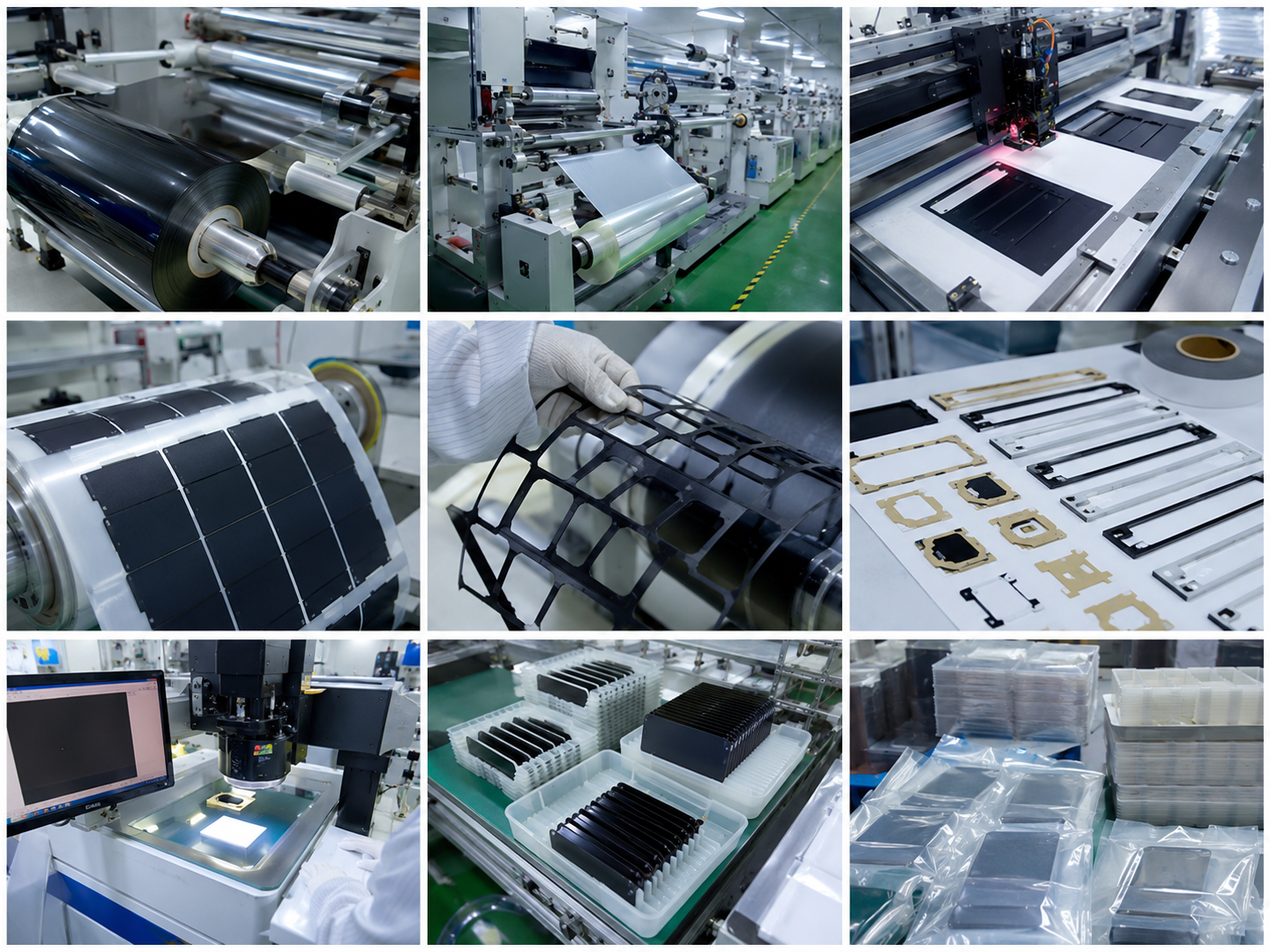
Quality Requirements for Optical Film Parts
Optical film parts need strict process control.
A defect that might be acceptable in a hidden mechanical part may not be acceptable near a display surface.
Important quality checks include:
| Inspection Item | Why It Matters |
|---|---|
| Dimensions | Ensures correct fit and light-control area |
| Thickness | Controls stack height and spacing |
| Edge quality | Reduces burrs and particles |
| Surface cleanliness | Prevents visible defects |
| Film flatness | Improves assembly and appearance |
| Adhesive position | Prevents shifting and overflow |
| Liner release | Improves peeling and operator handling |
| Packaging condition | Prevents scratches, dust, and curling |
For optical film components, cutting accuracy is only part of the result.
Clean handling and packaging are equally important.
A perfect shape with a scratch is still a rejected part.
Delivery Formats for Display Assembly
Optical film, foam, and adhesive parts can be supplied in different formats.
The right format depends on the assembly method.
| Delivery Format | Suitable Use |
|---|---|
| Individual pieces | Simple assembly or low-volume projects |
| Sheets | Manual picking and organized assembly |
| Rolls | Automated or high-volume application |
| Kiss-cut on liner | Adhesive films, tape frames, foam spacers |
| Pull-tab format | Easier peeling and positioning |
| Kits | Multi-part display module assembly |
| Clean trays or bags | Parts needing scratch and dust protection |
For assembly planning, buyers can review how die cut parts are supplied in sheets, rolls, or kits to match the production line.
Good delivery format can reduce missing parts, difficult peeling, dust exposure, scratches, and assembly delays.
What Buyers Should Provide Before Quotation
To recommend the right die cut optical film part, we usually need clear project details.
Helpful information includes:
- Drawing or sample
- Film material requirement
- Application location
- Light-control function
- Thickness and tolerance
- Adhesive requirement
- Bonding surface
- Cleanliness requirement
- Surface protection requirement
- Delivery format
- Annual volume
- Packaging preference
- Validation standard
If the material is not confirmed, we can help compare optical films, PET films, black films, protective films, adhesive tapes, foam spacers, and laminated structures.
For new display assembly projects, buyers can also review how to choose the right die cutting manufacturer before moving from sample approval to mass production.
Need Die Cut Optical Films for Display Assembly?
Die cut optical films support backlight modules, light control, surface protection, bonding, spacing, dust prevention, and display assembly efficiency.
But the final result depends on material selection, adhesive structure, cutting accuracy, cleanliness control, flatness, inspection, and packaging.
If you need die cut optical films, protective films, black PET films, adhesive frames, or foam spacers for display assembly, send us your drawing, sample, film requirement, adhesive structure, tolerance, annual volume, and packaging preference.
Sanken can help review material selection, lamination structure, die cutting method, inspection points, and delivery format before mass production.
Related Articles
You may also find these articles helpful:
- Why Is Precision Film Die Cutting Important for Consumer Electronics Screens?
- What Materials Avoid Bubble Generation During Optical Film Die Cutting?
- How to Solve Residual Adhesive Issues of Die-Cut Optical Protective Films?
- Why Is Precision Important in Display Film Converting?
- What Features Make Matte Optical Film Ideal for Touch Display Assembly?
- How Does Thickness Tolerance Affect Final Optical Component Fitting?
- Can Poor Die Cutting Affect Screen Performance?
Conclusion
Die cut optical films help display assemblies control light, protect surfaces, bond layers, manage spacing, reduce dust risk, and improve production handling. The best results come from matching the correct film, adhesive, foam spacer, die cutting method, cleanliness standard, and delivery format to the actual display structure.