
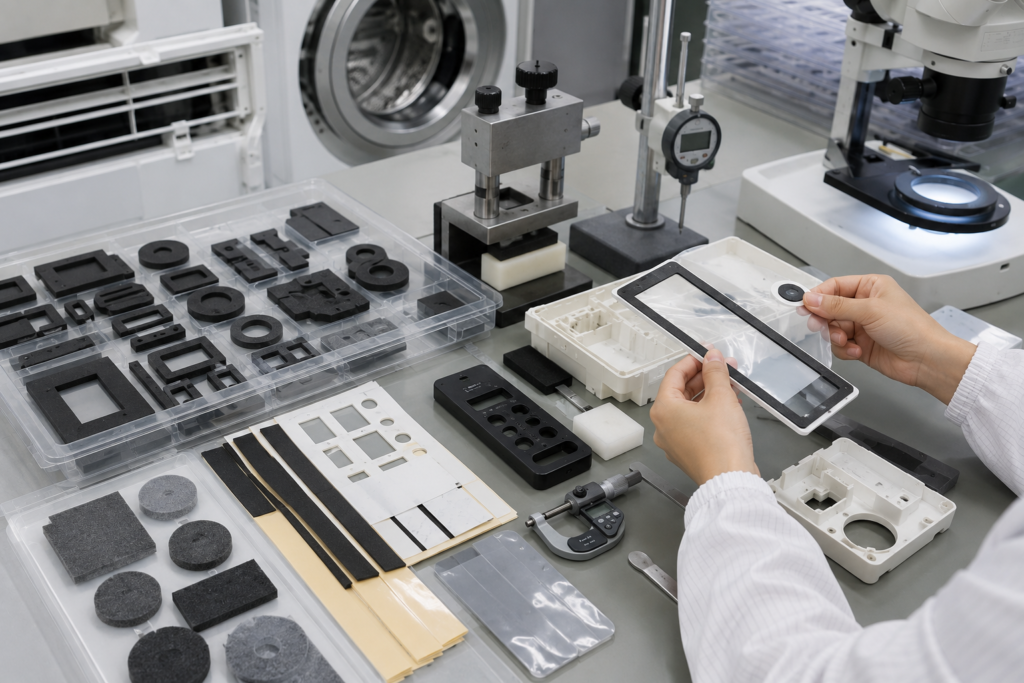
Refrigerators, air conditioners, and washing machines may look like large household appliances from the outside.
But inside each product, many small functional parts help improve sealing, cushioning, vibration control, insulation, bonding, dust protection, and assembly efficiency.
Many of these parts are produced by die cutting.
At Sanken, we use precision die cutting to convert foam, rubber, pressure-sensitive adhesive tape, PET insulation film, protective film, non-woven felt, and laminated materials into custom components for OEM appliance assembly.
These parts are usually hidden after installation.
But when they are missing, too thin, poorly bonded, or badly cut, the appliance may become noisy, leaky, unstable, difficult to assemble, or easier to damage.
Why Home Appliances Need Die Cut Parts
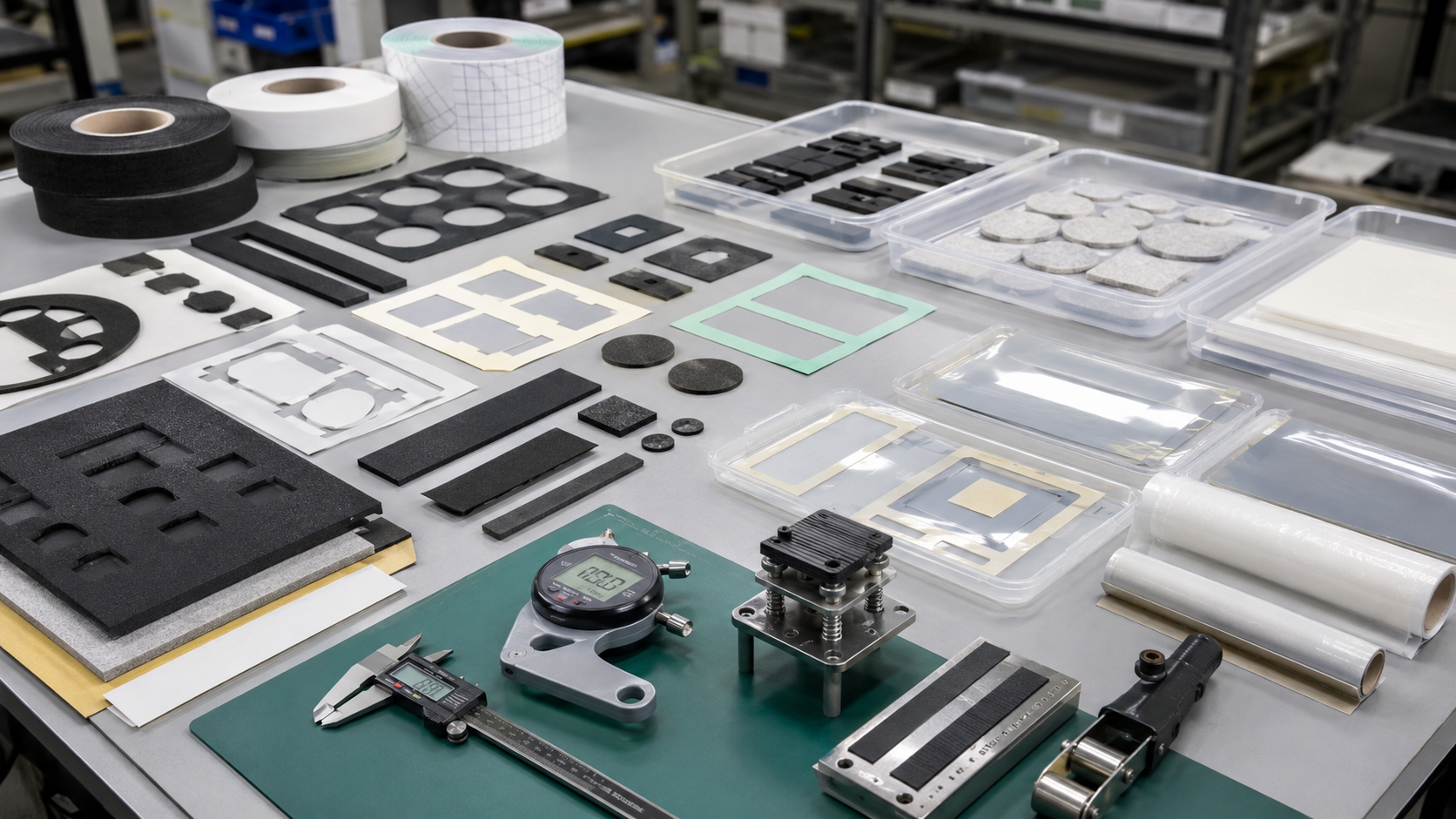
Home appliances combine plastic housings, metal panels, motors, ducts, electronic control boards, display panels, wiring areas, doors, covers, and moving parts.
Each area may need a small functional component.
Common die cut part functions include:
| Function | Common Die Cut Material |
|---|---|
| Sealing | Foam gaskets, adhesive-backed foam strips |
| Cushioning | EVA foam, PE foam, PU foam pads |
| Vibration reduction | Rubber pads, foam pads, felt pads |
| Bonding | Double-sided tape, foam tape, PET-backed adhesive tape |
| Electrical insulation | PET insulation films |
| Surface protection | Protective films with pull tabs |
| Anti-squeak support | Non-woven felt pads and strips |
| Dust protection | Foam seals, PET films, protective films |
For appliance OEM projects, custom die cut parts are designed around the real assembly location, not only the material shape.
A small gasket or pad must fit the appliance structure, support production handling, and remain stable after assembly.
Die Cut Parts Used in Refrigerators
Refrigerators need sealing, cushioning, insulation support, surface protection, and vibration control.
They include doors, panels, compressor areas, air ducts, control boards, display areas, shelves, and metal or plastic housings.
Common refrigerator die cut parts include:
| Refrigerator Area | Common Die Cut Part |
|---|---|
| Door and panel gaps | Foam gaskets, foam strips |
| Air duct areas | Foam seals and cushioning strips |
| Control panels | Adhesive tape frames, protective films |
| Electronic control boards | PET insulation films |
| Compressor or vibration areas | Rubber pads, foam cushioning pads |
| Display or touch areas | Protective films, black PET films |
| Internal contact points | Felt pads, foam pads |
Foam parts are often used to fill gaps and reduce air leakage.
Rubber pads can help reduce vibration from compressor-related areas.
PET films can support insulation around electronic control sections.
Protective films can prevent scratches during production, transport, and installation.
For sealing-related parts, foam gaskets and sealing components are commonly used when a refrigerator assembly needs soft compression and custom geometry.
Die Cut Parts Used in Air Conditioners
Air conditioners need airflow control, dust sealing, vibration reduction, bonding, insulation, and surface protection.
Because air moves through ducts, covers, vents, and filter structures, foam sealing and cushioning parts are especially important.
Common air conditioner die cut parts include:
- Foam duct seals
- Adhesive-backed foam strips
- Foam pads for plastic housing gaps
- Rubber damping pads
- PET insulation films for control boards
- Protective films for panels and display areas
- Double-sided tape frames for control panels
- Non-woven felt pads for contact noise reduction
Air conditioner assemblies often involve plastic covers, metal brackets, fan areas, ducts, control boards, and display panels.
If a foam seal is too thin, air leakage may increase.
If a rubber pad is too hard, vibration may transfer into the housing.
If an adhesive foam strip lifts, assembly quality may become unstable.
Foam should seal the gap.
Not slowly move away from its responsibility.
Die Cut Parts Used in Washing Machines
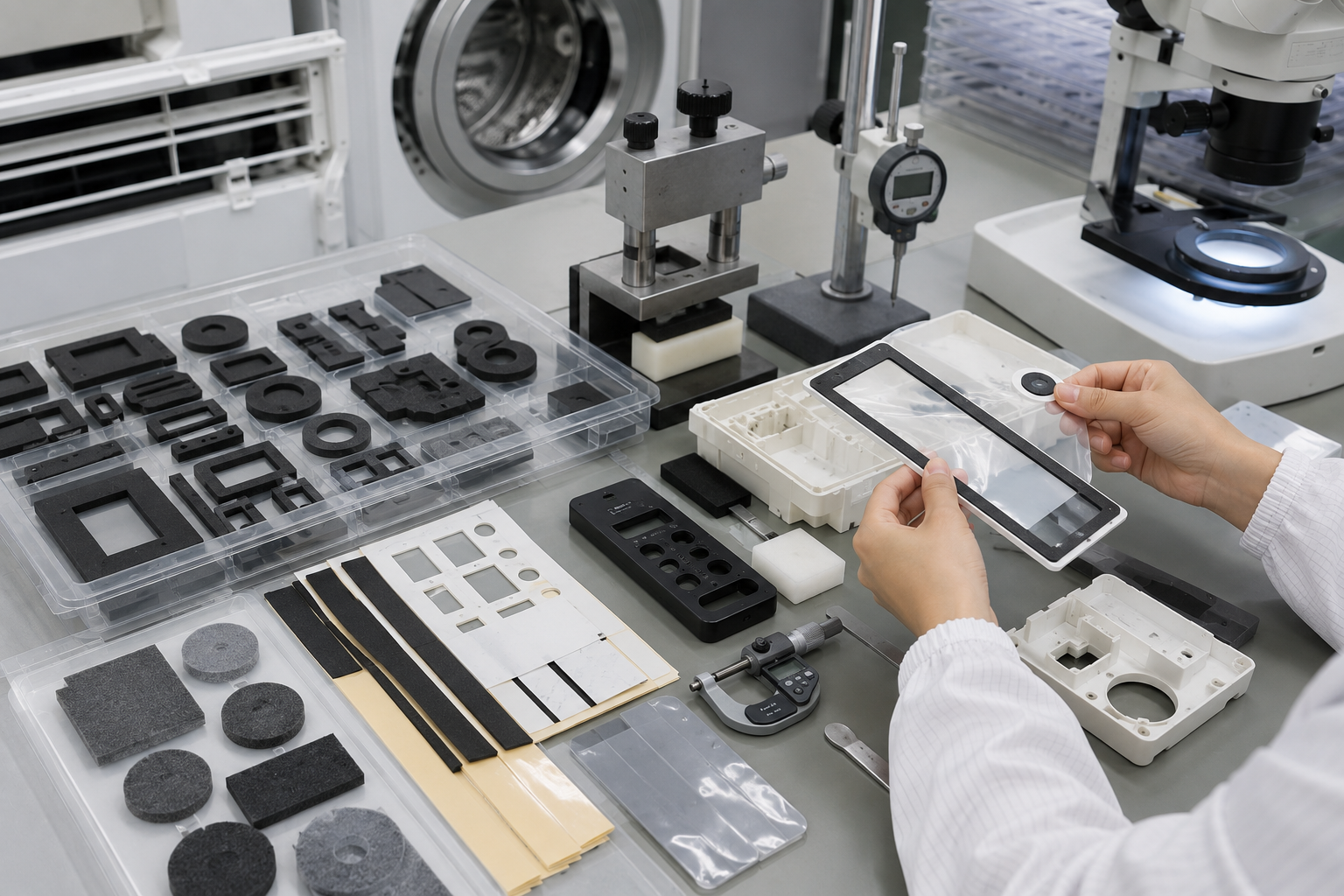
Washing machines create movement, vibration, moisture exposure, and repeated mechanical stress.
Die cut parts are often used for cushioning, anti-vibration support, sealing, surface protection, bonding, and electrical insulation.
Common washing machine die cut parts include:
| Washing Machine Area | Common Die Cut Part |
|---|---|
| Motor or vibration areas | Rubber damping pads, foam pads |
| Control panel | Adhesive tape frames, protective films |
| Internal housing contact points | Felt pads, foam cushioning pads |
| Wire and board areas | PET insulation films |
| Panel gaps | Foam strips and sealing pads |
| Door or cover areas | Foam gaskets and cushioning strips |
| Transport or assembly surfaces | Protective films |
Rubber pads are useful where vibration is stronger.
Foam pads help cushion contact points and fill small gaps.
Felt pads can reduce friction noise between housing parts.
PET insulation films can help protect electronic sections inside control areas.
A washing machine does not only need strength.
It also needs controlled contact, stable assembly, and vibration management.
Foam Gaskets and Foam Strips
Foam is one of the most common die cut materials in refrigerators, air conditioners, and washing machines.
Common foam materials include EVA foam, PE foam, PU foam, and EPDM foam.
Typical foam die cut parts include:
- Foam gaskets
- Foam sealing strips
- Foam cushioning pads
- Adhesive-backed foam tape
- Foam spacers
- Foam rings
- Foam duct seals
- Foam anti-rattle pads
Foam parts work by compression.
If the foam is too thin, it may not seal or cushion.
If it is too thick, the appliance may not assemble correctly.
If the foam has poor recovery, the sealing or cushioning function may weaken over time.
For foam gasket design, buyers should review thickness, density, compression gap, recovery, adhesive backing, and packaging.
Rubber Pads for Vibration Reduction
Rubber is often used where appliances need stronger damping or contact protection.
Common rubber die cut parts include:
- Rubber damping pads
- Rubber cushioning washers
- Rubber anti-vibration pads
- Rubber contact pads
- Rubber spacers
- Rubber sealing pads
In washing machines, rubber pads can help reduce vibration transfer.
In refrigerators, rubber pads may be used around compressor-related or panel contact areas.
In air conditioners, rubber pads can support vibration-sensitive sections.
Rubber hardness matters.
If it is too hard, it may transfer vibration.
If it is too soft, it may deform too much.
The best rubber pad matches the real load, contact area, and vibration condition.
Adhesive Tape Parts for Appliance Assembly
Many appliance parts need adhesive backing for faster and cleaner production.
Pressure-sensitive adhesive tape components help bond, mount, position, and hold parts during assembly.
Common adhesive die cut parts include:
| Adhesive Part | Appliance Use |
|---|---|
| Double-sided tape frames | Control panel bonding |
| Foam tape strips | Sealing and cushioning |
| PET-backed adhesive parts | Stable positioning |
| Transfer adhesive films | Thin bonding applications |
| Adhesive-backed foam pads | Quick placement and cushioning |
| Protective films with pull tabs | Surface protection and easy removal |
Adhesive selection must match the bonding surface.
Appliances may include plastic, painted metal, stainless steel, glass, rubber, PET film, coated panels, and textured surfaces.
These surfaces do not bond the same way.
For adhesive tape background, buyers can review what pressure sensitive adhesive tape is and where it is used in OEM assembly.
A good adhesive part should peel smoothly, stay flat, bond accurately, and resist lifting after handling, vibration, and temperature changes.
PET Insulation Films for Control Areas
Modern refrigerators, air conditioners, and washing machines include electronic control boards, displays, sensors, wiring, and user interface panels.
These areas may need thin insulation and protection parts.
Common PET film parts include:
- PET insulation films
- Adhesive-backed PET films
- PET spacers
- Protective PET films
- Black PET films for display or indicator areas
- PET-backed adhesive parts
PET film is useful because it is thin, stable, and suitable for custom die cutting.
It can help support electrical separation, surface protection, and positioning inside compact control areas.
For more detail, buyers can review custom die-cut PET insulation films for electronics assembly.
PET film parts should be clean, flat, accurately cut, and packaged carefully to avoid scratches, curling, particles, and assembly issues.
Protective Films for Panels and Visible Surfaces
Appliance panels and display areas can be scratched during production, shipping, or installation.
Die cut protective films help protect these visible surfaces.
Common protective film applications include:
- Refrigerator door panels
- Air conditioner display panels
- Washing machine control panels
- Touch surfaces
- Decorative covers
- Plastic housings
- Metal covers
- Temporary assembly protection areas
Protective films may include pull tabs for easier removal.
They may also be supplied kiss-cut on liners for organized manual assembly.
For display and panel-related projects, optical film die cut components may include protective films, black PET films, adhesive frames, PET insulation films, and foam spacers.
A protective film should protect the surface without leaving residue, curling, trapping dust, or creating scratches.
Non-Woven Felt for Noise and Contact Control
Non-woven felt is useful where parts may rub, squeak, or create contact noise.
In home appliances, felt can be used between plastic panels, metal covers, internal supports, wire areas, or vibration-prone contact points.
Common felt applications include:
- Anti-squeak pads
- Surface protection strips
- Wire contact pads
- Housing contact cushions
- Light sound dampening parts
- Adhesive-backed felt strips
Felt is especially useful when the problem is surface friction rather than large impact.
It helps reduce rubbing noise and protects surfaces from hard contact.
For appliance users, a quiet product feels better built.
Even if they never see the felt pad doing the work.
Manufacturing Process for Appliance Die Cut Parts
Most appliance die cut parts are made through material converting, lamination, die cutting, kiss cutting, waste removal, inspection, and packaging.
A typical process includes:
| Step | Purpose |
|---|---|
| Application review | Confirm sealing, cushioning, bonding, insulation, or protection need |
| Material selection | Choose foam, rubber, adhesive tape, PET film, protective film, or felt |
| Lamination | Add adhesive, liner, film, or backing layer if needed |
| Tooling design | Prepare die cutting tool based on drawing |
| Die cutting | Cut gaskets, pads, strips, frames, films, or custom shapes |
| Kiss cutting | Keep adhesive-backed parts on release liner |
| Waste removal | Remove unwanted material cleanly |
| Inspection | Check dimensions, thickness, edge, adhesive, and liner release |
| Packaging | Prevent dust, deformation, scratches, and missing parts |
For process background, buyers can review how die cutting transforms raw materials into precision components.
For assembly planning, this guide on die cut parts supplied in sheets, rolls, or kits explains how delivery format affects production efficiency.
Quality Checks Before Mass Production
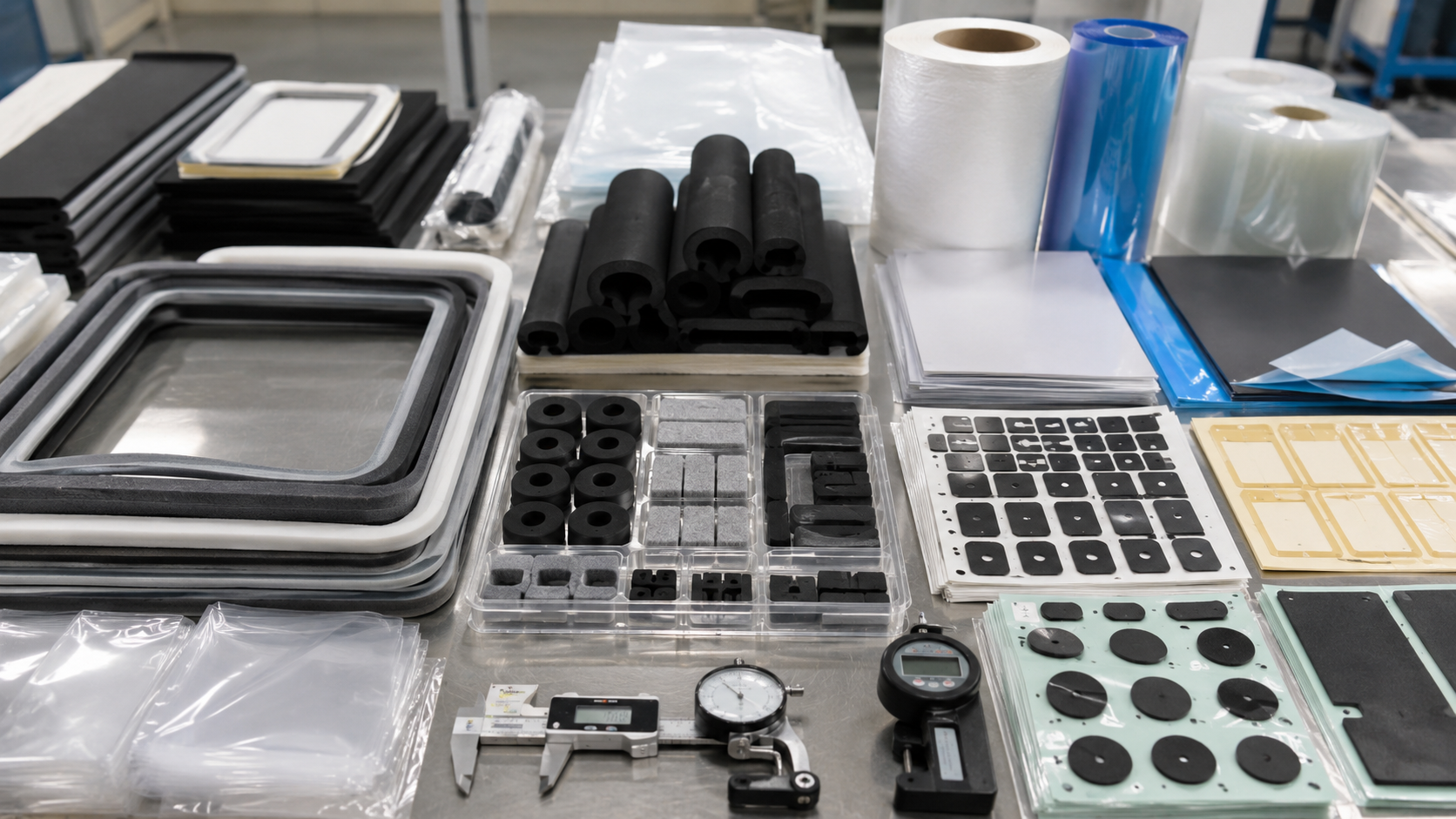
Appliance die cut parts must remain consistent from sample approval to mass production.
Important quality checks include:
| Inspection Item | Why It Matters |
|---|---|
| Dimensions | Ensures correct fit |
| Thickness | Controls compression and stack height |
| Density or hardness | Affects cushioning and vibration behavior |
| Compression recovery | Supports long-term sealing performance |
| Edge quality | Reduces tearing and poor fit |
| Adhesive position | Prevents lifting or shifting |
| Liner release | Improves assembly efficiency |
| Surface cleanliness | Protects panels and electronics |
| Packaging condition | Prevents deformation before use |
A part may pass one sample build.
Mass production needs repeatability.
The same foam gasket, rubber pad, adhesive tape frame, or PET film must perform consistently batch after batch.
What Buyers Should Provide Before Quotation
To recommend the right die cut part for refrigerators, air conditioners, or washing machines, we usually need clear project details.
Helpful information includes:
- Drawing or sample
- Appliance type and application location
- Main function
- Material preference
- Thickness and tolerance
- Adhesive requirement
- Bonding surface
- Compression gap
- Vibration or noise issue
- Insulation or surface protection requirement
- Annual volume
- Delivery format
- Packaging preference
- Testing requirement
If the material is not confirmed, Sanken can help compare foam, rubber, adhesive tape, PET film, protective film, non-woven felt, and laminated structures.
For supplier selection, buyers can also review how to choose the right die cutting manufacturer before moving from sampling to mass production.
Need Die Cut Parts for Home Appliance OEM Assembly?
Die cut parts help refrigerators, air conditioners, and washing machines improve sealing, cushioning, vibration control, bonding, insulation, surface protection, and assembly efficiency.
But the final result depends on material selection, adhesive backing, compression design, die cutting accuracy, inspection, packaging, and delivery format.
If you need foam gaskets, rubber pads, adhesive tape frames, PET insulation films, protective films, felt pads, foam strips, or laminated appliance components, send us your drawing, sample, application location, material requirement, tolerance, annual volume, and packaging preference.
Sanken can help review material selection, lamination structure, die cutting method, quality control points, and supply format before mass production.
Related Articles
You may also find these articles helpful:
- Die Cut Components in Appliances: From Sealing to Vibration Control Explained
- How Die Cut Parts Improve Sealing, Insulation, and Vibration Control in Home Appliances
- Custom Die Cut Foam Gaskets for Electronics, Automotive, and Appliance Assembly
- Foam Gasket Tape for Industrial Sealing: What OEM Buyers Should Know
- Adhesive Backed Die Cut Components for OEM Assembly
- Custom Die-Cut PET Insulation Films for Electronics Assembly
- How Die Cutting Transforms Raw Materials Into Precision Components
Conclusion
Refrigerators, air conditioners, and washing machines use many die cut parts to improve sealing, cushioning, vibration reduction, bonding, electrical insulation, surface protection, and assembly stability. Common parts include foam gaskets, adhesive-backed foam strips, rubber damping pads, PET insulation films, protective films, adhesive tape frames, and non-woven felt pads. The best result comes from matching each die cut material to the real appliance function and production process.