
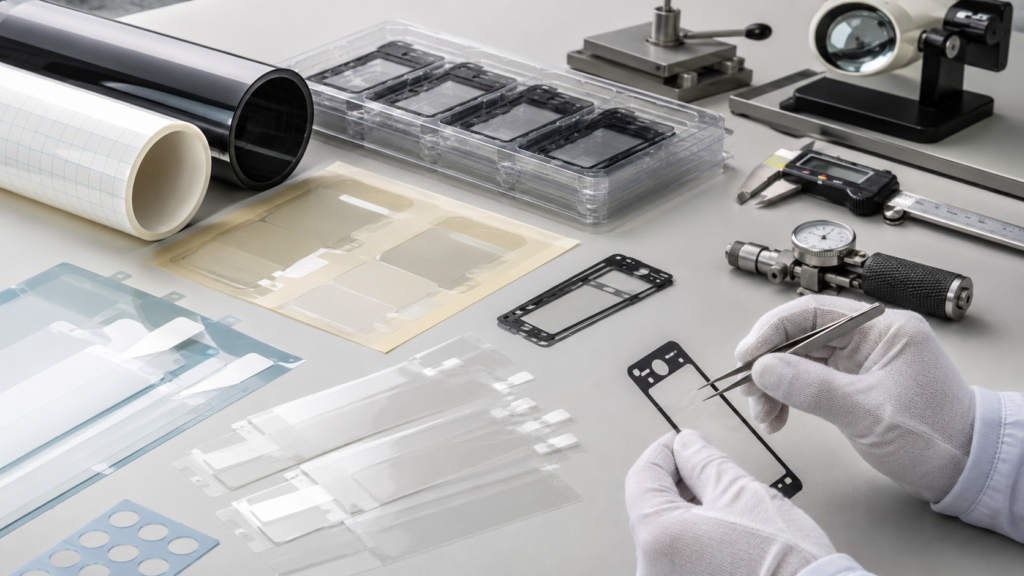
PET film is widely used in OEM products because it can be thin, stable, clean, flexible, and suitable for precision die cutting.
But not every PET film is used for the same purpose.
Some PET films protect surfaces.
Some PET films provide insulation.
Some PET films block light.
Some PET films support bonding when laminated with adhesive.
Some PET films are used temporarily, while others stay inside the final product.
At Sanken, we use precision die cutting to convert PET protective films, PET insulation films, black PET light-blocking films, adhesive-backed PET films, release liners, and laminated film structures into custom components for electronics, displays, sensors, appliances, automotive interiors, semiconductor equipment, and OEM assembly.
The right PET film depends on what the part must do.
Protection, insulation, and light blocking may all use PET film, but the design logic is different.
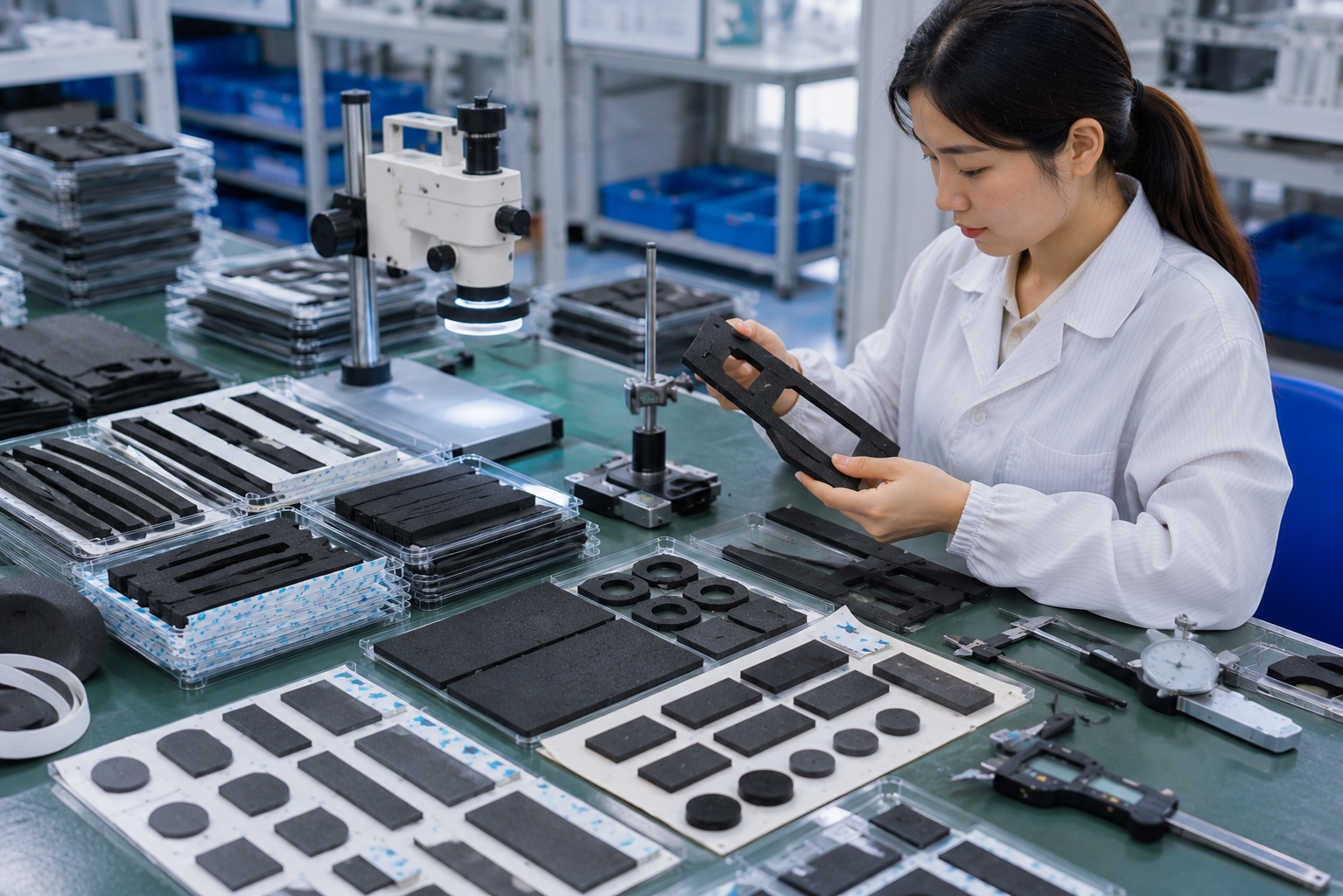
Start With the Function
Before choosing PET film, first define the function of the part.
A PET film used to protect a glossy surface has different requirements from a PET film used inside an electronic module.
A black PET film used for light blocking has different requirements from a clear PET insulation spacer.
| Function | Typical PET Film Choice | Key Requirement |
|---|---|---|
| Surface protection | PET protective film | Clean removal and scratch protection |
| Electrical insulation | PET insulation film | Thickness, stability, and clean edges |
| Light blocking | Black PET film | Opaque coverage and accurate windows |
| Bonding support | Adhesive-backed PET film | Adhesive match and stable positioning |
| Display masking | Black PET adhesive film | Edge quality and light control |
| Temporary handling protection | Pull-tab protective film | Easy removal and no residue |
| Assembly spacing | PET spacer film | Thickness and dimensional accuracy |
For OEM projects, custom die cut parts help PET film match the actual product structure instead of forcing operators to trim films manually.
Manual trimming may look simple.
In mass production, it often creates variation.
PET Protective Films for Surface Protection
PET protective films are used when a surface needs protection during production, handling, shipping, or final installation.
They can help reduce scratches, fingerprints, dust, rubbing marks, and fixture contact damage.
Common protected surfaces include:
- Display windows
- Control panels
- Appliance panels
- Automotive trim
- Plastic housings
- Metal covers
- Sensor windows
- Decorative surfaces
- Equipment panels
For temporary surface protection, the adhesive must be balanced.
It should stay in place during handling, but remove cleanly when needed.
Important selection factors include:
| Factor | Why It Matters |
|---|---|
| Adhesive tack | Controls holding force |
| Residue performance | Prevents cleaning problems after removal |
| Film thickness | Affects handling and stiffness |
| Surface compatibility | Prevents coating damage |
| Pull tab design | Improves removal |
| Liner release | Supports smooth peeling |
| Cleanliness | Reduces visible defects |
| Packaging | Prevents scratches and dust |
For more detail, buyers can review when OEM products need custom die-cut surface protection films.
A protective film should prevent defects.
It should not become one.
PET Insulation Films for Electronics
PET insulation films are used when thin electrical separation, surface protection, or internal coverage is needed.
They are common in electronic modules, control boards, connectors, battery-related electronic areas, appliances, automotive electronics, and industrial equipment.
Common PET insulation applications include:
| Application Area | PET Insulation Film Use |
|---|---|
| PCB areas | Electrical separation and surface protection |
| Connector zones | Local insulation and contact control |
| Control modules | Thin protection layer |
| Appliance electronics | Control board protection |
| Automotive electronics | Internal insulation and spacing |
| Electronic housings | Surface coverage |
| Sensor assemblies | Thin separation and protection |
For insulation applications, buyers can review custom die-cut PET insulation films for electronics assembly.
PET insulation films should be clean, flat, accurately cut, and stable during assembly.
Important selection factors include:
- Film thickness
- Die cutting tolerance
- Hole and window accuracy
- Edge quality
- Surface cleanliness
- Adhesive backing if needed
- Temperature exposure
- Assembly method
- Packaging condition
For insulation, the PET film must cover the correct area without interfering with nearby parts.
Too large may block assembly.
Too small may fail to protect the required zone.
Black PET Films for Light Blocking
Black PET films are used when OEM products need light control, visual masking, or dark surface coverage.
Common applications include:
- Display edge light blocking
- Sensor window masking
- LED indicator control
- Touch panel black borders
- Appliance display windows
- Automotive display trim
- Electronic housing coverage
- Internal light leakage reduction
For light blocking, the film must be opaque enough for the application and accurately cut around openings, windows, holes, or borders.
Important selection factors include:
| Factor | Why It Matters |
|---|---|
| Opacity | Controls light blocking performance |
| Film thickness | Affects stiffness and stack height |
| Surface finish | Affects appearance |
| Window accuracy | Controls visible area |
| Edge quality | Reduces visual defects |
| Adhesive alignment | Prevents exposed glue or overflow |
| Flatness | Prevents bubbles and lifting |
| Cleanliness | Reduces particles and visible marks |
For more detail, buyers can review black PET light-blocking film for displays, sensors, and electronic assemblies.
Black PET film is often close to visible surfaces.
That means small defects are easy to notice.
A tiny burr, scratch, offset, or dust particle can become a visible quality issue.
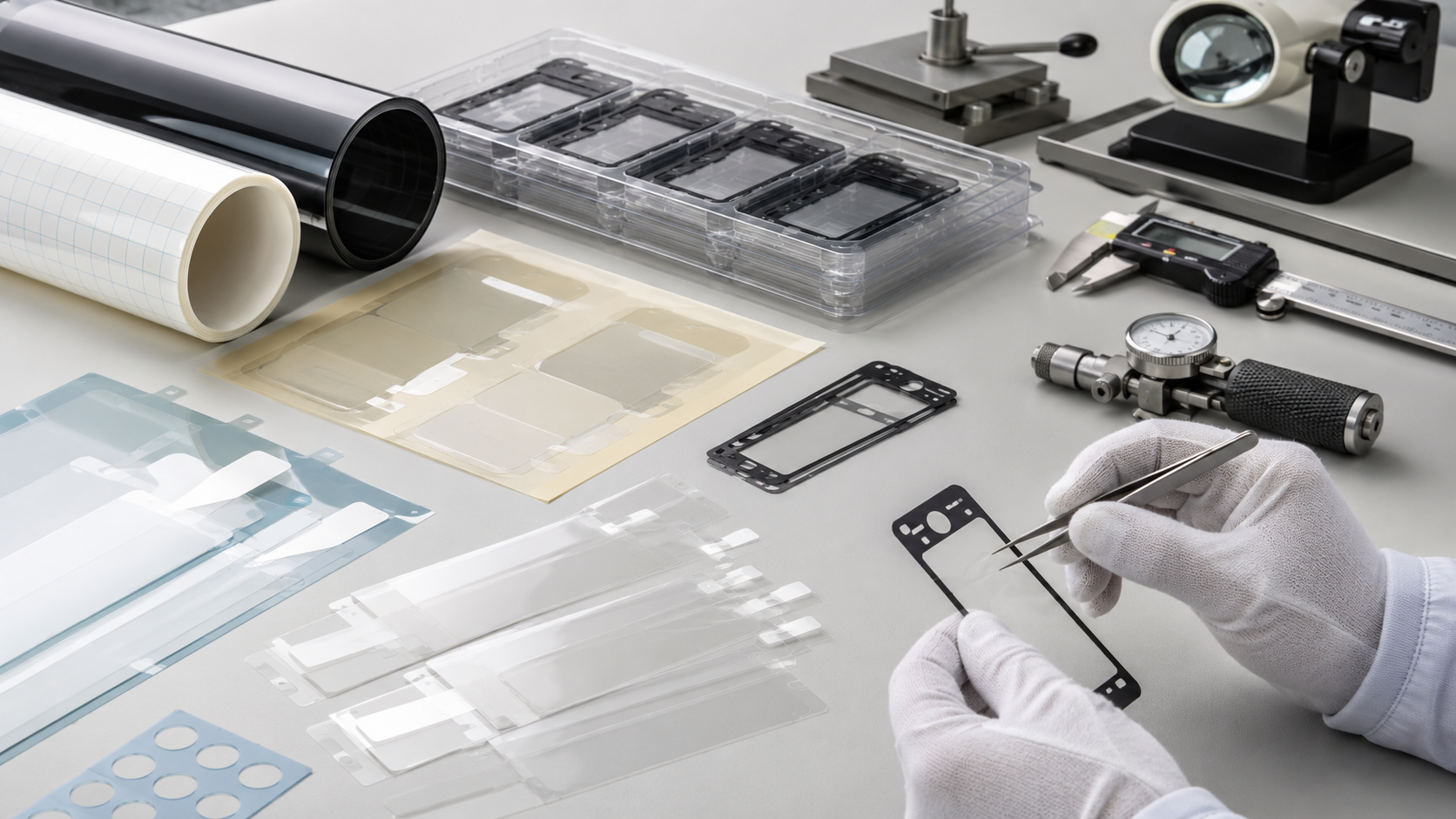
When Should You Use Adhesive-Backed PET Film?
Many PET film parts require adhesive backing.
Adhesive backing helps operators place the film accurately and keep it stable during assembly.
Common adhesive-backed PET structures include:
| Structure | Common Use |
|---|---|
| PET film + adhesive + liner | Insulation and positioning |
| Protective PET film + adhesive | Temporary surface protection |
| Black PET + adhesive | Light blocking and bonding |
| PET-backed adhesive tape | Stable thin bonding part |
| PET film with pull tab | Easier removal or placement |
| Laminated PET structure | Combined protection, insulation, and bonding |
Adhesive selection must match the bonding surface.
OEM surfaces may include glass, plastic, PET film, coated metal, painted surfaces, rubber, foam, textured housing, or stainless steel.
These surfaces do not bond the same way.
For adhesive-related risks, buyers can review why die cut adhesive parts fail after assembly.
The strongest adhesive is not always the best adhesive.
The right adhesive depends on surface energy, temperature, pressure, removal requirement, and product life.
Choose Thickness Based on Function
PET film thickness affects stiffness, handling, insulation support, stack height, and die cutting behavior.
A thinner film may be easier to fit into compact spaces, but it may curl or become harder to handle.
A thicker film may provide better stiffness and spacing, but it may affect assembly height.
| Requirement | Thickness Consideration |
|---|---|
| Surface protection | Easy handling and clean removal |
| Electrical insulation | Stable coverage and required separation |
| Light blocking | Opacity and stiffness |
| Spacing | Controlled stack height |
| Small film frames | Handling stability |
| Manual assembly | Peeling and placement behavior |
| Automated assembly | Roll stability and liner control |
Thickness should be selected together with adhesive, liner, shape, and assembly method.
A PET film is not just a flat material.
It becomes part of the product stack.
Die Cutting Design Tips for PET Film
PET films often include holes, windows, slots, frames, pull tabs, and narrow borders.
Good design improves cutting quality and assembly stability.
| Design Point | Why It Matters |
|---|---|
| Corner radius | Reduces lifting and tearing |
| Minimum width | Prevents deformation during peeling |
| Hole-to-edge distance | Improves cutting stability |
| Window accuracy | Supports display or sensor alignment |
| Adhesive coverage | Prevents overflow and weak bonding |
| Pull tab location | Improves handling |
| Liner type | Affects peeling and flatness |
| Part spacing | Improves picking and waste removal |
For adhesive-backed PET films and protective films, kiss cutting is often useful.
In kiss cutting, the PET film part is cut while the release liner remains intact.
This keeps parts organized and easier to peel.
For process comparison, buyers can review Die Cut vs Kiss Cut: What OEM Buyers Should Know for Adhesive Parts and Protective Films.
Manufacturing Process for Die Cut PET Films
Custom PET film parts are usually produced through material review, lamination, die cutting, kiss cutting, waste removal, inspection, and packaging.
A typical process includes:
| Step | Purpose |
|---|---|
| Application review | Confirm protection, insulation, or light-blocking function |
| Material selection | Choose PET protective film, PET insulation film, black PET film, adhesive, or liner |
| Lamination | Add adhesive, release liner, pull tab, or protective layer if required |
| Tooling design | Prepare die cutting tool based on drawing |
| Die cutting | Cut outer shape, windows, holes, slots, and frames |
| Kiss cutting | Keep adhesive-backed PET films on release liner |
| Waste removal | Remove unused film cleanly |
| Inspection | Check size, edge, surface, adhesive, and liner release |
| Packaging | Prevent dust, scratches, curling, and deformation |
For thin film process background, buyers can review how thin film die cutting supports high-precision OEM manufacturing.
For high-volume PET film parts, roll-to-roll die cutting can improve liner control, spacing, waste removal, and production consistency.
Supply Formats for OEM Assembly
PET film parts can be supplied in different formats depending on the production process.
| Supply Format | Suitable Use |
|---|---|
| Individual pieces | Simple placement or low-volume assembly |
| Sheets | Manual picking and organized assembly |
| Rolls | High-volume or automated application |
| Kiss-cut on liner | Adhesive-backed PET films |
| Pull-tab format | Easy removal or placement |
| Kits | Multi-part module assembly |
| Clean trays or bags | Dust and scratch protection |
For assembly planning, buyers can review how die cut parts are supplied in sheets, rolls, or kits.
The correct supply format can reduce missing parts, difficult peeling, fingerprints, dust, curling, and line delays.
Packaging is especially important for PET film because scratches, particles, or curled edges can affect assembly quality.
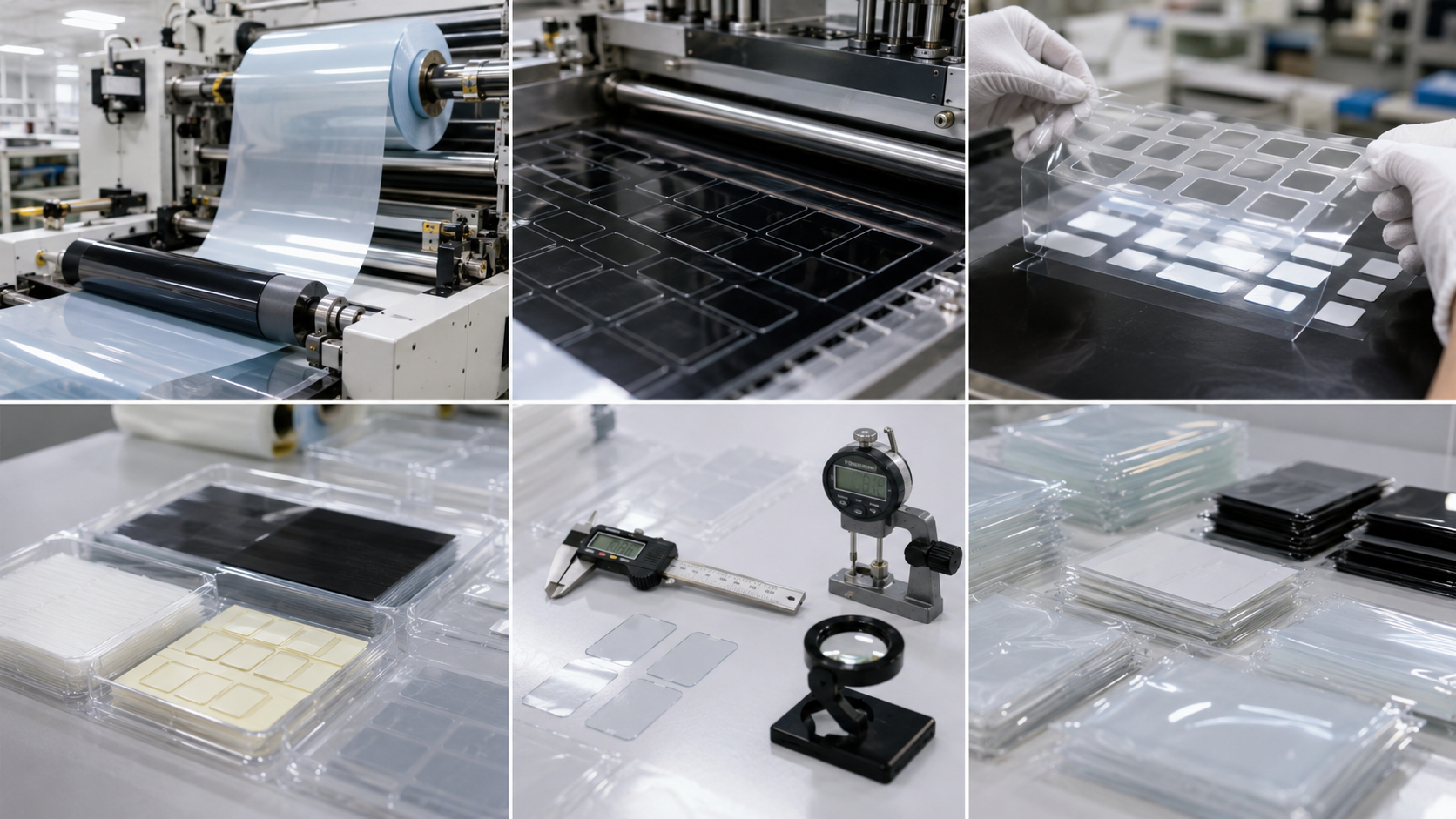
Quality Checks Before Mass Production
PET film parts must remain consistent from sample approval to production.
Important quality checks include:
| Inspection Item | Why It Matters |
|---|---|
| Dimensions | Ensures correct fit and coverage |
| Hole and window alignment | Prevents assembly interference |
| Film thickness | Controls stack height |
| Edge quality | Reduces burrs, particles, and lifting |
| Surface cleanliness | Protects visible and electronic areas |
| Adhesive position | Prevents glue overflow or shifting |
| Liner release | Improves peeling and placement |
| Flatness | Reduces curling and bubbles |
| Packaging condition | Prevents scratches and dust exposure |
For protection films, clean removal may be the key point.
For insulation films, coverage and edge quality may be more important.
For black PET films, window accuracy and surface cleanliness may decide whether the part passes visual inspection.
Inspection should match function.
What Buyers Should Provide Before Quotation
To recommend the right PET film, we usually need clear project details.
Helpful information includes:
- Drawing or sample
- Application location
- Protection, insulation, or light-blocking function
- PET film material requirement
- Film thickness
- Adhesive requirement
- Bonding surface
- Temporary or long-term use
- Hole or window design
- Pull tab requirement
- Cleanliness requirement
- Tolerance requirement
- Annual volume
- Delivery format
- Packaging preference
If the material is not confirmed, Sanken can help compare PET protective films, PET insulation films, black PET films, adhesive-backed PET films, release liners, pull-tab structures, and laminated PET film solutions.
For supplier selection, buyers can also review how to choose the right die cutting manufacturer before moving from sampling to mass production.
Need Custom Die-Cut PET Films?
PET film can support surface protection, electrical insulation, light blocking, bonding, positioning, and assembly efficiency.
But the correct choice depends on function, thickness, adhesive behavior, bonding surface, shape accuracy, liner release, cleanliness, packaging, and repeatable die cutting.
If you need PET protective films, PET insulation films, black PET light-blocking films, adhesive-backed PET films, pull-tab films, or laminated PET structures, send us your drawing, sample, application location, material requirement, tolerance, annual volume, and packaging preference.
Sanken can help review material selection, lamination structure, die cutting method, inspection points, and supply format before mass production.
Related Articles
You may also find these articles helpful:
- Custom Die-Cut PET Insulation Films for Electronics Assembly
- How Thin Film Die Cutting Supports High-Precision OEM Manufacturing
- When Do OEM Products Need Custom Die-Cut Surface Protection Films?
- Custom Die-Cut Black Light-Blocking Films for OEM Electronics
- Black PET Light-Blocking Film for Displays, Sensors, and Electronic Assemblies
- Why Is Precision Film Die Cutting Important for Consumer Electronics Screens?
- Die Cut vs Kiss Cut: What OEM Buyers Should Know for Adhesive Parts and Protective Films
Conclusion
PET film can be used for protection, insulation, or light blocking, but each function requires different selection logic. Protective PET films need clean removal and surface safety. PET insulation films need accurate coverage and stable thickness. Black PET films need opacity, window accuracy, and clean visual quality. The best solution comes from matching material, adhesive, thickness, shape design, packaging, and die cutting process to the real OEM application.