
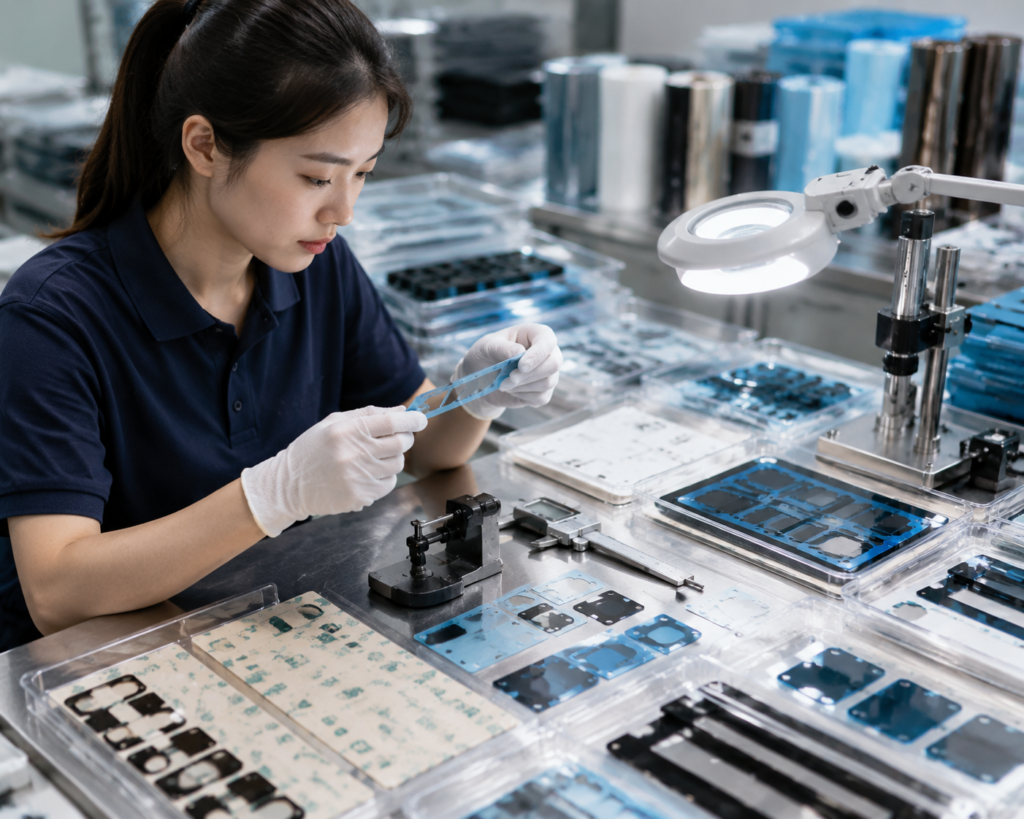
Modern electronic products are becoming smaller, thinner, and more integrated. Inside compact devices, electronic components must be protected from electrical contact, scratches, contamination, mechanical stress, and assembly-related damage.
Custom die cut insulation films and protective films provide manufacturers with precise, application-specific solutions that are difficult to achieve with standard sheets or manually cut materials. By converting PET films, adhesive films, and protective materials into exact shapes, OEM suppliers can improve component reliability, simplify assembly, and maintain consistent production quality.
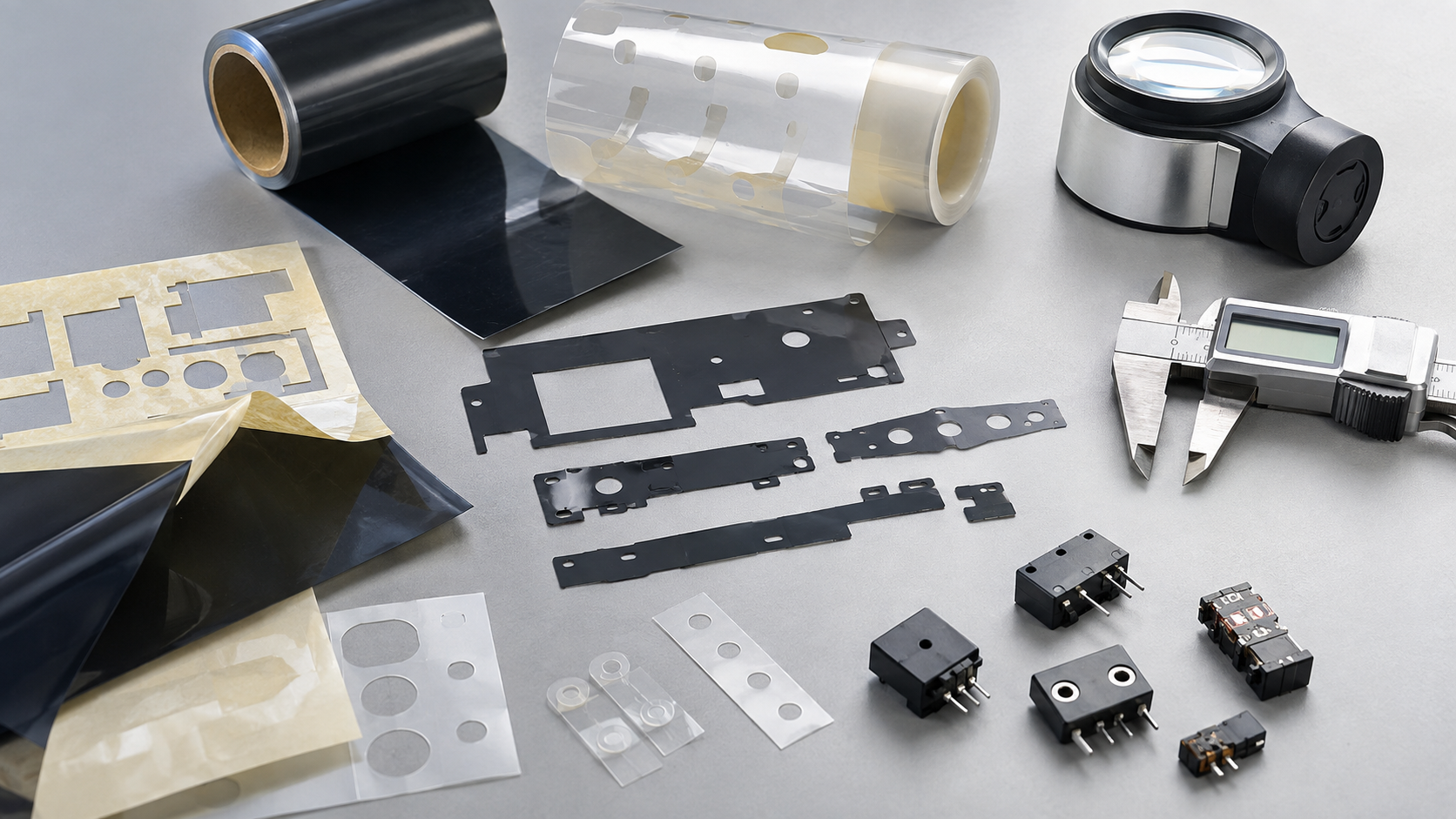
Electronic Components Require More Than Basic Film Protection
Electronic assemblies contain many sensitive areas where small defects can affect product performance.
Components such as displays, sensors, circuit assemblies, connectors, and control modules often require thin flexible materials to provide specific protection functions.
Custom die cut films can help with:
| Function | Purpose |
|---|---|
| Electrical insulation | Prevents unwanted contact between conductive parts |
| Surface protection | Prevents scratches and contamination |
| Light blocking | Controls unwanted light leakage |
| Positioning support | Keeps components accurately located |
| Layer separation | Maintains spacing between parts |
| Assembly protection | Reduces damage during production |
Unlike standard film sheets, custom die cut parts are produced according to the actual component structure. Openings, holes, adhesive areas, and edges can be precisely controlled to match the assembly design.
PET Insulation Films Provide Reliable Electrical Separation
PET film is one of the most commonly used materials for electronic insulation components because it combines electrical insulation performance with dimensional stability and thin construction.
Typical applications include:
- Electrical insulation barriers
- Connector insulation covers
- Electronic module separators
- Sensor protection layers
- Battery-related insulation parts
- Internal component isolation
Key advantages of PET insulation film include:
| Property | Benefit |
|---|---|
| Electrical insulation | Helps prevent short circuits and unwanted contact |
| Dimensional stability | Maintains accurate positioning |
| Thin profile | Fits compact electronic assemblies |
| Mechanical strength | Resists tearing during handling |
| Surface consistency | Supports reliable lamination and bonding |
PET films can be die cut into complex shapes including:
- Frames
- Rings
- Pads
- Strips
- Irregular profiles
- Components with holes and slots
For electronic assemblies with limited space, the ability to create thin and precise insulation parts is especially important.
Sanken provides precision die cutting services for PET films, adhesive materials, protective films, and other flexible components used in OEM manufacturing.
Protective Films Prevent Damage During Manufacturing
Protective films serve a different purpose from insulation films. They are usually temporary materials designed to protect surfaces during manufacturing, transportation, and assembly.
Common applications include:
- Display surface protection
- Optical component protection
- Plastic housing protection
- Metal surface protection
- Finished appearance protection
A typical protective film structure includes:
| Layer | Function |
|---|---|
| Base film | Provides physical protection |
| Adhesive layer | Holds film during processing |
| Release liner (optional) | Protects adhesive before use |
The adhesive must provide enough holding force during production while allowing clean removal afterward.
Important requirements include:
- No adhesive residue
- Easy peeling
- Stable adhesion during storage
- Protection against scratches and dust
- Compatibility with the protected surface
A protective film that bonds too strongly may damage the surface during removal. A film with insufficient adhesion may lift during manufacturing.
Why Custom Die Cutting Is Better Than Manual Film Cutting
Standard film sheets may appear cost-effective, but manual cutting creates several production challenges.
Custom die cutting provides:
- Consistent dimensions
- Repeatable positioning
- Cleaner edges
- Faster assembly
- Reduced material waste
- Better process control
Manual cutting may lead to:
| Issue | Production Impact |
|---|---|
| Size variation | Poor component fit |
| Uneven edges | Assembly interference |
| Incorrect openings | Misalignment |
| Adhesive contamination | Product quality issues |
| Slow processing | Higher labor cost |
For high-volume electronic manufacturing, repeatability is critical. A component that fits correctly during one assembly cycle must continue to perform consistently across thousands or millions of units.
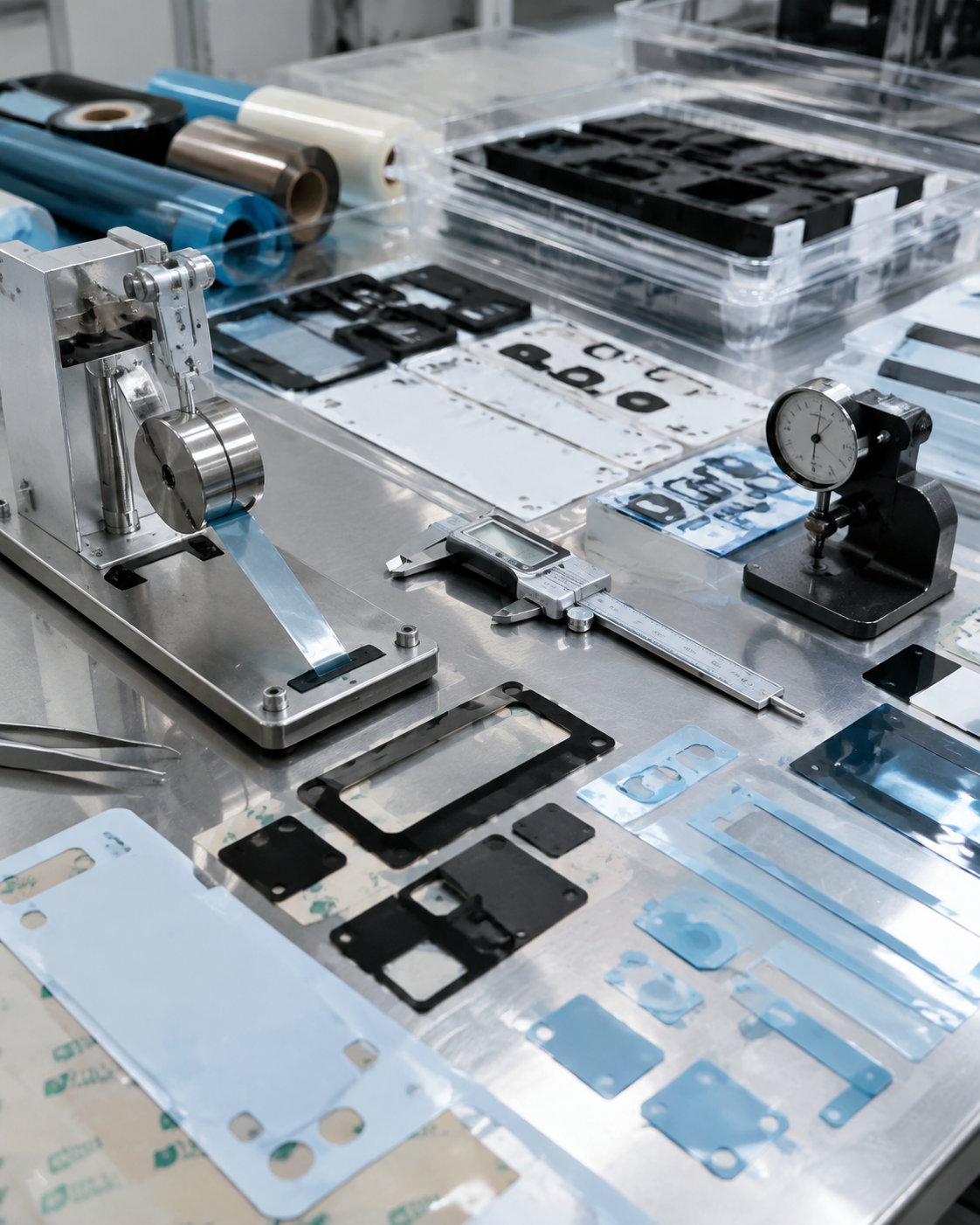
Adhesive-Backed Films Simplify Electronic Assembly
Many electronic components require films to remain accurately positioned during assembly.
Adding pressure-sensitive adhesive creates a ready-to-install component that combines protection and attachment.
Advantages include:
- Faster installation
- Improved positioning accuracy
- Reduced operator handling
- Better compatibility with automation
- Lower assembly variation
Common adhesive-backed film applications include:
- Display frames
- Sensor protection parts
- Electronic insulation pads
- Internal positioning films
- Component covers
However, adhesive selection is critical.
Engineers should consider:
| Factor | Importance |
|---|---|
| Bonding surface | Determines adhesion reliability |
| Temperature exposure | Affects long-term performance |
| Surface energy | Influences bonding strength |
| Adhesive thickness | Changes total stack height |
| Removal requirement | Determines adhesive behavior |
For temporary protective films, clean removal is usually the priority. For permanent insulation components, long-term positioning stability is more important.
Sanken manufactures adhesive-backed die cut components combining PET films, adhesives, protective layers, and release liners.
Multilayer Film Structures Combine Multiple Functions
Modern electronic products often require more than one function from a single component.
Multilayer constructions can combine:
- PET insulation
- Adhesive bonding
- Foam cushioning
- Protective surfaces
- Carrier layers
Examples include:
- PET film + adhesive
- PET film + foam + adhesive
- Protective film + removable adhesive
- Black PET + adhesive liner
These structures help reduce assembly steps by replacing several individual materials with one integrated component.
However, multilayer designs require careful manufacturing control.
Important process factors include:
- Layer alignment
- Adhesive thickness
- Lamination pressure
- Cutting depth
- Material movement
- Liner compatibility
Incorrect layer registration can create exposed adhesive edges, poor fit, or assembly problems.
Film Design Must Consider Manufacturing Requirements
A successful die cut film component begins with a manufacturing-friendly design.
Engineers should review:
| Design Factor | Consideration |
|---|---|
| Minimum feature size | Supports stable cutting |
| Hole location | Ensures component alignment |
| Corner radius | Reduces stress and cracking |
| Adhesive setback | Prevents contamination |
| Part spacing | Improves waste removal |
| Critical tolerance | Controls important dimensions |
Very small features, sharp corners, and narrow sections may increase production difficulty.
A good design balances product requirements with realistic manufacturing capability.
Early design review helps identify possible issues before tooling and mass production.
Quality Control Ensures Reliable Film Components
Because insulation and protective films are often used in precision electronic assemblies, quality control is essential.
Inspection may include:
| Inspection Item | Purpose |
|---|---|
| Material verification | Confirms correct film specification |
| Thickness measurement | Controls assembly height |
| Dimensional inspection | Ensures proper fit |
| Edge inspection | Detects cutting defects |
| Adhesive position check | Prevents bonding issues |
| Surface inspection | Detects contamination or damage |
For optical and electronic applications, even small defects may become visible after final assembly.
Consistent inspection throughout production helps prevent quality issues from reaching customers.
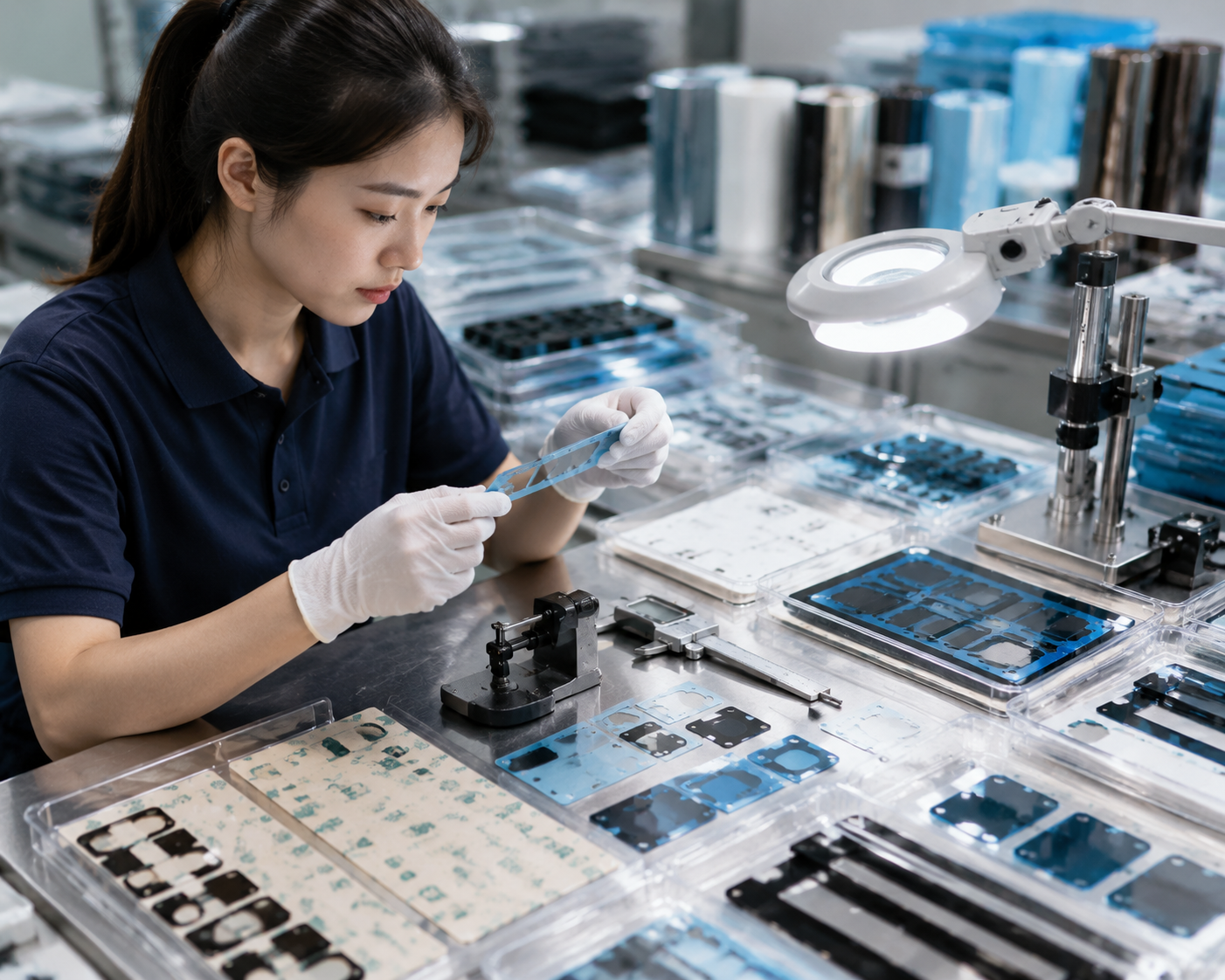
How Sanken Supports Electronic Film Applications
Sanken manufactures custom die cut PET insulation films, protective films, black PET light-blocking films, adhesive-backed film components, and multilayer flexible parts for electronic and optical OEM applications.
We support customers from material selection and drawing review through laminating, precision die cutting, prototype development, inspection, and mass production.
By combining suitable materials with controlled converting processes, Sanken helps electronic manufacturers improve protection, assembly efficiency, and product reliability.
You May Also Be Interested In
- How to Choose Die Cut Films, Foams, and Adhesive Parts for Electronic Components
- Black PET Film vs Protective Film: What Is the Difference for OEM Applications?
- Die-Cut Light-Blocking Films for Optical and Electronic Components
- What Die Cut Parts Are Used in Consumer Electronics Assembly?
- How to Choose the Right Die Cutting Manufacturer for Your OEM Project
Conclusion
Custom die cut insulation films and protective films play an important role in modern electronic manufacturing. PET insulation films provide reliable electrical separation, while protective films help prevent damage during production and handling.
Through precision die cutting, OEM manufacturers can achieve accurate dimensions, clean edges, efficient assembly, and consistent product quality.
Selecting the right film material, adhesive structure, and converting process early in development helps reduce manufacturing risks and supports reliable electronic product performance.