
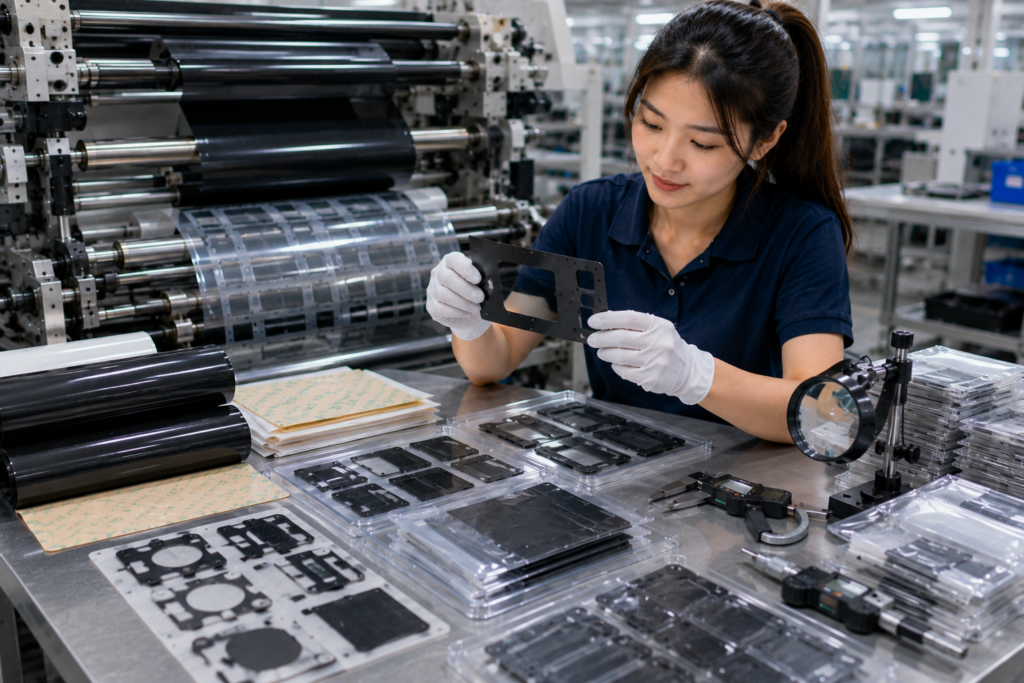
Light leakage is easy to notice in electronic products.
A display border glows unevenly.
An LED indicator spreads light into the wrong area.
A sensor window shows a messy edge.
A control panel looks bright where it should stay dark.
A thin gap inside the housing becomes visible after power-on.
Black PET film helps solve these problems by blocking unwanted light, masking openings, controlling visual borders, and supporting cleaner electronic assembly.
At Sanken, we use precision die cutting to convert black PET films, adhesive-backed black films, protective films, release liners, and laminated film structures into custom parts for electronic assemblies, display areas, sensor windows, control panels, appliances, automotive interiors, and OEM manufacturing.
A black PET film part may be thin.
But if it is poorly cut, misaligned, scratched, curled, or contaminated, the final product may show visible defects immediately.
What Is Black PET Film?
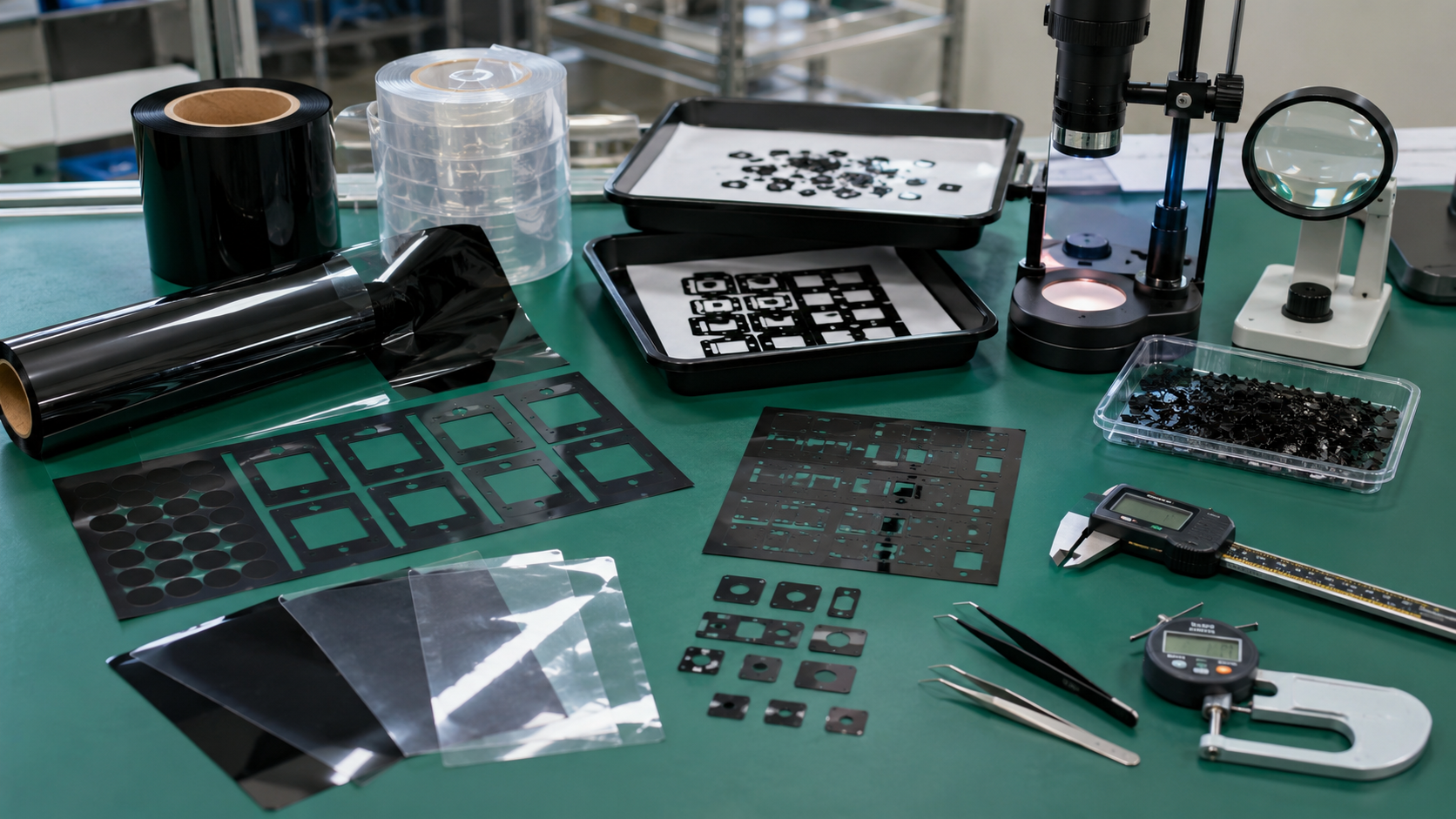
Black PET film is a thin polyester film used for light blocking, visual masking, surface coverage, and selected assembly support.
It can be supplied as a plain film, adhesive-backed film, kiss-cut film part, or laminated film structure.
Common forms include:
| Black PET Film Form | Common Function |
|---|---|
| Black PET film frame | Display border masking |
| Adhesive-backed black PET film | Easy placement and stable bonding |
| Black masking film | Covers selected areas or gaps |
| Black sensor window film | Defines clear optical openings |
| LED light-control film | Reduces unwanted light spread |
| Kiss-cut black PET film | Supports easier peeling from liner |
| Laminated black film structure | Combines light blocking, bonding, and protection |
For OEM projects, custom die cut parts allow black PET film to match the exact assembly shape, window position, hole location, and bonding area.
This improves repeatability compared with manual trimming.
Manual cutting may work during sample testing.
Mass production usually needs controlled geometry.
Why Light Leakage Happens in Electronic Assemblies
Light leakage usually happens when light escapes through a gap, edge, opening, thin wall, or poorly masked area.
Common causes include:
| Cause | Possible Result |
|---|---|
| Display edge gap | Visible glow around the border |
| Poor masking alignment | Uneven black frame |
| Weak light-blocking material | Light passes through the film |
| Rough die cut edge | Shadow, burr, or irregular border |
| Film lifting | Light enters through lifted edges |
| Adhesive overflow | Contamination near the visible area |
| Dust or particles | Visible defects after assembly |
For electronic assemblies, light leakage is not only a functional issue.
It is also an appearance issue.
The product may work electrically, but still look defective if the light border is uneven.
Where Black PET Film Is Used
Black PET film can be used in many electronic assembly areas where light, appearance, and surface coverage need control.
| Assembly Area | Black PET Film Use |
|---|---|
| Display modules | Border masking and light leakage reduction |
| LED indicator areas | Light direction and glow control |
| Sensor windows | Opening control and visual masking |
| Control panels | Black coverage and clean appearance |
| Touch interface areas | Frame masking and surface coverage |
| Electronic housings | Internal structure hiding |
| Appliance displays | Indicator and panel light control |
| Automotive electronics | Display, sensor, and trim light control |
For display and optical-related assemblies, optical film die cut components may include black PET films, protective films, adhesive frames, PET insulation films, and foam spacers.
When black PET film works well, users may not notice it.
When it fails, they often notice it quickly.
How Black PET Film Blocks Unwanted Light
Black PET film works as a thin barrier between a light source and a visible area.
It can block edge glow, hide internal structures, and make openings look cleaner.
Common light-control functions include:
- Blocking display edge light leakage
- Masking uneven housing gaps
- Reducing LED light spread
- Defining sensor window borders
- Covering internal bright surfaces
- Improving black border consistency
- Reducing unwanted internal reflection
For more background, buyers can review what black light-blocking film is used for in electronic products.
The film must be selected and cut according to the real optical path.
If the film is too small, light may escape.
If it is too large, it may block the required opening.
Adhesive-Backed Black PET Film
Many black PET film parts use pressure-sensitive adhesive backing.
Adhesive backing helps the film stay in place during assembly and final use.
Common structures include:
| Structure | Common Use |
|---|---|
| Black PET + adhesive + liner | Display and sensor masking |
| Black PET frame on release liner | Easy picking and placement |
| Black PET film with pull tab | Better manual handling |
| Black PET + protective liner | Surface protection before use |
| Laminated black PET structure | Light blocking plus bonding support |
Adhesive selection must match the bonding surface.
Electronic assemblies may include glass, PET film, plastic housing, coated panels, painted surfaces, metal covers, rubber, or textured materials.
These surfaces do not bond the same way.
For adhesive-related risks, buyers can review why die cut adhesive parts fail after assembly.
The adhesive should hold the film accurately without glue overflow, edge lifting, residue, or difficult peeling.
Why Die Cutting Accuracy Matters
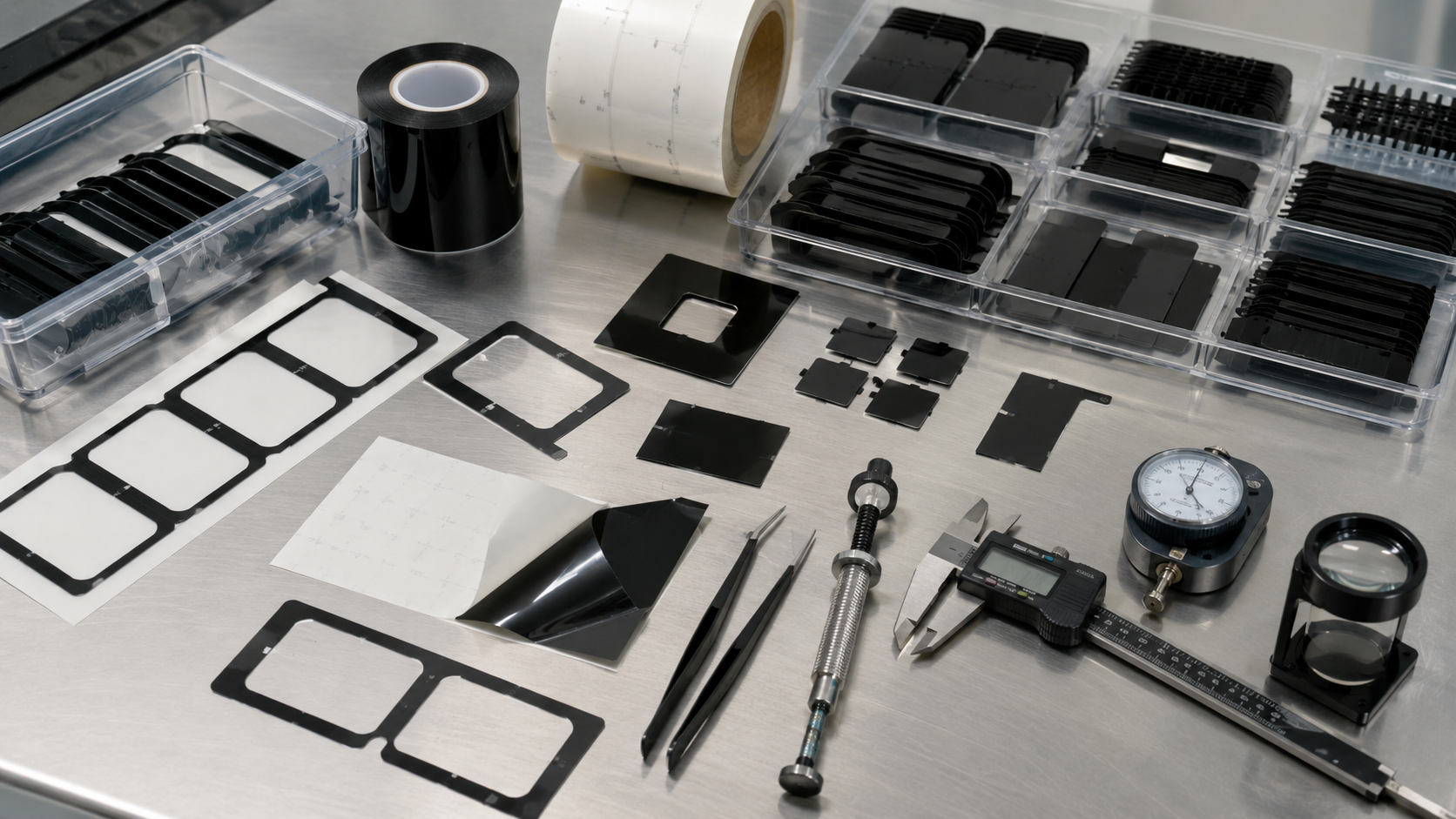
Black PET film parts often include narrow frames, windows, slots, holes, and complex contours.
These features must align with displays, LEDs, sensors, buttons, connectors, or housing openings.
Important die cutting requirements include:
| Requirement | Why It Matters |
|---|---|
| Window accuracy | Controls visible display or sensor area |
| Border width | Supports light blocking and part strength |
| Edge quality | Reduces burrs, particles, and visible defects |
| Hole alignment | Prevents assembly interference |
| Adhesive alignment | Prevents exposed glue or overflow |
| Flatness | Reduces bubbles and lifting |
| Liner release | Supports smooth peeling and placement |
For thin display-related parts, buyers can review why precision film die cutting is important for consumer electronics screens.
A black PET film frame that shifts during peeling may lose the accuracy created during die cutting.
So liner release and handling design matter too.
Kiss Cutting Supports Cleaner Assembly
Kiss cutting is often used for adhesive-backed black PET film parts.
In kiss cutting, the black PET film is cut while the release liner remains intact.
This keeps parts organized before use.
Kiss-cut black PET films can improve:
- Manual picking
- Peeling stability
- Part organization
- Placement accuracy
- Cleaner handling
- Reduced missing parts
- Sheet or roll supply
- Pull-tab design
For process comparison, buyers can review Die Cut vs Kiss Cut: What OEM Buyers Should Know for Adhesive Parts and Protective Films.
A good film part should not only be accurate on the liner.
It should remain accurate after peeling and placement.
Design Tips for Black PET Light-Blocking Film
Good design helps reduce light leakage, edge lifting, adhesive overflow, and assembly variation.
| Design Point | Why It Matters |
|---|---|
| Window size | Controls display, LED, or sensor opening |
| Border width | Affects light blocking and film strength |
| Corner radius | Reduces lifting and tearing |
| Minimum width | Prevents stretching during peeling |
| Hole-to-edge distance | Improves die cutting stability |
| Adhesive coverage | Prevents weak bonding or overflow |
| Pull tab position | Improves manual placement |
| Part spacing on liner | Supports cleaner assembly |
Very narrow black PET frames may stretch during peeling.
Sharp corners may lift after bonding.
Small inner waste areas may be difficult to remove cleanly.
The best design considers cutting, waste removal, peeling, placement, bonding, and final visual inspection.
Manufacturing Process for Black PET Film Parts
Custom black PET film components are usually produced through material review, lamination, die cutting, kiss cutting, waste removal, inspection, and packaging.
| Step | Purpose |
|---|---|
| Application review | Confirm light leakage, masking, and assembly requirement |
| Material selection | Choose black PET film, adhesive, liner, or laminate |
| Lamination | Add adhesive backing, release liner, or protective layer |
| Tooling design | Prepare die cutting tool based on drawing |
| Die cutting | Cut outer shape, windows, holes, slots, and frames |
| Kiss cutting | Keep adhesive-backed films on release liner |
| Waste removal | Remove unused film cleanly |
| Inspection | Check size, edge, adhesive, surface, and liner release |
| Packaging | Prevent dust, scratches, curling, and deformation |
For thin film process details, buyers can review how thin film die cutting supports high-precision OEM manufacturing.
For high-volume black PET film components, roll-to-roll die cutting can improve liner control, part spacing, waste removal, and production consistency.
Quality Checks Before Mass Production
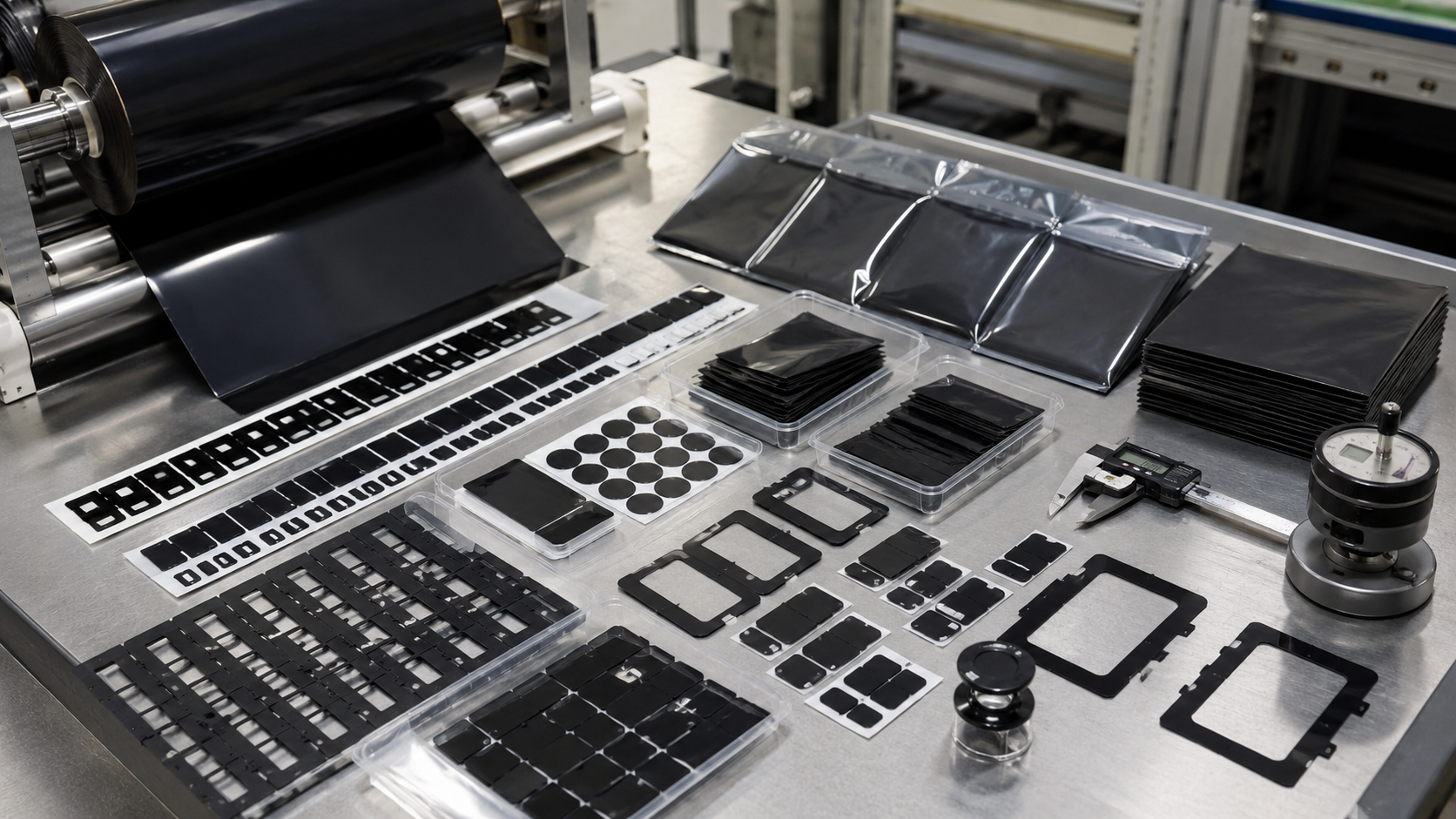
Black PET film parts are often close to visible product areas, so inspection should match both function and appearance.
Important quality checks include:
| Inspection Item | Why It Matters |
|---|---|
| Dimensions | Ensures correct fit |
| Window alignment | Controls display, LED, or sensor opening |
| Edge quality | Reduces burrs and visible defects |
| Adhesive position | Prevents glue overflow |
| Surface cleanliness | Reduces particles and marks |
| Flatness | Prevents bubbles and lifting |
| Liner release | Improves peeling and placement |
| Packaging condition | Prevents scratches and dust |
For black film components, appearance is part of performance.
A part can block light and still fail if it is scratched, dirty, misaligned, curled, or difficult to apply.
Packaging and Supply Format
Black PET film parts can be supplied in different formats according to the assembly process.
| Supply Format | Suitable Use |
|---|---|
| Individual pieces | Simple placement or low-volume production |
| Sheets | Manual picking and organized assembly |
| Rolls | High-volume or automated application |
| Kiss-cut on liner | Adhesive-backed black PET films |
| Pull-tab format | Easier peeling and positioning |
| Kits | Multi-part module assembly |
| Clean trays or bags | Dust and scratch protection |
For assembly planning, buyers can review how die cut parts are supplied in sheets, rolls, or kits.
Packaging should prevent dust, scratches, film curling, adhesive contamination, and edge damage.
Black surfaces often make defects easier to see, so packaging should be planned early.
What Buyers Should Provide Before Quotation
To recommend the right black PET light-blocking film, we usually need clear project details.
Helpful information includes:
- Drawing or sample
- Electronic assembly application
- Display, LED, sensor, or housing area
- Light leakage problem or masking requirement
- Black PET film material requirement
- Film thickness
- Adhesive requirement
- Bonding surface
- Window or hole design
- Surface finish requirement
- Pull tab requirement
- Cleanliness requirement
- Tolerance requirement
- Annual volume
- Delivery format
- Packaging preference
If the material is not confirmed, Sanken can help compare black PET film, adhesive-backed black film, release liner, pull-tab structure, protective film, and laminated black film options.
For supplier selection, buyers can also review how to choose the right die cutting manufacturer for your OEM project before moving from sampling to mass production.
Need Black PET Film for Electronic Assemblies?
Black PET film helps prevent light leakage in electronic assemblies by blocking unwanted light, masking borders, defining openings, and improving visual consistency.
But the final result depends on material opacity, adhesive behavior, window accuracy, edge quality, liner release, cleanliness, packaging, and repeatable die cutting.
If you need black PET film frames, adhesive-backed black PET films, display masking films, LED light-control films, sensor window films, pull-tab black films, or laminated black PET structures, send us your drawing, sample, application location, material requirement, tolerance, annual volume, and packaging preference.
Sanken can help review material selection, lamination structure, die cutting method, inspection points, and supply format before mass production.
Related Articles
You may also find these articles helpful:
- How Black PET Film Helps Prevent Light Leakage in Display and Sensor Modules
- What Is Black Light-Blocking Film Used for in Electronic Products?
- Custom Die-Cut Black Light-Blocking Films for OEM Electronics
- Which PET Film Should You Choose for Protection, Insulation, or Light Blocking?
- How Thin Film Die Cutting Supports High-Precision OEM Manufacturing
- Why Is Precision Film Die Cutting Important for Consumer Electronics Screens?
- Die Cut vs Kiss Cut: What OEM Buyers Should Know for Adhesive Parts and Protective Films
Conclusion
Black PET film helps prevent light leakage in electronic assemblies by blocking unwanted light, masking display and sensor borders, controlling LED glow, and improving visual consistency. The best result comes from selecting the right black PET film, controlling adhesive backing, maintaining accurate window alignment, ensuring clean edges, and supplying parts in assembly-friendly formats such as sheets, rolls, or kiss-cut liners.