
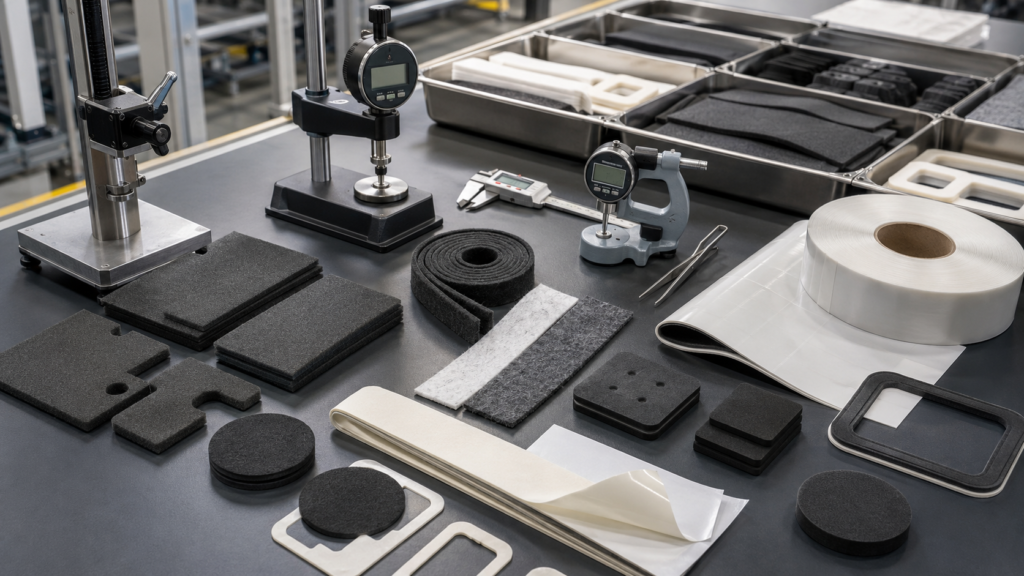
Automotive interiors are full of small contact points.
Door panels touch brackets.
Trim parts contact plastic housings.
Wire harnesses move near hard surfaces.
Display modules sit inside frames.
Air ducts, covers, clips, and panels may vibrate during driving.
When these parts move, rub, or hit each other, the result can be noise, vibration, rattles, squeaks, and an uncomfortable cabin experience.
Die cut foam, felt, and rubber parts help reduce these problems by adding soft contact, cushioning, damping, gap filling, and anti-rattle support exactly where the interior structure needs it.
At Sanken, we use precision die cutting to convert foam, non-woven felt, rubber, adhesive-backed materials, and laminated structures into custom automotive interior components for OEM assembly.
Small pad.
Quiet cabin.
Why Automotive Interiors Create Vibration Problems
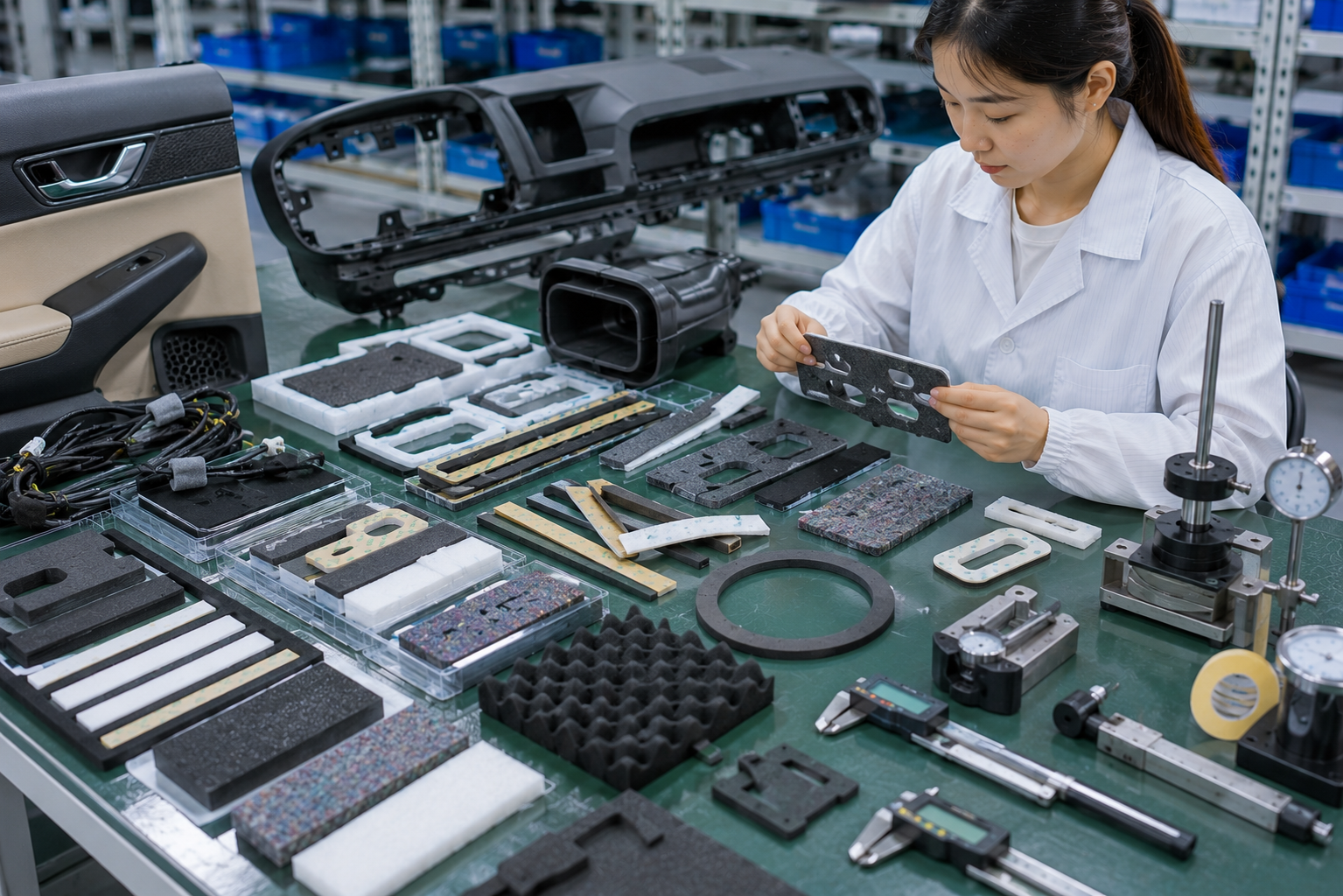
Automotive interiors combine many materials and structures.
Plastic, metal, fabric, leather, rubber, foam, wiring, clips, fasteners, and electronic modules are installed close together. During driving, these parts experience vibration, road impact, thermal expansion, door closing force, and repeated contact.
Common interior vibration problems include:
| Problem | Common Cause | Die Cut Solution |
|---|---|---|
| Rattle | Loose gap between trim parts | Foam or felt anti-rattle pads |
| Squeak | Surfaces rubbing together | Felt strips or soft foam pads |
| Buzz | Small part vibration | Foam cushioning or rubber damping pads |
| Hard contact | Plastic or metal hitting another surface | Foam pads or rubber bumpers |
| Air duct vibration | Duct movement or gap variation | Foam sealing strips |
| Wire harness noise | Wires hitting panels | Felt wraps or foam protection pads |
| Display vibration | Module movement inside frame | Foam spacers or rubber pads |
For automotive die cut components, the goal is not only to fill space.
The goal is to control contact, compression, movement, and long-term stability.
Foam Parts for Cushioning and Gap Filling
Foam is widely used in automotive interiors because it can compress, recover, fill gaps, and reduce hard contact between parts.
Common die cut foam materials include EVA foam, PE foam, PU foam, and EPDM foam.
Typical automotive interior foam parts include:
- Anti-rattle foam pads
- Foam sealing strips
- Foam gasket frames
- Foam spacers
- Adhesive-backed foam tape
- Display support foam
- Door panel cushioning pads
- HVAC duct foam seals
For sealing and cushioning applications, foam gaskets and sealing components are commonly used because foam can be die cut into custom shapes and installed in specific contact areas.
Foam works best when compression is controlled.
If the foam is too thin, it may not contact the mating surface.
If it is too thick, it may create assembly stress.
If the foam has poor recovery, the rattle may return after use.
Foam should stay helpful, not retire early.
Felt Parts for Squeak and Friction Control
Non-woven felt is often used when the main problem is friction noise.
In automotive interiors, squeaks often happen when two surfaces rub during driving. Felt creates a softer sliding surface and reduces hard friction contact.
Common die cut felt applications include:
| Felt Part | Automotive Interior Use |
|---|---|
| Felt pads | Anti-squeak support between trim parts |
| Felt strips | Door panel and dashboard contact areas |
| Adhesive-backed felt | Easy placement on plastic or metal surfaces |
| Wire harness felt pads | Reduce rubbing and contact noise |
| Felt liners | Protect surfaces from friction |
| Small felt cushions | Control local contact points |
Felt is especially useful where the part does not need strong compression, but needs quieter surface contact.
For example, a felt strip between a plastic trim piece and a metal bracket may reduce squeak during vibration.
A small felt pad near a wire harness may prevent rubbing noise.
Felt does not need to be large to be useful.
It just needs to be in the right place.
Rubber Parts for Damping and Stronger Contact Protection
Rubber is useful when the application needs stronger damping, more durable contact support, or higher resistance to repeated compression.
Common automotive interior rubber parts include:
- Rubber damping pads
- Rubber bumpers
- Rubber spacers
- Rubber cushioning washers
- Rubber anti-vibration pads
- Adhesive-backed rubber pads
- Rubber contact protection parts
Rubber is often selected when foam may be too soft or felt may not provide enough damping.
However, rubber hardness must be chosen carefully.
If the rubber is too hard, vibration may transfer through the part.
If it is too soft, the part may deform too much.
The correct rubber pad should match the load, contact area, vibration condition, and assembly space.
Choosing Between Foam, Felt, and Rubber
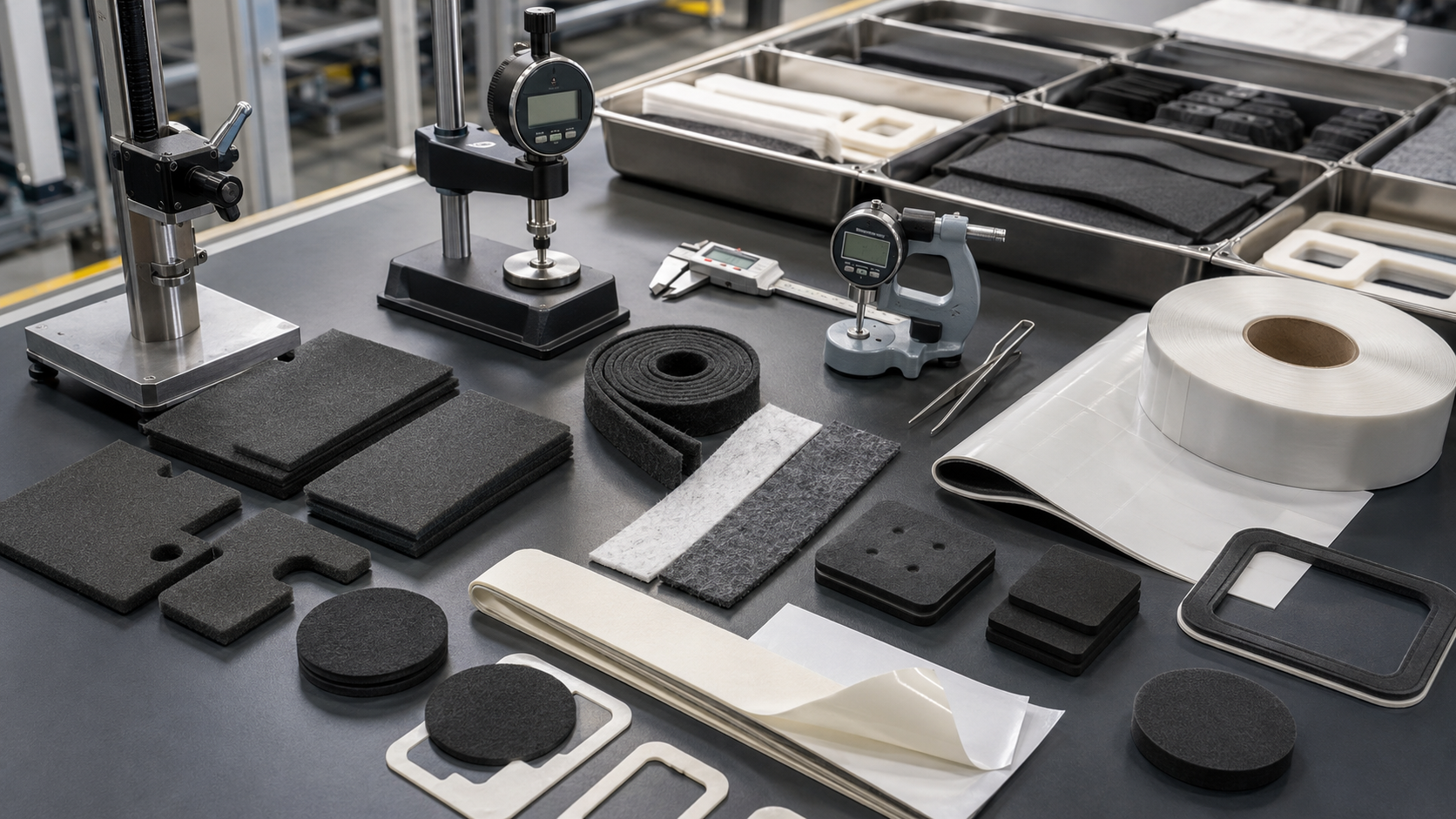
Foam, felt, and rubber can all reduce interior noise and vibration, but they work in different ways.
| Material | Best For | Key Selection Factor |
|---|---|---|
| Foam | Gap filling, cushioning, sealing, anti-rattle support | Thickness, density, compression recovery |
| Felt | Squeak reduction and friction control | Surface softness, thickness, adhesive backing |
| Rubber | Stronger damping and contact protection | Hardness, thickness, load condition |
| Adhesive-backed foam | Fast placement and stable positioning | Adhesive match and liner release |
| Adhesive-backed felt | Anti-squeak pads and strips | Bonding surface and placement area |
| Laminated structures | Multiple functions in one part | Layer alignment and total thickness |
For many automotive interiors, the best solution is not one material for all areas.
A door panel may need foam in one area, felt in another area, and rubber in a vibration-sensitive location.
Material selection should follow the problem.
Not the habit.
Adhesive Backing Improves Assembly Efficiency
Many foam, felt, and rubber interior parts use pressure-sensitive adhesive backing.
Adhesive backing helps operators place the part quickly and keep it in position before final assembly.
Common adhesive-backed parts include:
- Foam tape pads
- Felt anti-squeak strips
- Rubber damping pads
- Foam gasket frames
- Foam spacers
- Wire harness protection pads
- Laminated foam and adhesive structures
Adhesive selection must match the bonding surface.
Automotive interiors may include textured plastic, painted metal, fabric-backed parts, PET film, rubber, foam, and coated surfaces.
These surfaces do not bond the same way.
For adhesive-related risks, buyers can review why die cut adhesive parts fail after assembly.
A good adhesive-backed part should peel smoothly, stay flat, bond accurately, and resist lifting during handling, vibration, heat, and long-term use.
Design Details That Affect NVH Performance
The shape of a die cut part affects how well it works in the assembly.
Important design points include:
| Design Point | Why It Matters |
|---|---|
| Thickness | Controls compression and contact |
| Density or hardness | Affects cushioning and damping |
| Minimum width | Prevents tearing or deformation |
| Corner radius | Reduces stress and edge lifting |
| Adhesive coverage | Supports stable placement |
| Pull tab design | Improves peeling and handling |
| Part spacing on liner | Improves operator efficiency |
| Packaging method | Prevents compression marks or dust |
For foam parts, narrow walls may tear during die cutting or peeling.
For felt strips, adhesive backing must stay stable on the liner.
For rubber pads, hardness and thickness should be reviewed together.
Good NVH parts are designed for cutting, peeling, placing, compressing, and long-term use.
Manufacturing Process for Automotive Interior NVH Parts
Die cut foam, felt, and rubber parts are usually produced through material review, lamination, die cutting, kiss cutting, waste removal, inspection, and packaging.
A typical process includes:
| Step | Purpose |
|---|---|
| Application review | Confirm rattle, squeak, vibration, impact, or sealing issue |
| Material selection | Choose foam, felt, rubber, adhesive, or liner |
| Lamination | Add adhesive backing, liner, or film layer if required |
| Tooling design | Prepare die cutting tool based on drawing |
| Die cutting | Cut pads, strips, gaskets, frames, or custom shapes |
| Kiss cutting | Keep adhesive-backed parts on release liner |
| Waste removal | Remove unused material cleanly |
| Inspection | Check size, thickness, edge, adhesive, and liner release |
| Packaging | Prevent compression marks, dust, sticking, and deformation |
For process background, buyers can review how die cutting works from foam rolls to finished parts.
For high-volume adhesive-backed foam and felt parts, roll-to-roll die cutting can improve liner control, part spacing, waste removal, and production consistency.
Quality Checks Before Mass Production
Automotive interior NVH components should remain consistent from sample approval to mass production.
Important quality checks include:
| Inspection Item | Why It Matters |
|---|---|
| Dimensions | Ensures correct placement |
| Thickness | Controls compression and fit |
| Foam density | Affects cushioning and recovery |
| Rubber hardness | Affects damping behavior |
| Felt surface quality | Affects friction and noise control |
| Adhesive position | Prevents shifting and lifting |
| Liner release | Improves peeling and assembly |
| Edge quality | Reduces tearing and poor fit |
| Packaging condition | Prevents deformation before use |
For interior vibration control, one good sample is not enough.
The production batch must repeat the same thickness, shape, adhesive behavior, and handling performance.
Supply Formats for Automotive Assembly
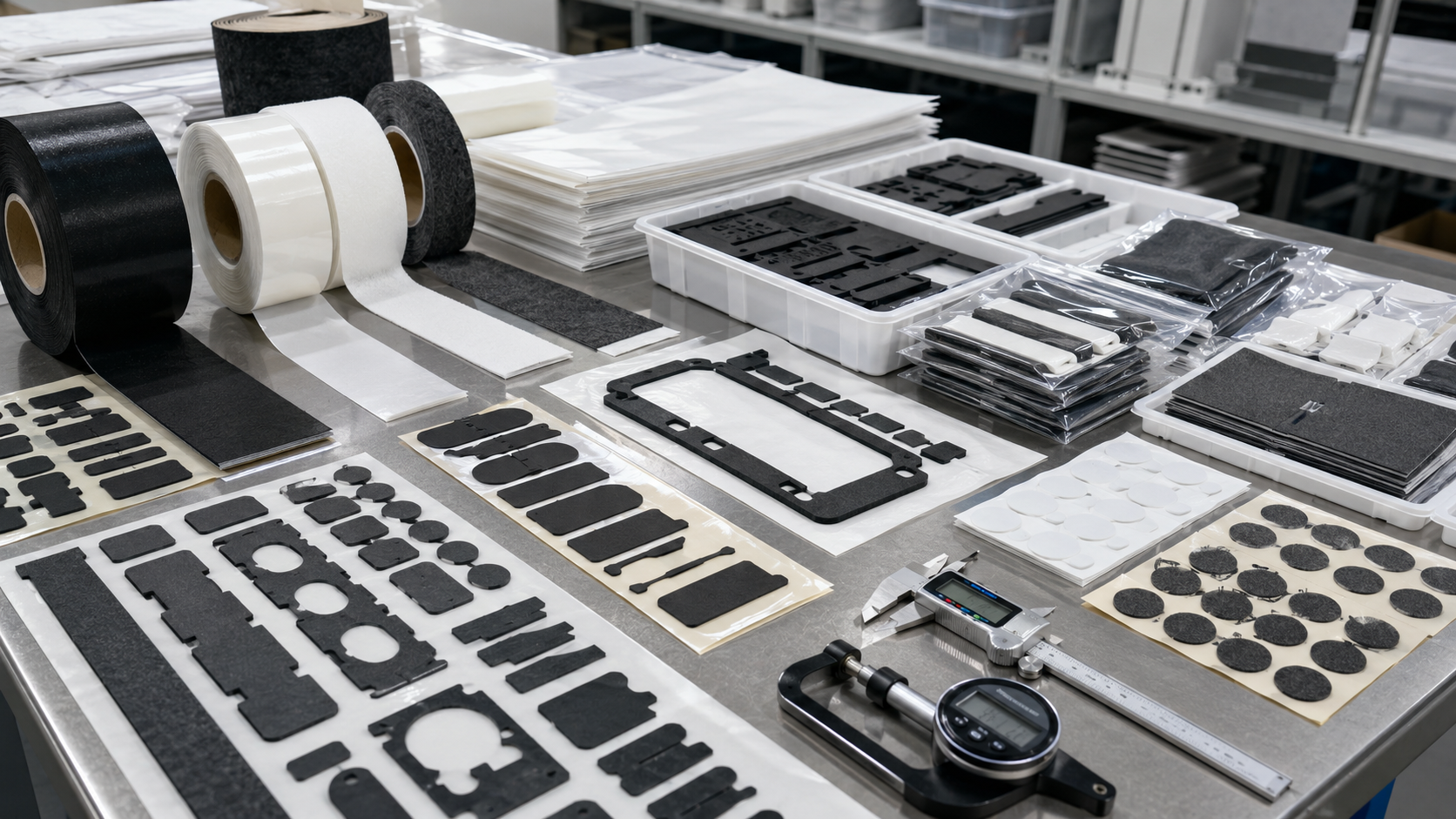
Foam, felt, and rubber parts can be supplied in different formats depending on the assembly process.
| Supply Format | Suitable Use |
|---|---|
| Individual pieces | Simple or lower-volume assembly |
| Sheets | Manual picking and organized placement |
| Rolls | High-volume or automated application |
| Kiss-cut on liner | Adhesive-backed foam and felt parts |
| Kits | Multi-part interior module assembly |
| Clean trays or bags | Parts needing deformation protection |
For assembly planning, buyers can review how die cut parts are supplied in sheets, rolls, or kits.
Packaging is especially important for soft materials.
Foam should not be compressed before use.
Felt should stay clean.
Rubber pads should remain flat.
Adhesive-backed parts should not collect dust or shift on the liner.
What Engineers Should Provide Before Quotation
To recommend the right foam, felt, or rubber die cut part, we usually need clear project details.
Helpful information includes:
- Drawing or sample
- Automotive interior application location
- Noise, vibration, rattle, squeak, or impact issue
- Foam, felt, or rubber material preference
- Thickness and tolerance
- Foam density or rubber hardness requirement
- Compression gap
- Adhesive requirement
- Bonding surface
- Temperature exposure
- Manual or automated assembly
- Annual volume
- Delivery format
- Packaging preference
- Testing or validation requirement
If the material is not confirmed, Sanken can help compare EVA foam, PE foam, PU foam, EPDM foam, non-woven felt, rubber, adhesive backing, release liner, and laminated structures.
For supplier selection, buyers can also review how to choose the right die cutting manufacturer for your OEM project before moving from sampling to mass production.
Need Foam, Felt, or Rubber Parts for Automotive Interior Vibration Control?
Die cut foam, felt, and rubber parts help reduce vibration, rattles, squeaks, impact, hard contact, and assembly variation in automotive interiors.
But the final result depends on material selection, thickness, density, hardness, compression, adhesive backing, bonding surface, die cutting accuracy, inspection, packaging, and delivery format.
If you need anti-rattle foam pads, felt strips, rubber damping pads, foam gasket frames, adhesive-backed cushioning parts, wire harness protection pads, or laminated NVH components, send us your drawing, sample, application location, material requirement, tolerance, annual volume, and packaging preference.
Sanken can help review material selection, lamination structure, die cutting method, quality control points, and supply format before mass production.
Related Articles
You may also find these articles helpful:
- How Die Cut Foam, Felt, and Rubber Parts Improve EV Interior NVH Performance
- Why Vehicles Have Noise and Vibration Problems — and How Die Cut NVH Parts Help
- How to Choose Die Cut NVH Materials for Automotive Interior Vibration Control
- Why Is NVH Performance So Important in EV Interior Design?
- Custom Die-Cut Foam and Felt Parts for Sound Dampening and Vibration Reduction
- How to Choose Die Cut Foam Materials for Noise, Vibration, and Impact Control
- Why Foam Materials Are Used for Sound Absorption and Shock Protection in OEM Products
Conclusion
Die cut foam, felt, and rubber parts reduce vibration in automotive interiors by controlling contact, filling gaps, cushioning impact, reducing friction, and damping repeated movement. Foam is useful for compression and gap filling. Felt helps reduce squeak and rubbing noise. Rubber supports stronger damping and contact protection. The best result comes from matching material, shape, adhesive backing, packaging, and die cutting process to the real interior assembly condition.