
Electric vehicles are quiet.
That is a major selling point.
It is also a major challenge for interior engineers.
When there is less engine noise, small rattles, squeaks, buzzes, panel vibration, wire harness movement, and trim contact sounds become much easier to hear.
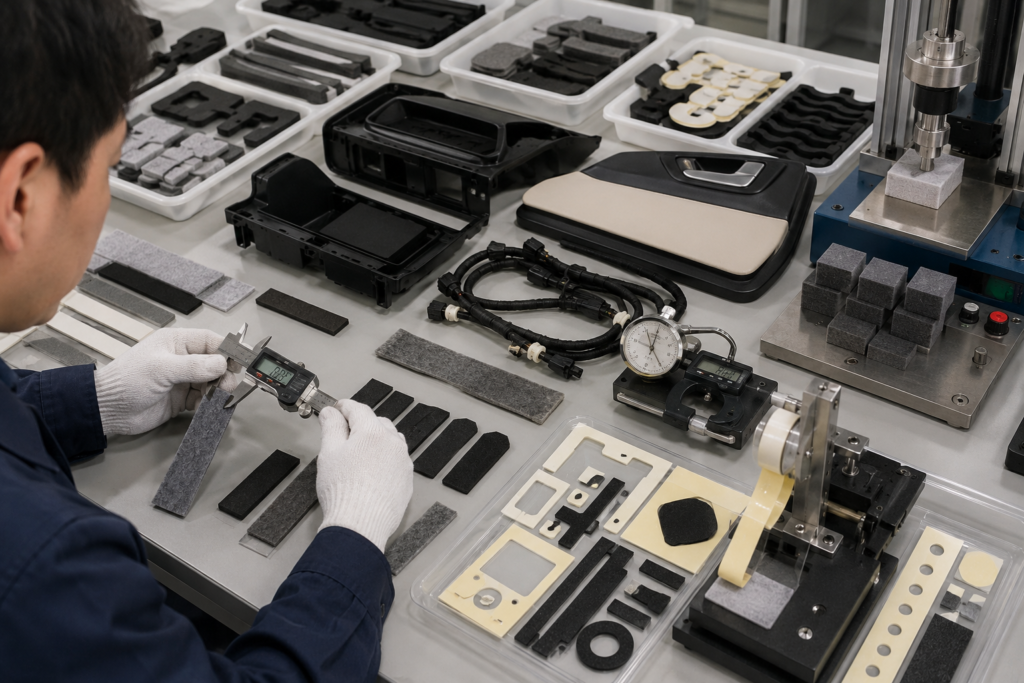
At Sanken, we use precision die cutting to manufacture foam pads, non-woven felt strips, rubber damping pads, adhesive-backed NVH parts, and laminated interior components for EV and automotive OEM assembly.
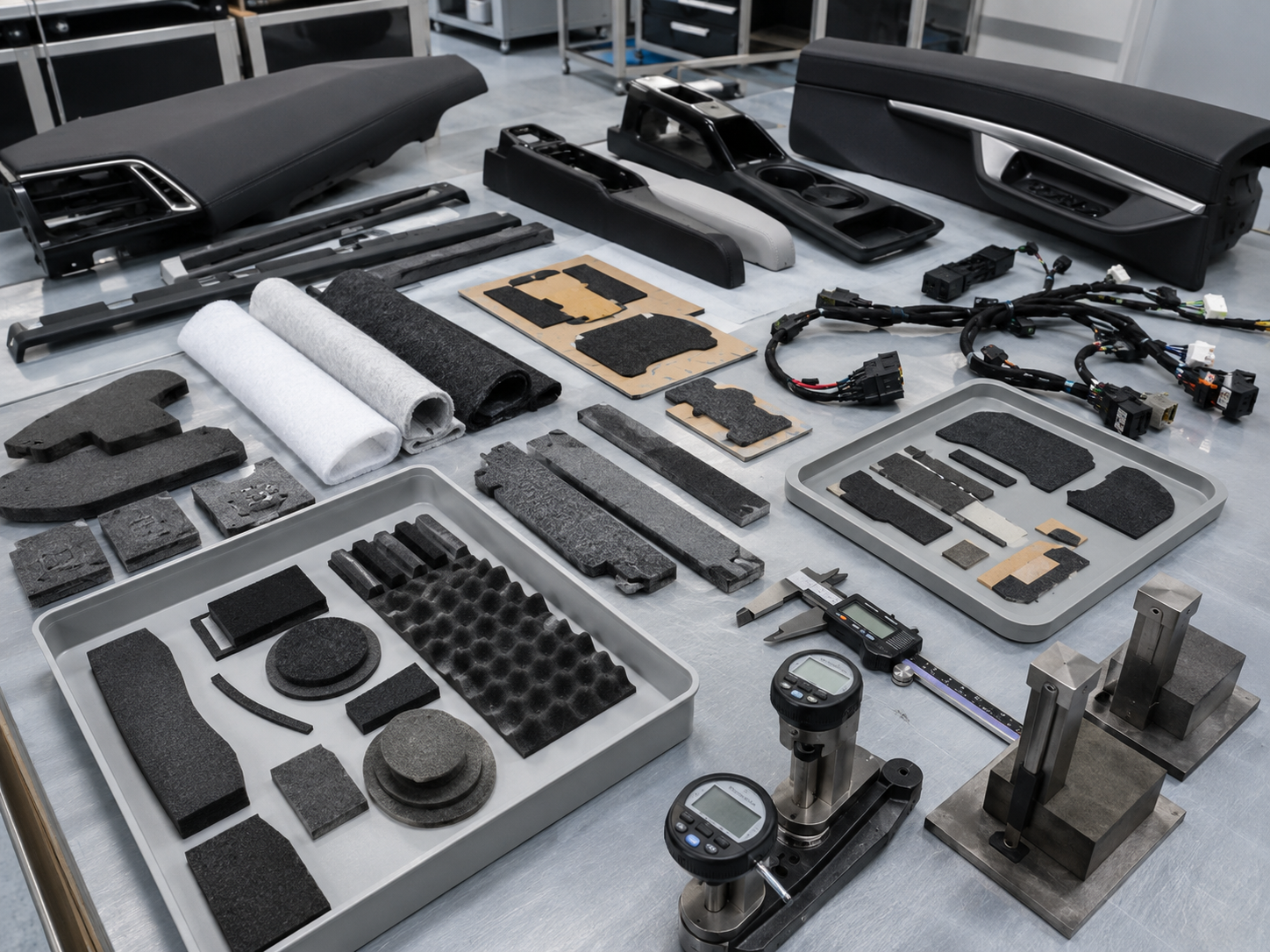
These parts are usually hidden behind dashboards, door panels, center consoles, seats, HVAC ducts, displays, and trim structures.
But they help decide whether the cabin feels quiet, solid, and premium.
Why EV Interiors Need NVH Die Cut Parts
NVH means noise, vibration, and harshness.
In EV interiors, NVH problems often come from hard parts touching each other, loose gaps, moving wire harnesses, vibrating trim panels, speaker areas, HVAC airflow, and electronic module contact points.
Common problems include:
| NVH Problem | Typical Cause |
|---|---|
| Rattle | Loose gap between trim or housing parts |
| Squeak | Friction between plastic, metal, or decorative surfaces |
| Buzz | Small part vibration under driving conditions |
| Harsh contact | Hard surfaces touching without cushioning |
| Wire harness noise | Cable movement against interior panels |
| Panel vibration | Poor damping or weak contact support |
For automotive die cut components, the purpose is not just to fill space.
The purpose is to control contact, movement, compression, and vibration inside the cabin.
Foam Parts for Gap Filling and Anti-Rattle Control
Foam is one of the most common materials used in EV interior NVH applications.
It compresses into gaps, cushions contact points, and helps reduce small vibrations between interior parts.
Common die cut foam NVH parts include:
- Foam anti-rattle pads
- Foam strips for dashboard gaps
- Adhesive-backed foam cushions
- Foam spacers around displays
- Foam seals around speaker areas
- Foam pads for center console contact points
- Foam cushioning parts for interior electronics
Foam is useful because it can be soft, lightweight, compressible, and easy to die cut into custom shapes.
For sealing and cushioning needs, foam gaskets and sealing components can support EV trim, door panels, electronic housings, HVAC ducts, and display assemblies.
The key is compression.
If the foam is too thin, it may not touch the contact area.
If it is too thick, the trim may not assemble correctly.
If it has poor recovery, the rattle may come back later.
Foam should solve the problem.
Not take a short vacation and disappear.
Felt Parts for Anti-Squeak and Surface Cushioning
Non-woven felt is often used where two surfaces may rub against each other.
It is especially useful for reducing squeaks caused by plastic-to-plastic, plastic-to-metal, or decorative trim contact.
Common die cut felt parts include:
| Application Area | Felt Part Function |
|---|---|
| Door panels | Anti-squeak and contact cushioning |
| Dashboard trim | Reduce surface friction noise |
| Center console | Prevent rubbing and small rattles |
| Seat trim | Cushion contact points |
| Wire harness areas | Reduce cable movement noise |
| HVAC duct contact areas | Reduce plastic contact noise |
| Decorative panels | Protect surfaces and reduce squeak |
Felt is soft, flexible, and easy to apply with adhesive backing.
It can reduce friction without adding too much thickness.
For EV interiors, this matters because small squeaks are not covered by engine noise.
They stand on stage.
And nobody invited them.
Rubber Parts for Stronger Vibration Damping
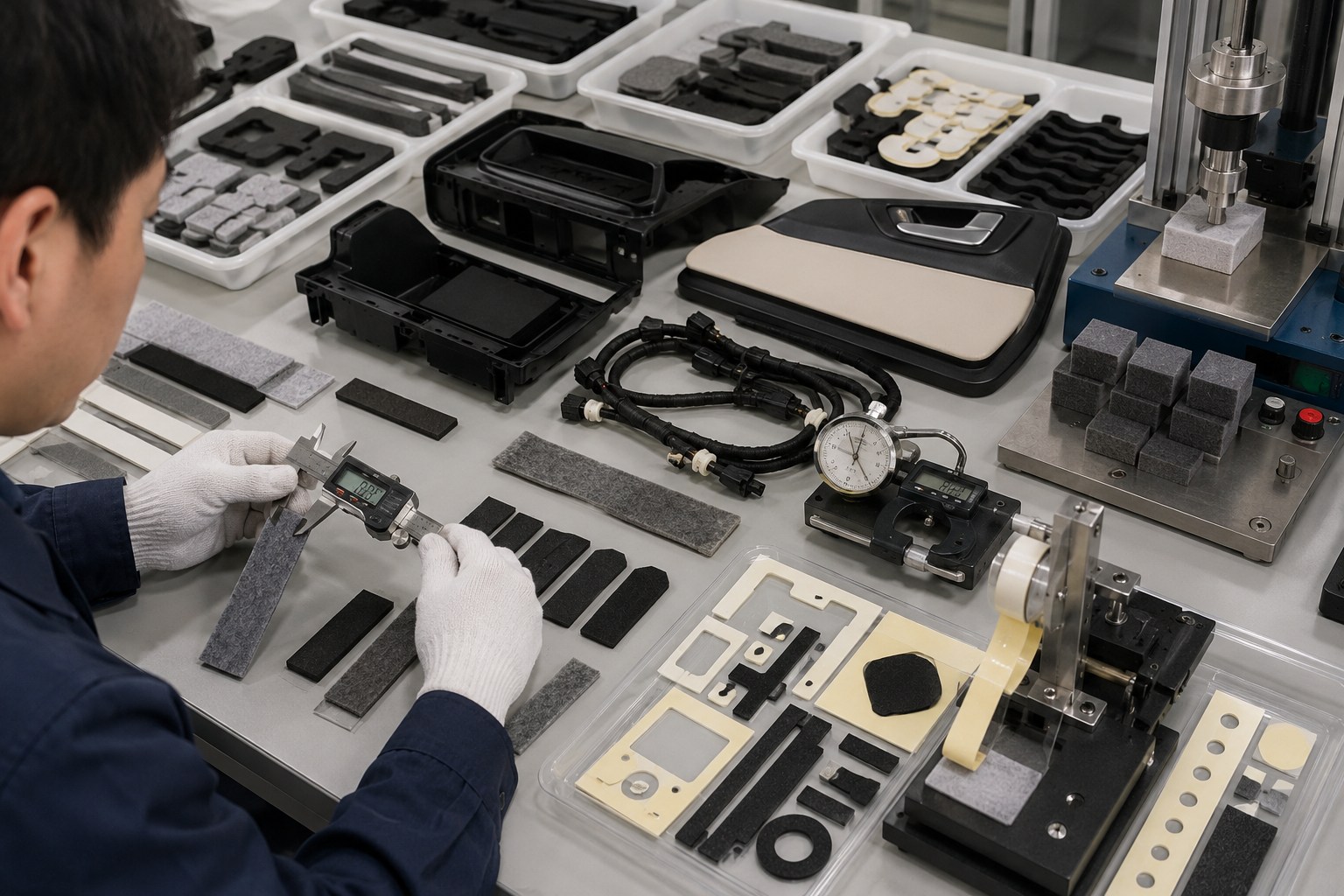
Rubber is used when EV interior components need stronger damping, impact resistance, or long-term support.
Compared with foam and felt, rubber is denser and usually better for stronger vibration control.
Common die cut rubber NVH parts include:
- Rubber damping pads
- Rubber cushioning washers
- Rubber anti-vibration pads
- Speaker vibration pads
- Motor or actuator damping parts
- Control module contact pads
- Protective rubber spacers
Rubber is useful when the vibration source is stronger or when the part needs better durability.
But rubber hardness must be selected carefully.
If the rubber is too hard, it may transfer vibration instead of absorbing it.
If it is too soft, it may lose support or deform too much.
The best rubber part is not always the thickest or hardest one.
It is the one that matches the actual vibration condition.
How Foam, Felt, and Rubber Work Together
Many EV interior NVH problems need more than one material.
Foam can fill the gap.
Felt can reduce squeak.
Rubber can damp stronger vibration.
Adhesive can keep everything in the right position.
In some projects, laminated materials are used to combine several functions in one die cut part.
Examples include:
| Laminated Structure | Purpose |
|---|---|
| Foam with adhesive backing | Cushioning and easy assembly |
| Felt with PSA backing | Anti-squeak and quick placement |
| Rubber with adhesive backing | Damping and stable positioning |
| Foam plus film plus adhesive | Cushioning, protection, and bonding |
| Felt plus adhesive plus release liner | Clean handling and manual application |
A good NVH design is not only about selecting one material.
It is about choosing the right material stack for the actual assembly condition.
Where These Parts Are Used in EV Interiors
Die cut foam, felt, and rubber parts are used throughout the EV cabin.
Common application areas include:
| EV Interior Area | Common Die Cut NVH Parts |
|---|---|
| Dashboard | Foam pads, felt strips, rubber contact pads |
| Door panels | Felt pads, foam strips, anti-rattle pads |
| Center console | Foam spacers, felt pads, adhesive cushions |
| Display area | Foam spacers, adhesive pads, black films |
| Wire harness area | Felt wraps, foam tape, cushioning pads |
| Seat trim | Felt anti-squeak pads, foam cushions |
| HVAC ducts | Foam seals, felt pads, rubber damping parts |
| Speaker areas | Foam sealing rings, rubber damping pads |
For display and trim-related areas, optical film die cut components may also be used with protective films, black light-blocking films, adhesive frames, and foam spacers.
The goal is to make each interior area quieter, better protected, and easier to assemble.
Adhesive Backing Matters
Most EV interior NVH parts need adhesive backing.
Without adhesive, the part may shift during assembly or vehicle use.
But adhesive selection must match the bonding surface.
EV interiors may include plastic, metal, fabric, rubber, foam, glass, painted parts, and textured decorative surfaces.
These surfaces do not bond the same way.
A good adhesive-backed NVH part should:
- Peel smoothly from the liner
- Stay flat before application
- Bond accurately to the target surface
- Resist lifting after heat and vibration
- Avoid adhesive overflow
- Support fast manual or automated assembly
For high-volume adhesive-backed parts, roll-to-roll die cutting can improve consistency, part spacing, waste removal, and delivery efficiency.
Die Cutting Process for EV NVH Parts
EV interior NVH parts are usually made through material converting, lamination, die cutting, waste removal, inspection, and packaging.
A typical process includes:
| Step | Purpose |
|---|---|
| Application review | Confirm noise source, gap, surface, and installation method |
| Material selection | Choose foam, felt, rubber, adhesive, or laminated material |
| Lamination | Add adhesive, liner, film, or backing layer if needed |
| Tooling design | Prepare die cutting tool based on drawing |
| Die cutting | Cut pads, strips, frames, or custom shapes |
| Kiss cutting | Keep adhesive-backed parts on release liner |
| Waste removal | Remove unused material cleanly |
| Inspection | Check size, thickness, edge, adhesive, and liner release |
| Packaging | Prevent deformation, dust, sticking, and missing parts |
For foam-related production details, buyers can review how die cutting works from foam rolls to finished parts.
Process control is important because soft materials can deform, stretch, tear, or shift during cutting if the tool and structure are not designed properly.
Quality Checks Before Mass Production
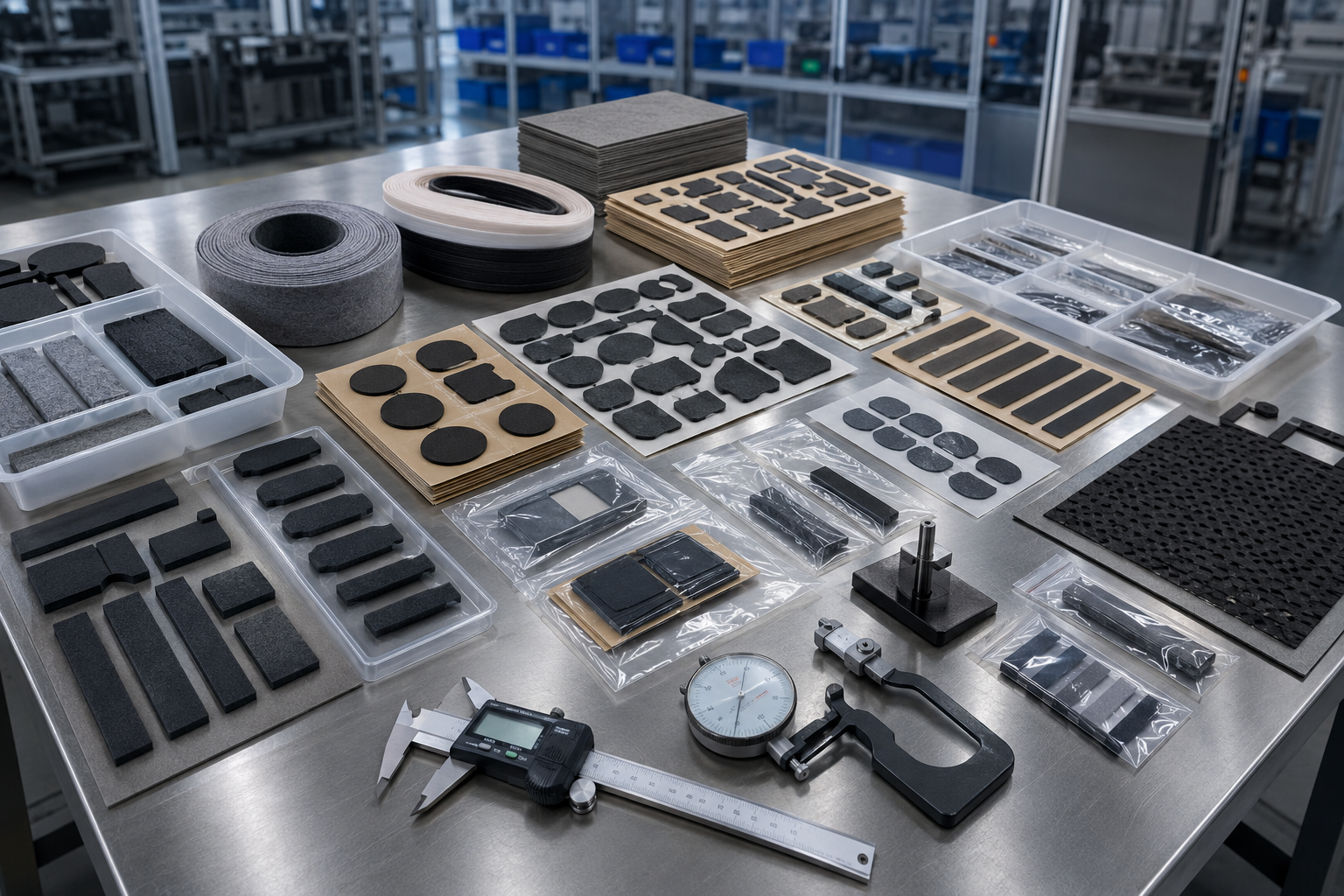
EV interior NVH parts must be stable from sample approval to mass production.
A small change in thickness, density, hardness, adhesive position, or edge quality can affect performance.
Important quality checks include:
| Inspection Item | Why It Matters |
|---|---|
| Dimensions | Ensures correct installation |
| Thickness | Controls compression and fit |
| Density or hardness | Affects damping and cushioning |
| Compression recovery | Supports long-term NVH performance |
| Edge quality | Reduces particles and poor contact |
| Adhesive position | Prevents lifting or shifting |
| Liner release | Improves assembly efficiency |
| Packaging condition | Prevents deformation before use |
For EV interiors, the approved sample is only the start.
The real target is stable repeat production.
How to Choose the Right NVH Material
Choosing foam, felt, or rubber should start with the actual problem.
Use foam when the main need is gap filling, cushioning, or anti-rattle control.
Use felt when the main need is anti-squeak or soft surface contact.
Use rubber when the main need is stronger vibration damping or durable impact support.
Useful project information includes:
- Drawing or sample
- EV interior application area
- Noise or vibration problem
- Material preference
- Thickness and tolerance
- Adhesive requirement
- Bonding surface
- Compression gap
- Temperature range
- Annual volume
- Delivery format
- Packaging preference
If the material is not confirmed, Sanken can help compare foam, non-woven felt, rubber, adhesive tape, and laminated structures before sampling.
For supplier selection, buyers can also review how to choose the right die cutting manufacturer before moving from prototype to production.
Need Die Cut Foam, Felt, or Rubber NVH Parts for EV Interiors?
Die cut foam, felt, and rubber parts improve EV interior NVH performance by reducing rattles, squeaks, vibration, harsh contact, and assembly noise.
But the final result depends on material selection, compression, adhesive backing, die cutting accuracy, inspection, and delivery format.
If you need custom die cut parts for OEM assembly, send us your drawing, sample, application location, noise or vibration issue, material requirement, adhesive structure, tolerance, annual volume, and packaging preference.
Sanken can help review material selection, lamination structure, die cutting method, inspection points, and delivery format before mass production.
Related Articles
You may also find these articles helpful:
- Why Vehicles Have Noise and Vibration Problems — and How Die Cut NVH Parts Help
- Where Are Die Cut Parts Used in Automotive Manufacturing?
- What Is Die Cutting in Automotive OEM Manufacturing? Materials, Process, and Applications
- How Automation Improves Precision Die Cutting for Automotive OEM Parts
- Custom Die Cut Foam Gaskets for Automotive Electronics
- Adhesive Backed Die Cut Components for OEM Assembly
- How Die Cutting Transforms Raw Materials Into Precision Components
Conclusion
Die cut foam, felt, and rubber parts help EV interiors feel quieter, more stable, and better built. Foam fills gaps and reduces rattles. Felt reduces squeaks and surface friction. Rubber damps stronger vibration. When these materials are selected and converted correctly, they improve NVH performance without complicating assembly.