
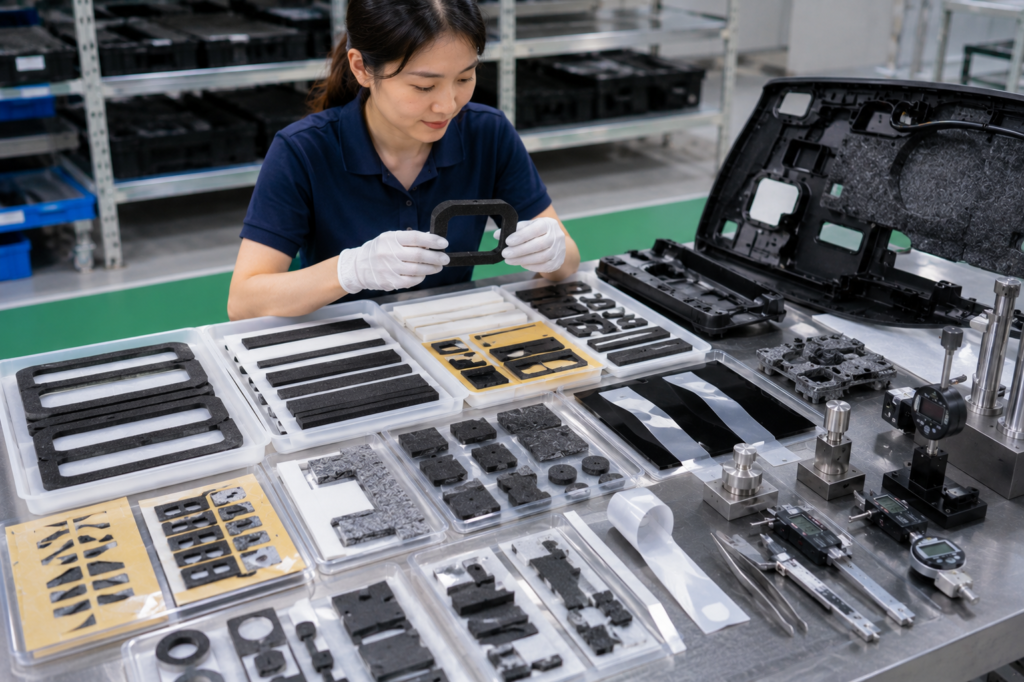
Choosing an automotive die cutting supplier is not only about finding someone who can cut a shape.
For OEM projects, die cut parts must fit the drawing, match the material requirement, survive the assembly process, and remain consistent from sampling to mass production.
A foam gasket may affect sealing.
A felt pad may reduce interior squeak.
A rubber pad may control vibration.
An adhesive tape frame may affect bonding accuracy.
A PET insulation film may protect an electronic area.
A black PET film may prevent display light leakage.
At Sanken, we use precision die cutting to manufacture custom foam, rubber, felt, adhesive tape, PET film, protective film, and laminated components for automotive OEM assembly.
The right supplier should understand both the part and the application.
Small component. Big responsibility.
Start With Automotive Application Experience
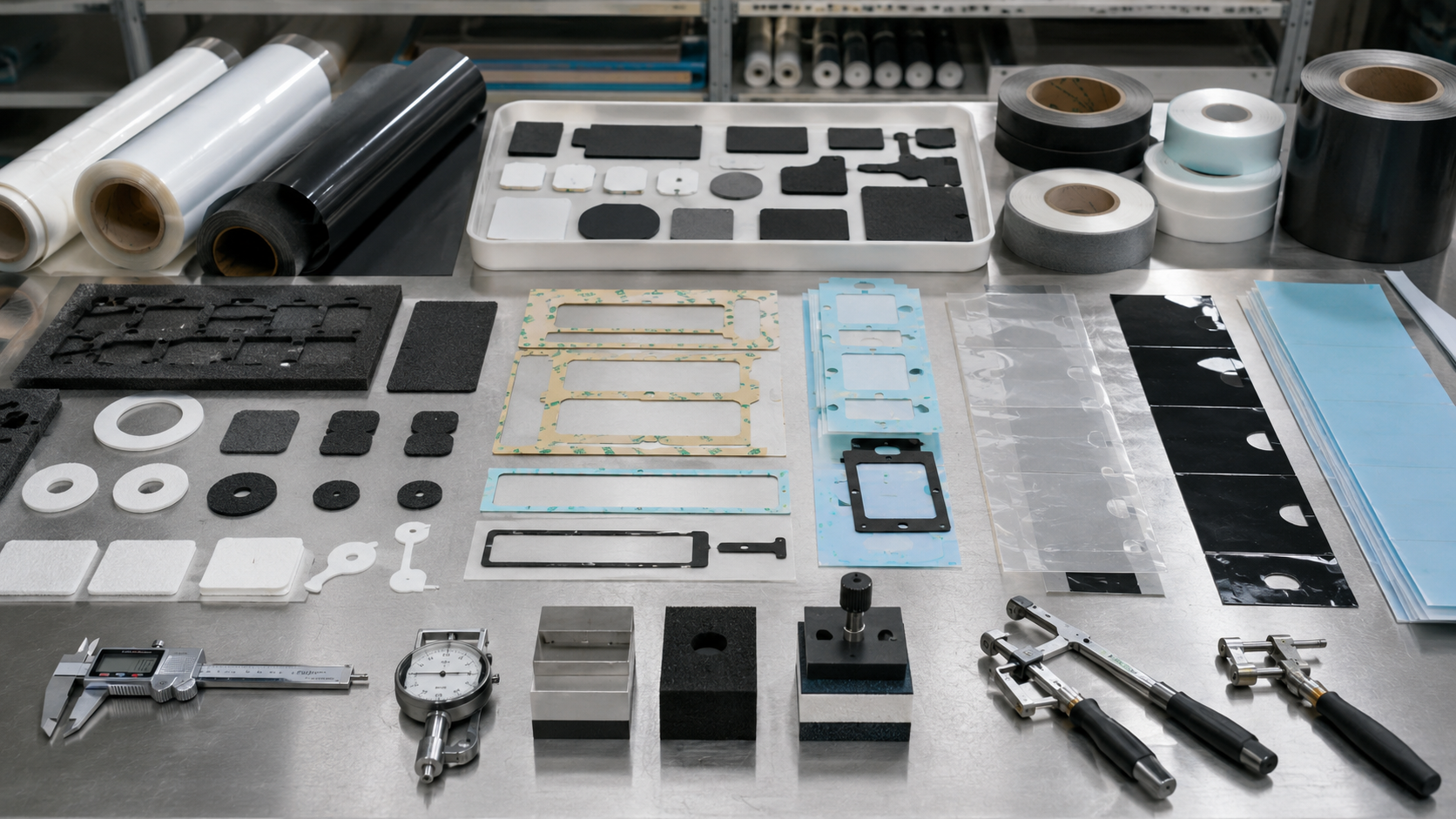
Automotive die cut parts are used in many areas of a vehicle.
Each area has different performance and assembly requirements.
| Automotive Area | Common Die Cut Components |
|---|---|
| Interior trim | Foam pads, felt strips, adhesive-backed cushioning parts |
| Door panels | Anti-rattle foam, felt pads, sealing strips |
| HVAC ducts | Foam seals, adhesive-backed foam strips |
| Automotive electronics | PET insulation films, foam gaskets, adhesive tape parts |
| Displays and sensors | Black PET films, protective films, adhesive frames |
| Wire harness areas | Felt pads, foam protection pads, adhesive-backed strips |
| Lighting areas | Foam gaskets, black PET films, protective films |
| Control modules | PET films, adhesive tapes, foam cushions |
A reliable supplier should ask about the application location before recommending material.
For automotive die cut components, the same material may behave differently depending on compression gap, bonding surface, temperature exposure, vibration, and assembly process.
A supplier who only asks for “material, size, quantity” may miss important engineering risks.
A supplier who asks about function, surface, tolerance, assembly method, and packaging is usually more valuable.
Check Material Capability
Automotive OEM projects often require multiple material types.
A supplier should be able to process different materials and help compare options when the material is not fully confirmed.
| Material | Common Automotive Use |
|---|---|
| EVA foam | Cushioning and impact protection |
| PE foam | Gap filling and light sealing |
| PU foam | Soft contact and cushioning |
| EPDM foam | Sealing, anti-rattle, and durable compression |
| Rubber | Vibration damping and contact protection |
| Non-woven felt | Anti-squeak and friction control |
| Adhesive tape | Bonding, positioning, and assembly support |
| PET insulation film | Electronic area protection |
| Black PET film | Light blocking for displays and sensors |
| Protective film | Surface protection during handling |
For sealing and cushioning, foam gaskets and sealing components are commonly used because foam can compress into gaps and match custom shapes.
Material capability is not only about what the supplier can buy.
It is about whether the supplier understands how to laminate, die cut, inspect, package, and deliver the material correctly.
Review Adhesive Converting Experience
Many automotive die cut parts use pressure-sensitive adhesive backing.
Adhesive-backed parts are easier to position during assembly, but they also create risks if the adhesive does not match the bonding surface.
Common automotive bonding surfaces include:
- Textured plastic
- Painted metal
- PET film
- Rubber
- Foam
- Glass
- Coated panels
- Fabric-backed trim
- Electronic housings
These surfaces do not bond the same way.
A reliable supplier should review adhesive type, liner release, peel behavior, assembly pressure, storage condition, and temperature exposure.
For adhesive-related issues, buyers can review why die cut adhesive parts fail after assembly.
The strongest adhesive is not always the right adhesive.
The correct adhesive should match the surface, shape, process, and product life.
Confirm Process Capability
A good automotive die cutting supplier should have more than one cutting method or converting process.
Different materials and part designs may require different process choices.
| Process Capability | Why It Matters |
|---|---|
| Lamination | Combines foam, tape, film, felt, or liner layers |
| Flatbed die cutting | Useful for sheets, thicker materials, and custom shapes |
| Rotary die cutting | Supports roll-to-roll production and high-volume parts |
| Kiss cutting | Keeps adhesive-backed parts on release liner |
| Slitting and rewinding | Prepares roll materials for converting |
| Waste removal | Controls edge cleanliness and production stability |
| Sheet, roll, or kit supply | Matches OEM assembly method |
For high-volume adhesive-backed foam, felt, tape, and film parts, roll-to-roll die cutting can improve liner control, part spacing, waste removal, and repeatability.
For sample development or thicker parts, process selection should be reviewed based on material thickness, tolerance, and part structure.
The best process is the one that fits the material and production volume.
Not the one that is easiest for the supplier.
Evaluate Engineering Support Before Tooling
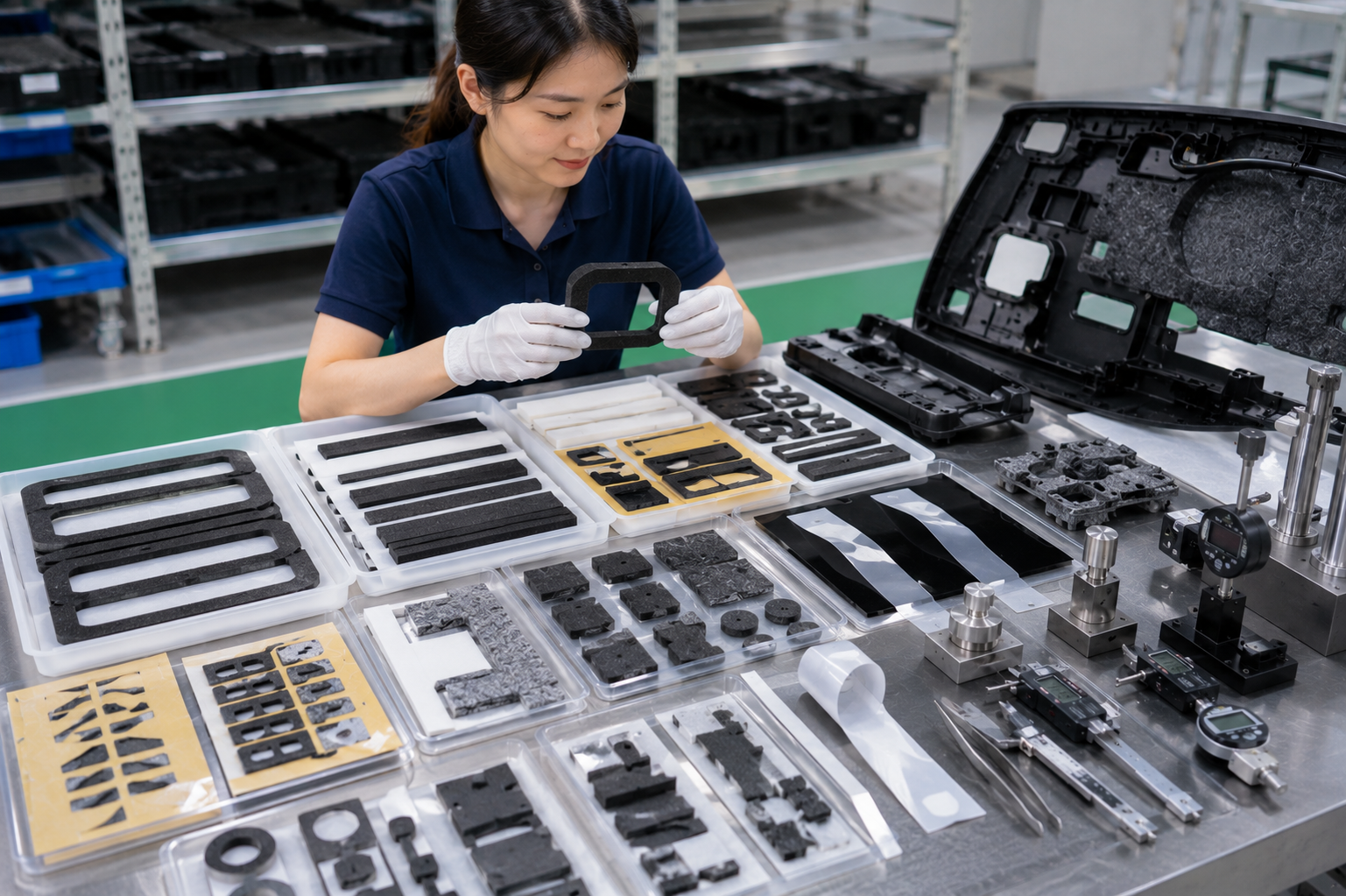
A reliable supplier should help identify risks before tooling and mass production.
Engineering support may include:
| Engineering Review Item | Why It Matters |
|---|---|
| Minimum width | Prevents tearing, stretching, or weak bonding |
| Corner radius | Reduces edge lifting and stress concentration |
| Hole-to-edge distance | Improves cutting stability |
| Compression gap | Helps choose foam thickness and density |
| Adhesive coverage | Prevents weak bonding or glue overflow |
| Liner and pull tab design | Improves peeling and assembly handling |
| Packaging method | Prevents deformation, dust, and missing parts |
For adhesive-backed parts and protective films, buyers can also review Die Cut vs Kiss Cut because delivery on liner can strongly affect assembly efficiency.
A supplier should not say “yes” to every drawing without review.
Sometimes the most useful supplier is the one who says:
“This narrow area may tear during peeling.”
That feedback can save time before mass production.
Check Tolerance and Quality Control
Automotive components need stable quality from sample approval to production.
Tolerance control should match the function of each part.
| Component Type | Key Quality Focus |
|---|---|
| Foam gasket | Thickness, compression, dimensions, edge quality |
| Felt pad | Thickness, fiber stability, adhesive position |
| Rubber pad | Hardness, thickness, shape, surface quality |
| Adhesive tape frame | Adhesive position, liner release, peel behavior |
| PET insulation film | Hole alignment, cleanliness, edge quality |
| Black PET film | Window accuracy, surface cleanliness, flatness |
| Protective film | Clean removal, pull tab, surface cleanliness |
A good inspection plan should not use the same focus for every material.
Foam needs compression review.
Adhesive tape needs liner and peel review.
Black PET film needs visual cleanliness and window accuracy.
PET insulation film needs coverage and edge quality.
For tolerance-related background, buyers can review why tolerance control can make or break die cut components.
Ask About Sampling and Trial Production
Automotive OEM projects often require sampling before mass production.
A reliable supplier should support sample making, design feedback, material comparison, and small-batch trial production.
A good sampling process should review:
- Drawing accuracy
- Material selection
- Adhesive bonding surface
- Compression behavior
- Peeling and liner release
- Assembly fit
- Packaging method
- Inspection criteria
- Potential mass production risks
A sample should not only look correct on a desk.
It should be tested in the real assembly position.
A foam pad may look good before compression.
A tape frame may look good before peeling.
A black PET frame may look good before light testing.
The assembly tells the truth.
Packaging and Delivery Format Matter
Automotive die cut parts can be damaged or become difficult to use if packaging is not planned correctly.
Soft foam can be compressed.
Felt can collect dust.
Adhesive tape can shift or stick.
Protective film can scratch.
PET film can curl.
Rubber pads can deform.
Common supply formats include:
| Supply Format | Suitable Use |
|---|---|
| Individual pieces | Simple or lower-volume assembly |
| Sheets | Manual picking and organized production |
| Rolls | High-volume or automated application |
| Kiss-cut on liner | Adhesive-backed parts and films |
| Pull-tab format | Easier peeling and placement |
| Kits | Multi-part module assembly |
| Clean trays or bags | Parts needing deformation or dust protection |
For assembly planning, buyers can review how die cut parts are supplied in sheets, rolls, or kits.
Good packaging protects the part before the part protects the vehicle assembly.
Supply Stability and Communication
A reliable automotive die cutting supplier should communicate clearly during quotation, sampling, production, and shipment.
Engineers and buyers should check whether the supplier can support:
- Drawing review
- Material comparison
- Adhesive selection
- Sample feedback
- Tooling discussion
- Production timeline control
- Quality documentation
- Packaging confirmation
- Engineering change support
- Batch-to-batch consistency
Automotive projects often change during development.
A supplier that responds clearly and understands the part function can reduce delays and misunderstandings.
Low price is helpful.
Clear communication prevents expensive surprises.
Supplier Evaluation Checklist
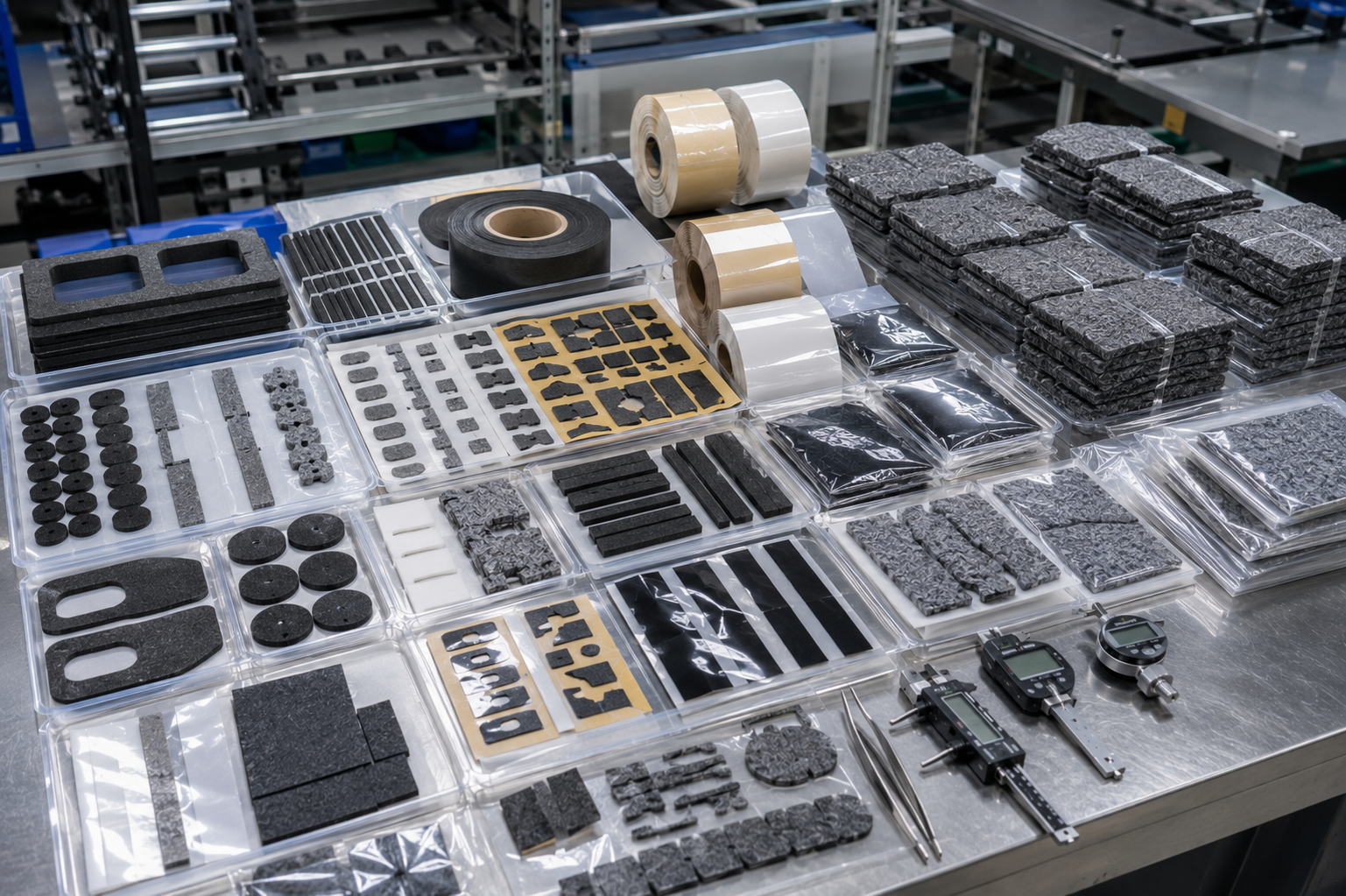
Before choosing an automotive die cutting supplier, engineers and buyers can use this checklist.
| Checklist Item | What to Confirm |
|---|---|
| Automotive experience | Does the supplier understand vehicle interior, electronics, sealing, NVH, or film applications? |
| Material range | Can they process foam, rubber, felt, adhesive tape, PET film, and protective film? |
| Converting process | Can they support lamination, die cutting, kiss cutting, and roll-to-roll converting? |
| Engineering review | Do they provide manufacturability feedback before tooling? |
| Adhesive support | Do they review bonding surface and liner release? |
| Quality control | Do inspections match the component function? |
| Packaging | Can they supply sheets, rolls, kits, or kiss-cut liner formats? |
| Sampling | Can they support trial samples and design changes? |
| Communication | Do they respond clearly and document requirements? |
| Production stability | Can they maintain repeatable batch quality? |
For broader supplier selection, buyers can also review how to choose the right die cutting manufacturer for your OEM project.
What Buyers Should Provide Before Quotation
To help the supplier recommend the right solution, buyers should prepare clear project details.
Useful information includes:
- 2D drawing or sample
- Automotive application location
- Main function
- Material preference
- Thickness and tolerance
- Foam density or rubber hardness requirement
- Adhesive requirement
- Bonding surface
- Compression gap
- Temperature exposure
- Cleanliness requirement
- Manual or automated assembly
- Annual volume
- Delivery format
- Packaging preference
- Testing or validation requirement
If the material is not confirmed, Sanken can help compare foam, rubber, felt, adhesive tape, PET film, protective film, black PET film, release liner, and laminated structures.
Need a Reliable Automotive Die Cutting Supplier?
A reliable automotive die cutting supplier should understand materials, applications, die cutting processes, adhesive behavior, tolerance control, inspection, packaging, and production repeatability.
If you need foam gaskets, felt anti-squeak pads, rubber damping pads, adhesive tape frames, PET insulation films, black PET light-blocking films, protective films, or laminated automotive components, send us your drawing, sample, application location, material requirement, tolerance, annual volume, and packaging preference.
Sanken can help review material selection, lamination structure, die cutting method, quality control points, and supply format before mass production.
Related Articles
You may also find these articles helpful:
- How to Choose the Right Die Cutting Manufacturer for Your OEM Project
- How Purchasing Managers Can Qualify a Die-Cutting Supplier
- What Is Die Cutting in Automotive OEM Manufacturing? Materials, Process, and Applications
- Where Are Die Cut Parts Used in Automotive Manufacturing?
- How Die Cut Foam, Felt, and Rubber Parts Reduce Vibration in Automotive Interiors
- How to Choose Die Cut NVH Materials for Automotive Interior Vibration Control
- Why Tolerance Control Can Make or Break Die Cut Components
Conclusion
Choosing a reliable automotive die cutting supplier requires more than comparing prices. Engineers and buyers should review application experience, material capability, adhesive converting knowledge, process capability, tolerance control, sampling support, quality inspection, packaging, delivery format, and communication. The right supplier helps reduce assembly risk, improve part consistency, and support smoother OEM production from prototype to mass production.