
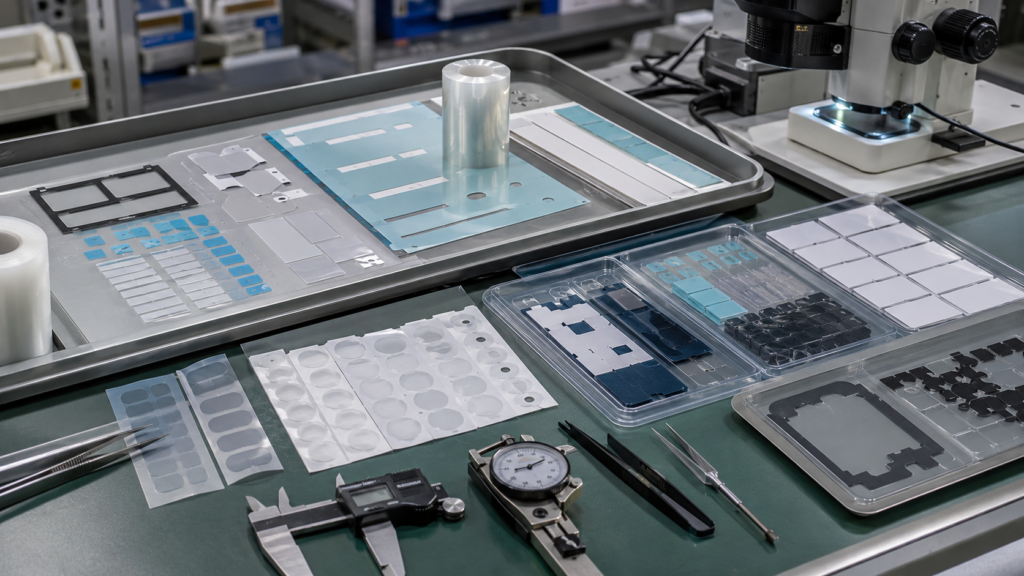
Custom die-cut PET insulation films are used in many electronic components because they are thin, stable, lightweight, and easy to convert into precise shapes.
They help protect batteries, PCBs, connectors, sensors, display modules, control panels, power modules, and electronic housings from electrical contact, scratches, dust, and assembly damage.
At Sanken, we use precision die cutting to convert PET film, adhesive-backed PET film, protective film, release liner, and laminated PET structures into custom insulation parts for OEM electronics assembly.
Choosing the right PET insulation film is not only about material name.
It is about thickness, adhesive structure, bonding surface, tolerance, cleanliness, liner release, packaging, and how the part will be used on the production line.
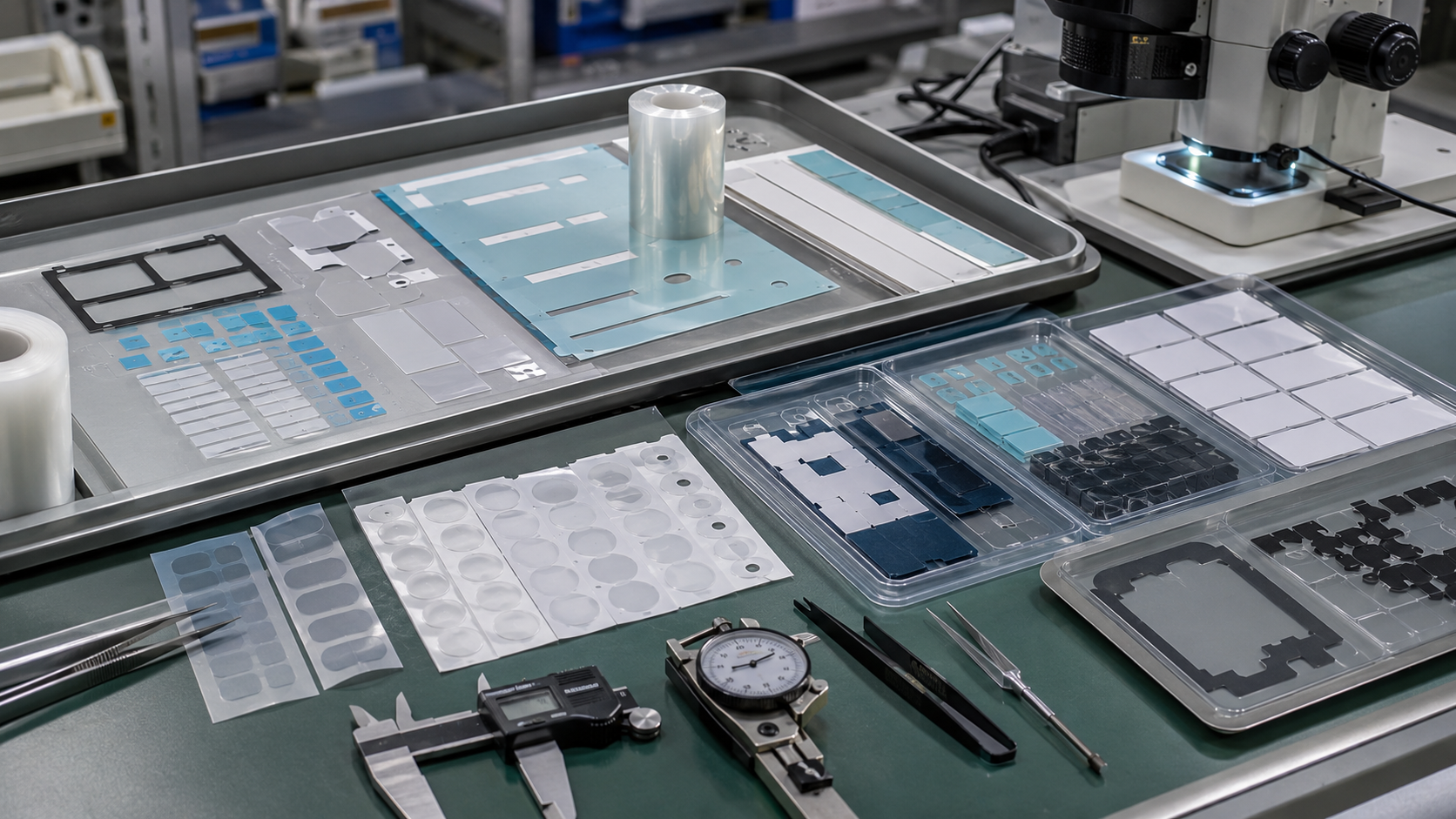
Start With the Application Area
Before choosing PET film thickness or adhesive, confirm where the part will be used.
Different electronic components need different PET film structures.
| Application Area | PET Film Function |
|---|---|
| Battery components | Cell, tab, busbar, and module insulation |
| PCB areas | Electrical separation and surface protection |
| Connectors | Contact protection and insulation |
| Sensors | Dust protection and insulation support |
| Display modules | Insulation, backing protection, and light-control support |
| Control panels | Electrical separation and surface protection |
| Power modules | Component separation and protective covering |
| Housings | Scratch protection and internal spacing |
For electronic projects, custom die cut parts are usually designed around the exact component layout.
The PET film must cover the right area.
Almost right is not enough when insulation is involved.
Choose the Right PET Film Thickness
Thickness affects insulation coverage, fit, flexibility, handling, and assembly space.
If the PET film is too thin, it may not provide enough protection for the application.
If it is too thick, it may interfere with assembly or create fitting problems.
Important thickness questions include:
- What space is available inside the component?
- Does the part need to bend or stay flat?
- Does it need adhesive backing?
- Is total laminated thickness controlled?
- Is the film used near a moving or compressed area?
- Is the tolerance based on raw material thickness or finished part thickness?
| Thickness Factor | Why It Matters |
|---|---|
| Film thickness | Controls insulation layer and fit |
| Adhesive thickness | Changes total finished part height |
| Liner thickness | Affects handling before assembly |
| Laminated thickness | Controls final component stack-up |
| Thickness tolerance | Supports stable repeat production |
For compact electronic components, even a small thickness change can affect fitting.
A PET film should protect the part without making the assembly harder.
Decide Whether Adhesive Backing Is Needed
Many custom PET insulation films are supplied with pressure-sensitive adhesive backing.
Adhesive helps operators place the insulation part quickly and keep it in position during assembly.
Common adhesive PET structures include:
| PET Film Structure | Common Use |
|---|---|
| PET film without adhesive | Loose insulation layer or separator |
| PET film with PSA backing | Easy positioning and bonding |
| PET film with release liner | Clean handling before assembly |
| PET film with pull tab | Easier manual peeling |
| PET film with protective layer | Surface protection during handling |
| PET plus adhesive plus liner | Assembly-ready insulation part |
Adhesive selection must match the bonding surface.
Plastic, metal, coated surfaces, glass, film, and battery materials do not bond the same way.
A good adhesive-backed PET film should peel smoothly, stay flat, bond accurately, and avoid adhesive overflow.
For adhesive failure risks, buyers can review why die cut adhesive parts fail after assembly.
Match the PET Film to the Bonding Surface
The bonding surface has a major effect on adhesive performance.
Before choosing adhesive-backed PET film, confirm the real surface material and condition.
| Bonding Surface Detail | Why It Matters |
|---|---|
| Surface material | Different materials need different adhesive types |
| Surface texture | Rough or curved surfaces may reduce bonding area |
| Surface cleanliness | Dust or oil can cause lifting |
| Coating or paint | Coated surfaces may affect adhesion |
| Assembly pressure | Adhesive needs proper contact pressure |
| Working environment | Heat, humidity, and vibration may affect long-term bonding |
If the surface is unknown, sample testing is important.
A PET film that bonds well to one plastic may not bond well to another plastic.
The adhesive wants the full story.
Check Shape, Holes, Slots, and Minimum Width
PET insulation films are often die cut into complex shapes.
They may include holes, slots, windows, narrow strips, tabs, or frame structures.
Good design helps reduce cutting problems and assembly failure.
Important design points include:
| Design Point | Why It Matters |
|---|---|
| Outer shape | Controls insulation coverage |
| Hole position | Supports accurate assembly |
| Slot design | Prevents tearing or distortion |
| Minimum width | Reduces deformation during die cutting |
| Corner radius | Improves edge stability |
| Pull tab | Makes peeling and placement easier |
| Part spacing on liner | Improves operator handling |
Sharp corners may look good in a drawing.
But rounded corners are often better for die cutting, peeling, and long-term stability.
A small corner can cause a big lift.
Very dramatic for such a tiny feature.
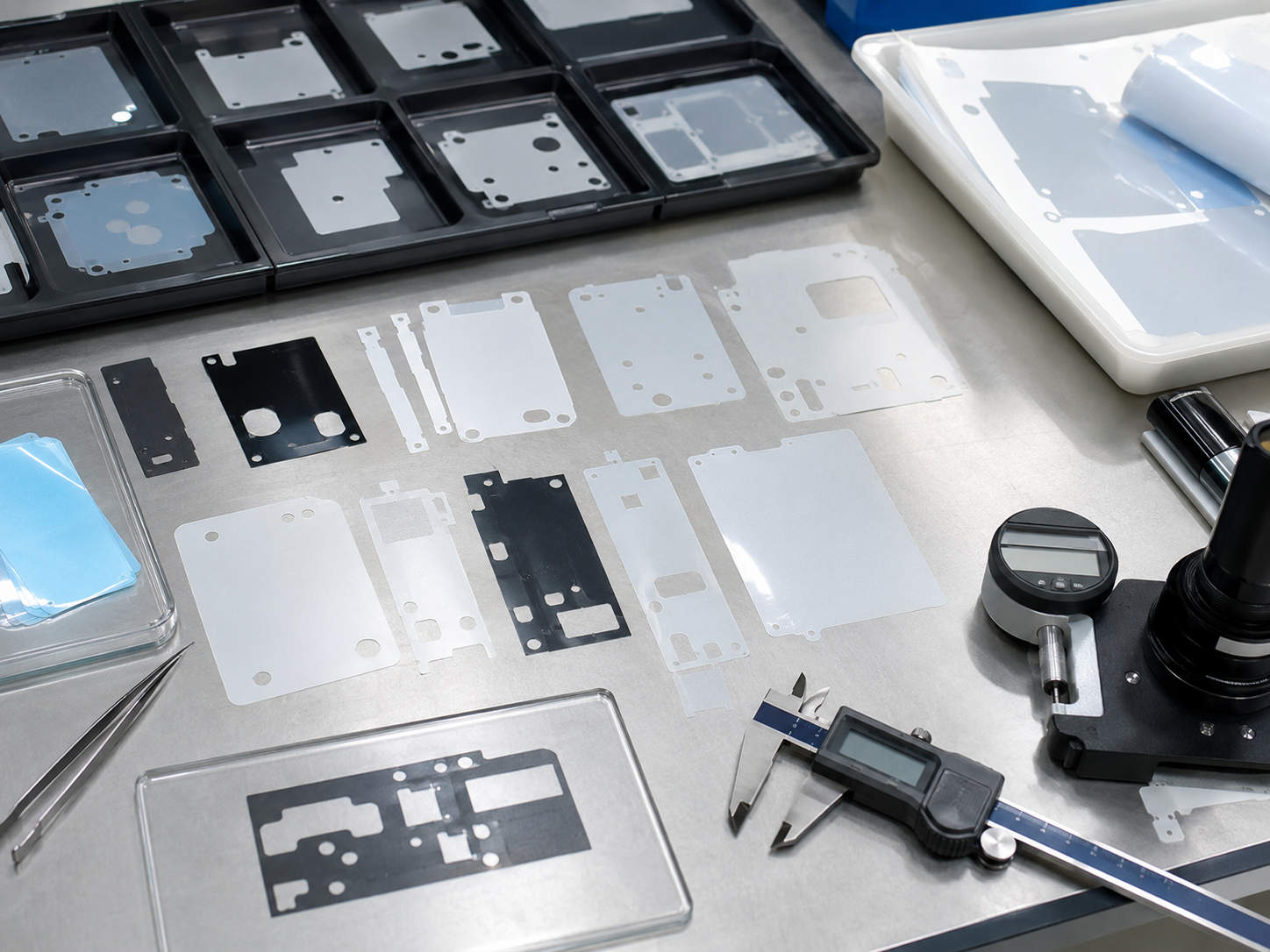
Control Tolerance and Dimensional Accuracy
Electronic components often have limited space.
PET insulation films must fit accurately around screw holes, connectors, tabs, busbars, PCB areas, and display structures.
Important dimensional checks include:
- Outer dimension
- Inner cutout size
- Hole diameter
- Hole-to-edge distance
- Slot width
- Corner radius
- Part orientation
- Adhesive position
- Overall flatness
For PET insulation parts, tolerance should match the real assembly need.
Overly loose tolerance may cause fitting or coverage problems.
Overly tight tolerance may increase tooling difficulty and cost.
The best tolerance is practical, measurable, and connected to the actual risk.
Consider Cleanliness Requirements
PET films used in electronics should be clean, flat, and well protected.
Dust, scratches, particles, adhesive residue, curling, or burrs can affect electronic assembly.
This is especially important for display modules, sensors, control panels, battery components, and visible electronic interfaces.
Key cleanliness controls include:
| Cleanliness Factor | Why It Matters |
|---|---|
| Edge quality | Reduces burrs and particles |
| Surface cleanliness | Protects electronic areas |
| Film flatness | Improves handling and placement |
| Packaging cleanliness | Prevents contamination before use |
| Liner condition | Affects peeling and adhesive surface quality |
For display-related projects, optical film die cut components often require stricter surface protection and packaging control.
A perfect shape with dust on it is still a rejected part.
Choose the Right Die Cutting and Delivery Format
PET insulation films can be supplied in several formats depending on the assembly process.
| Delivery Format | Suitable Use |
|---|---|
| Individual pieces | Simple assembly or low-volume production |
| Sheets | Manual picking and organized assembly |
| Rolls | Automated or high-volume application |
| Kiss-cut on liner | Adhesive-backed PET insulation films |
| Pull-tab format | Easier manual peeling and positioning |
| Kits | Multi-part electronic module assembly |
| Clean trays or bags | Parts needing scratch and dust protection |
For high-volume PET film parts, roll-to-roll die cutting can improve production consistency and efficiency.
For adhesive-backed PET films, kiss cutting is often useful because the PET part remains on the release liner until assembly.
For assembly planning, buyers can also review how die cut parts are supplied in sheets, rolls, or kits.
Good delivery format reduces missing parts, difficult peeling, film curling, scratches, and production delays.
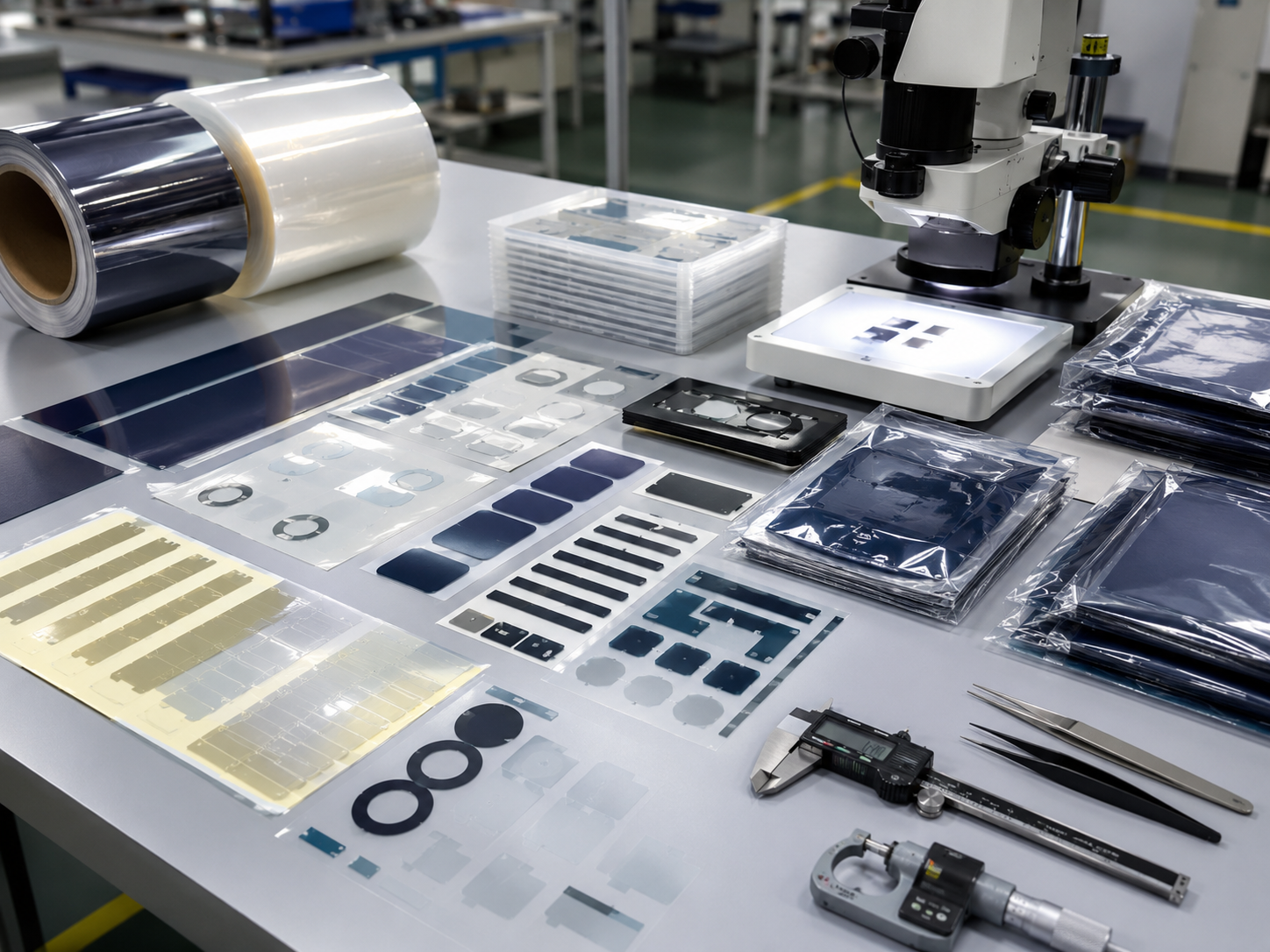
Review Quality Control Before Mass Production
Sample approval is only the beginning.
The real goal is stable repeat production.
Important inspection points include:
| Inspection Item | Why It Matters |
|---|---|
| Dimensions | Ensures correct insulation coverage |
| Thickness | Controls fit and stack height |
| Hole alignment | Supports accurate assembly |
| Edge quality | Reduces burrs and particles |
| Surface cleanliness | Protects electronic components |
| Adhesive position | Prevents shifting or bonding failure |
| Liner release | Improves peeling and placement |
| Curling control | Keeps films flat during assembly |
| Packaging condition | Prevents scratches and deformation |
For battery, PCB, connector, and sensor applications, PET insulation parts should be checked before mass production to avoid assembly risk.
The film is thin.
The responsibility is not.
What Buyers Should Provide Before Quotation
To recommend the right custom die-cut PET insulation film, we usually need clear project details.
Helpful information includes:
- Drawing or sample
- PET film thickness
- PET color or surface requirement
- Adhesive requirement
- Release liner requirement
- Bonding surface
- Application location
- Electrical insulation requirement
- Temperature range
- Cleanliness requirement
- Tolerance
- Annual volume
- Delivery format
- Packaging preference
- Validation standard
If the material is not confirmed, Sanken can help compare PET film thickness, adhesive structures, protective films, release liners, and laminated PET insulation solutions.
For supplier selection, buyers can also review how to choose the right die cutting manufacturer before moving from sampling to mass production.
Need Custom Die-Cut PET Insulation Films?
Custom die-cut PET insulation films help electronic components improve insulation coverage, protection, assembly accuracy, bonding stability, and production efficiency.
But the final result depends on PET thickness, adhesive backing, bonding surface, tolerance, cleanliness, liner release, die cutting accuracy, and packaging.
If you need die cut PET insulation films, adhesive-backed PET parts, protective PET films, or laminated PET structures, send us your drawing, sample, PET film requirement, adhesive structure, tolerance, application location, annual volume, and packaging preference.
Sanken can help review material selection, lamination structure, die cutting method, inspection points, and delivery format before mass production.
Related Articles
You may also find these articles helpful:
- What Is PET Film Used For in Electrical Insulation?
- Custom Die-Cut PET Insulation Films for Electronics Assembly
- Why Is PET Film Commonly Used in Electronics?
- Can PET Film Be Laminated With Adhesives?
- Die Cut PET Insulation Films for Battery and Electronics
- Why Insulation Films Must Be Precision Die Cut for Electronics
- What Industries Use Custom PET Film Die Cutting?
Conclusion
Choosing custom die-cut PET insulation films for electronic components requires more than selecting a film thickness. Buyers should review the application area, insulation coverage, adhesive backing, bonding surface, tolerance, cleanliness, delivery format, and packaging. When these details are controlled early, PET insulation films can support safer, cleaner, and more stable OEM electronics assembly.