
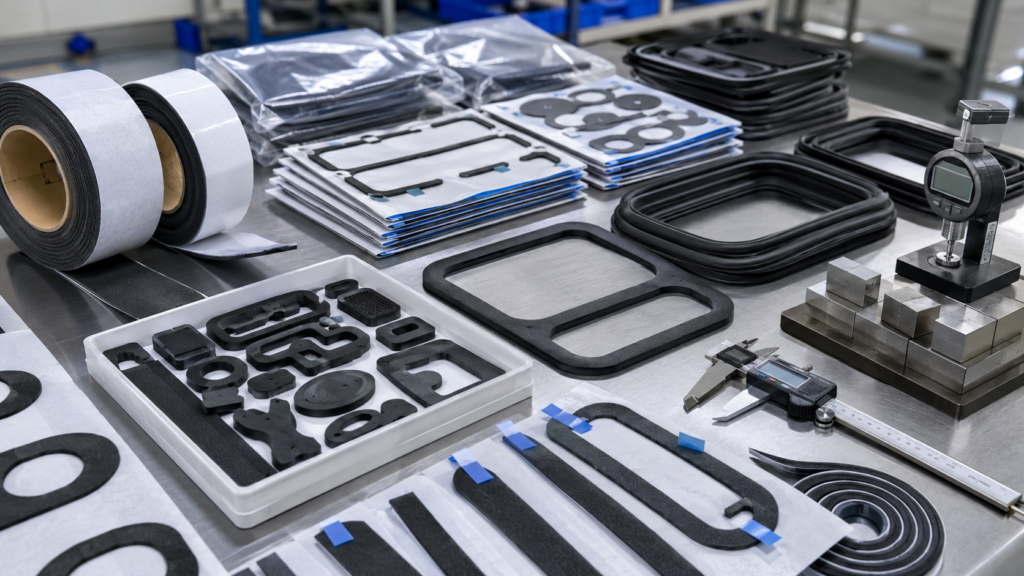
Automotive waterproofing and dust sealing are not solved by shape alone.
A gasket may look correct on a drawing, but still fail if the foam is too soft, the adhesive is wrong, the compression gap is unstable, or the edge quality is poor.
At Sanken, we manufacture precision die cutting components for automotive OEM and Tier supplier projects. We convert foam, rubber, EPDM foam, adhesive tape, PET film, PI film and laminated materials into sealing, cushioning, insulation and assembly-ready parts.
For waterproofing and dust sealing, the right die cut gasket must do three things well:
It must fit.
It must compress.
It must stay reliable after assembly.
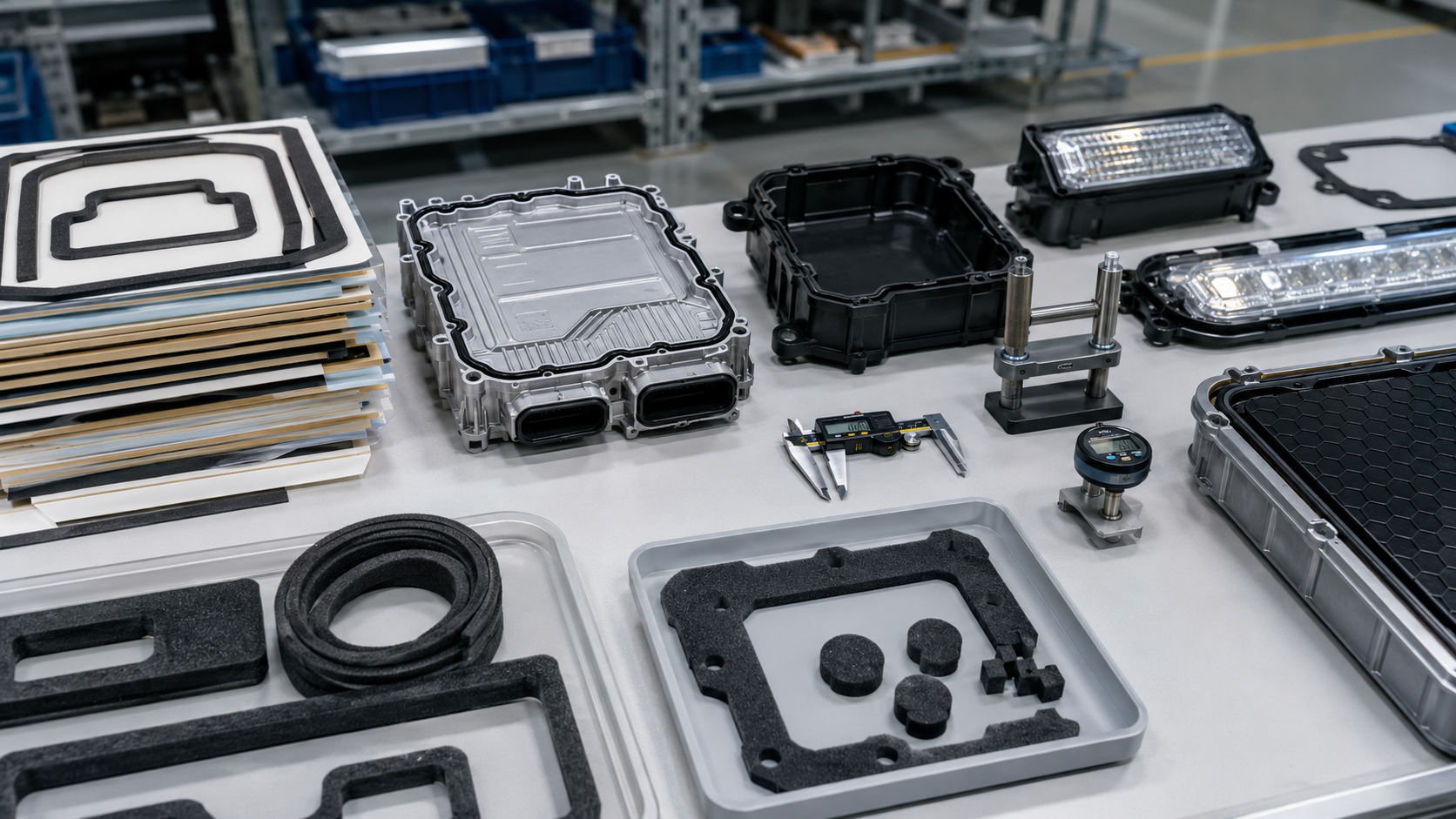
Where Are Automotive Sealing Gaskets Used?
Die cut gaskets are used in many hidden automotive areas.
They help prevent dust, moisture, air leakage, vibration, rattling and surface contact damage.
Common applications include:
| Automotive Area | Gasket Function |
|---|---|
| ECU housings | Dust sealing and vibration cushioning |
| EV battery packs | Sealing, insulation support and compression control |
| Lighting modules | Dust and moisture protection |
| HVAC systems | Air sealing and noise reduction |
| Door systems | Gap filling and anti-rattle support |
| Camera and sensor modules | Dust sealing and positioning support |
| Interior trim | Cushioning, NVH control and surface protection |
| Wire harness areas | Protection and abrasion reduction |
For vehicle projects, automotive die cut components often need to support sealing and assembly performance at the same time.
A gasket is not just a soft ring.
It is a functional part inside the vehicle system.
Start With the Sealing Requirement
Before choosing gasket material, we first ask what the gasket must seal against.
Waterproofing and dust sealing are different.
A gasket for dust protection may not need the same compression force as a gasket used near moisture exposure.
A gasket used inside an ECU housing may have different requirements from a gasket used around a lighting module or battery enclosure.
Important questions include:
- Is the gasket used for dust, water, air or noise control?
- Is the gasket inside or outside the vehicle?
- What is the compression gap?
- What surfaces will the gasket contact?
- Does the gasket need adhesive backing?
- What temperature range will it face?
- Will it be manually assembled or automatically applied?
- How long should the sealing performance last?
If these questions are not answered early, the first sample may look fine but fail later.
That is the expensive way to learn.
Choose the Right Gasket Material
The material decides the basic sealing behavior.
Different foam and rubber materials are used for different automotive gasket needs.
| Material | Best Used For | Key Advantage |
|---|---|---|
| EPDM foam | Automotive dust sealing, light moisture protection and outdoor exposure | Weather resistance and compression performance |
| PE foam | General sealing, cushioning and gap filling | Lightweight and cost-effective |
| EVA foam | Cushioning, shock absorption and assembly support | Flexible and easy to process |
| PU foam | Soft compression and surface protection | Gentle cushioning |
| Silicone foam | Heat-resistant sealing | Better high-temperature performance |
| Solid rubber | Stronger sealing and vibration control | Durable and dense |
| Foam tape | Bonding, sealing and easy assembly | Adhesive-backed structure |
For many waterproofing and dust sealing projects, foam gaskets and sealing components are selected because they can compress into gaps and support easier assembly.
EPDM foam is often a strong choice for automotive sealing because it provides better durability than many general cushioning foams.
But it is not always the cheapest option.
And cheapest is not always cheaper after rework.
Check Compression, Not Only Thickness
Many buyers focus on gasket thickness first.
Thickness matters.
But compression behavior matters more.
A sealing gasket must compress enough to close the gap, but not so much that it collapses or loses recovery.
If the foam is too soft, it may flatten over time.
If it is too hard, the assembly may not close properly.
If the compression gap is inconsistent, sealing pressure may change from one area to another.
We usually review:
| Compression Factor | Why It Matters |
|---|---|
| Foam thickness | Controls gasket height and fit |
| Density or hardness | Affects sealing force |
| Compression recovery | Supports long-term sealing |
| Assembly gap | Determines actual gasket compression |
| Surface flatness | Affects contact pressure |
| Aging performance | Shows whether sealing force may drop over time |
For automotive parts, the gasket must work after assembly, not only during inspection.
A beautiful gasket on the table means nothing if it does not seal in the housing.
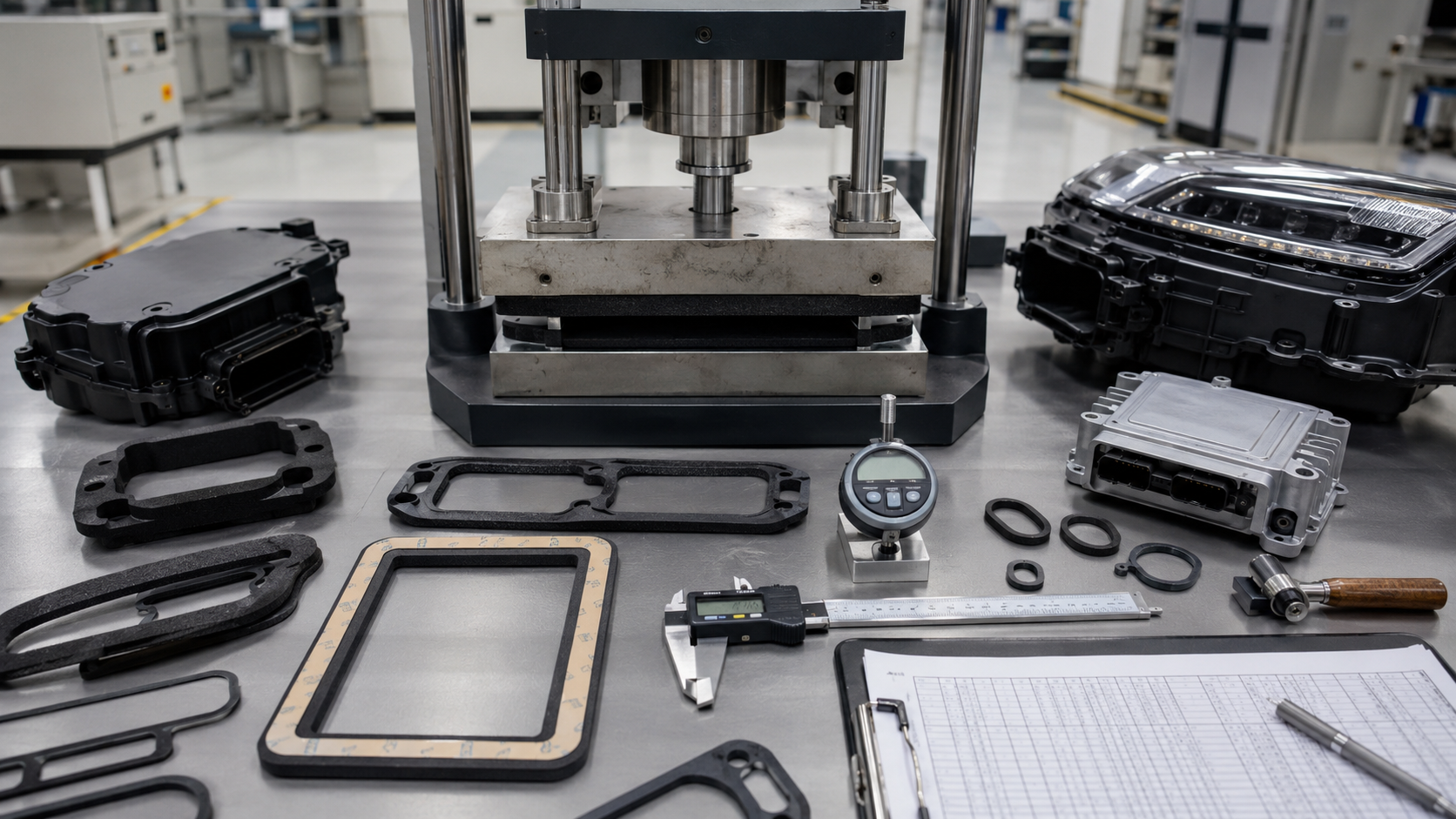
Decide Whether Adhesive Backing Is Needed
Many automotive die cut gaskets use adhesive backing.
This helps operators position the gasket during assembly.
But adhesive backing must be chosen carefully.
The adhesive must match the bonding surface.
Plastic, metal, painted parts, rubber, glass and textured surfaces do not bond the same way.
A gasket may lift if the adhesive is not suitable.
It may also shift if the liner release is poor or the adhesive edge is not clean.
Common adhesive-backed gasket structures include:
- Single-sided adhesive foam gasket
- Double-sided adhesive foam gasket
- EPDM foam with PSA backing
- Foam tape gasket on release liner
- Rubber gasket with adhesive backing
- Gasket with pull tab for easier peeling
- Multilayer foam, film and adhesive structure
For adhesive gasket production, die cutting must control the foam layer, adhesive layer and release liner together.
This is where material converting experience matters.
Control Tolerance and Edge Quality
Waterproofing and dust sealing depend on fit.
If the gasket is too small, it may leave a gap.
If the gasket is too large, it may wrinkle or interfere with assembly.
If the hole position is wrong, the part may shift.
If the edge is rough, particles may appear.
Important quality points include:
| Inspection Item | Why It Matters |
|---|---|
| Outer dimension | Ensures correct fit |
| Inner opening | Controls sealing path |
| Hole position | Supports alignment |
| Width of gasket wall | Prevents tearing or deformation |
| Thickness | Controls compression |
| Edge cleanliness | Reduces particles and leakage risk |
| Adhesive position | Prevents bonding failure |
| Liner release | Improves assembly efficiency |
For narrow gasket frames, the design should be reviewed before tooling.
A narrow foam wall may tear during die cutting or waste removal.
A sharp corner may deform.
A small hole may be difficult to clear.
CAD drawings are clean.
Foam has opinions.
We respect the foam.
Choose the Right Die Cutting Process
Different gasket designs need different die cutting processes.
For thicker foam and rubber, flatbed die cutting is often suitable.
For roll materials and high-volume adhesive-backed gaskets, roll-to-roll die cutting can improve consistency and production efficiency.
For adhesive-backed foam gaskets, kiss cutting is often used.
This cuts the gasket layer while keeping the release liner intact.
| Process | Best Used For |
|---|---|
| Flatbed die cutting | Thicker foam, rubber and sheet-based parts |
| Rotary die cutting | Roll materials and high-volume production |
| Kiss cutting | Adhesive-backed gaskets on liner |
| Half cutting | Controlled depth multilayer structures |
| Lamination + die cutting | Foam, adhesive, film and liner combinations |
The right process depends on material thickness, gasket shape, tolerance, adhesive structure and annual volume.
For gasket manufacturing details, buyers can also review how die cutting works from foam rolls to finished parts.
Match the Delivery Format to Assembly
A gasket should not only be made correctly.
It should also be easy to use.
The delivery format affects assembly speed, peeling behavior, deformation risk and labor cost.
| Delivery Format | Suitable Use |
|---|---|
| Individual pieces | Simple assembly or low-volume projects |
| Sheets | Manual picking and organized assembly |
| Rolls | Automated or high-volume application |
| Kiss-cut on liner | Adhesive-backed foam gaskets |
| Kits | Multi-part automotive assemblies |
| Trays or bags | Gaskets that need deformation protection |
For manual assembly, die cut parts supplied in sheets can make picking and placement easier.
For automated assembly, rolls may be more efficient.
For complex modules, kits can reduce missing parts and improve production control.
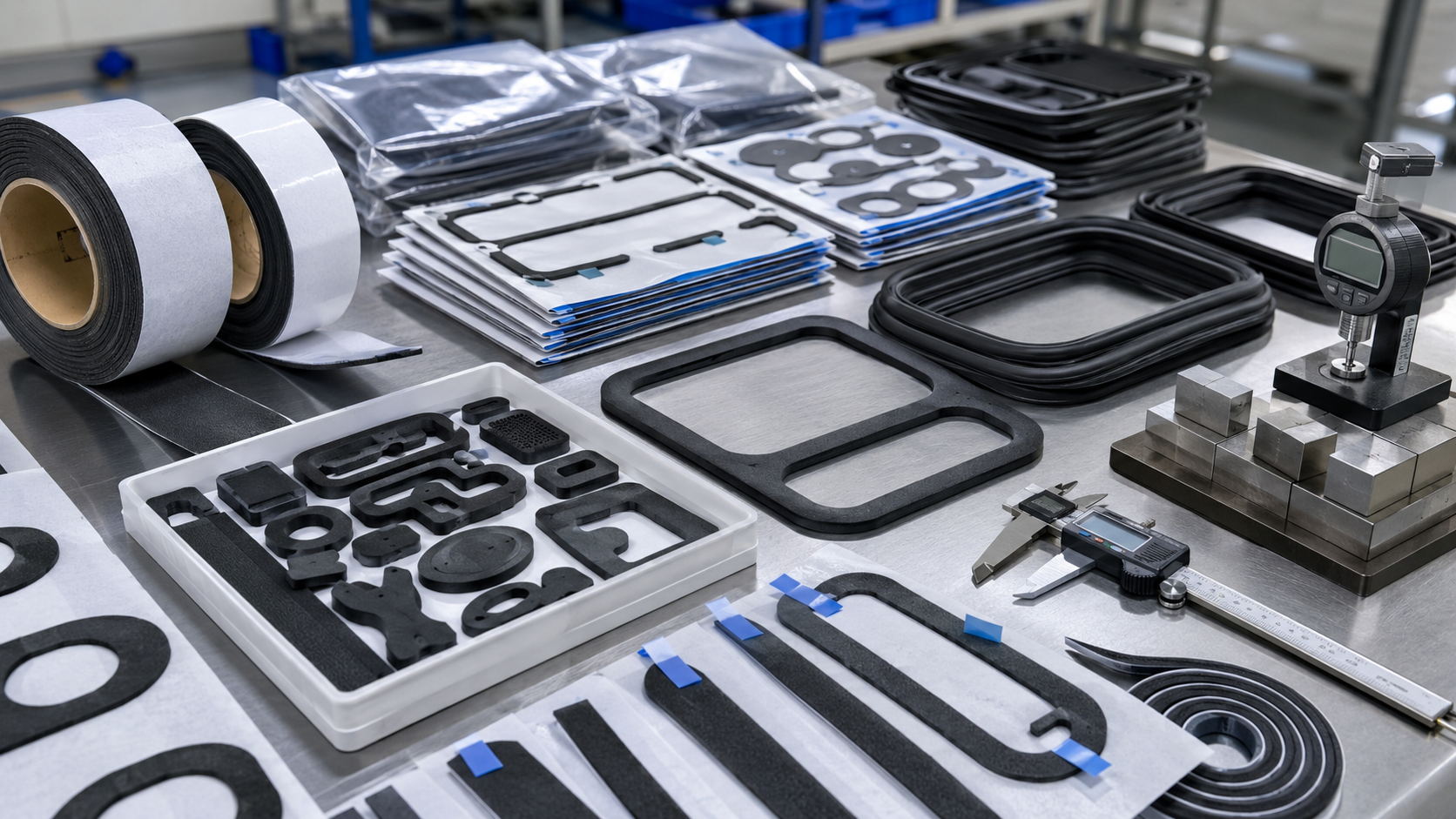
Common Mistakes When Choosing Automotive Gaskets
Most sealing failures start before production.
They start during material choice, design review or process planning.
Common mistakes include:
- Choosing foam only by price
- Ignoring compression gap
- Using the wrong adhesive for the surface
- Designing gasket walls too narrow
- Ignoring liner release
- Not checking aging performance
- Using poor packaging that deforms parts
- Testing only dimensions, not sealing behavior
- Switching material batches without validation
A gasket may pass a simple visual check and still fail during assembly.
That is why we review material, adhesive, design and use conditions together.
Buyer Checklist Before Starting a Gasket Project
Before asking for quotation, prepare as much information as possible.
This helps us recommend the right gasket structure faster.
Useful details include:
- Drawing or sample
- Application location
- Waterproofing or dust sealing requirement
- Foam or rubber preference
- Thickness and tolerance
- Compression gap
- Bonding surface
- Adhesive requirement
- Temperature range
- Aging or durability requirement
- Assembly method
- Annual volume
- Delivery format
- Packaging preference
If the material is not confirmed, we can help compare EPDM foam, PE foam, EVA foam, PU foam, silicone foam, rubber and adhesive-backed structures.
For new OEM programs, buyers can also review how to choose the right die cutting manufacturer before moving from sample approval to mass production.
Need Automotive Waterproofing or Dust Sealing Gaskets?
Choosing die cut gaskets for automotive waterproofing and dust sealing requires more than selecting a foam thickness.
The right gasket depends on material, compression, adhesive backing, tolerance, die cutting process, inspection and delivery format.
If you need custom die cut parts for OEM assembly, send us your drawing, sample, sealing requirement, material preference, adhesive structure, tolerance, application location, compression gap, annual volume and packaging preference.
Sanken can help review gasket material, adhesive backing, die cutting method, inspection points and delivery format before mass production.
Related Articles
You may also find these articles helpful:
- What Material Is Best for Automotive Electronic Gaskets?
- Die Cut Gaskets for Automotive Electronics: What to Check First
- Custom Die Cut Foam Gaskets for Automotive Electronics
- Foam Gasket Materials: How to Choose the Right Foam for Sealing and Cushioning
- How to Stop Foam Gaskets from Losing Sealing Performance
- Die Cut Foam Gaskets: 7 Mistakes That Cause Poor Sealing
- How Are Adhesive Foam Die-Cut Gaskets Manufactured for OEM Sealing Applications?
Conclusion
Automotive waterproofing and dust sealing gaskets must be chosen by function, not just shape. The right foam or rubber material, compression design, adhesive backing, tolerance control and delivery format help the gasket seal reliably during real OEM assembly and long-term vehicle use.