
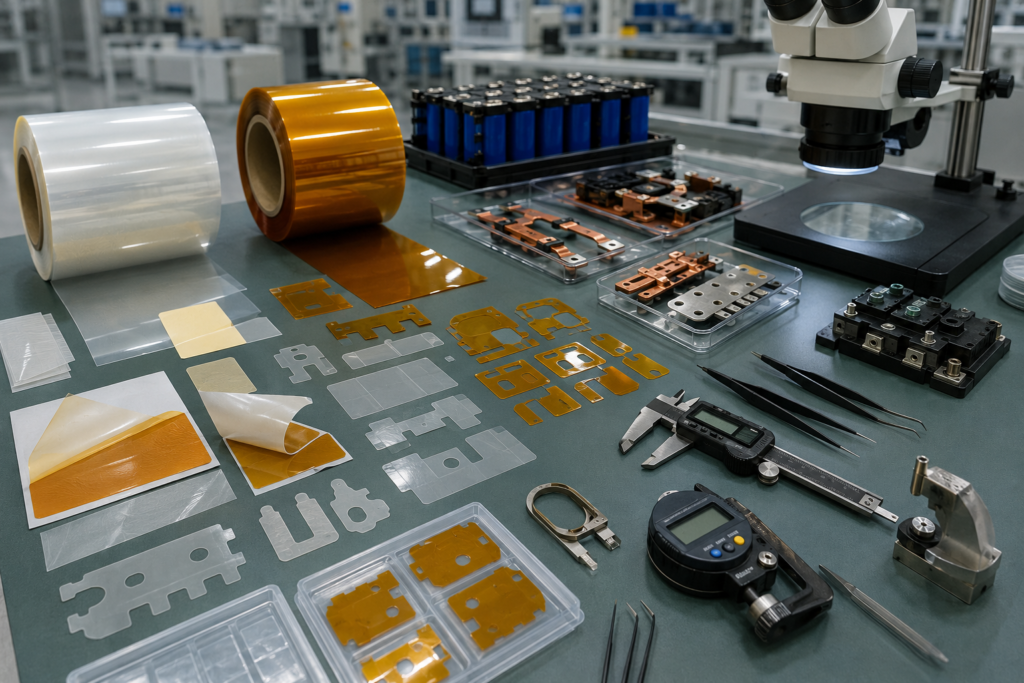
PET and PI insulation films are widely used in OEM electronics because they are thin, stable, lightweight and easy to convert into custom shapes.
They protect electronic parts from electrical contact, heat, scratches, dust, assembly damage and short-circuit risk.
At Sanken, we use precision die cutting to convert PET film, PI film, adhesive-backed films, protective films and laminated insulation structures into custom parts for batteries, PCBs, connectors, sensors, displays and electronic modules.
The film may look simple.
But if it curls, shifts, scratches, leaves particles or fails to cover the right area, the whole assembly can become risky.
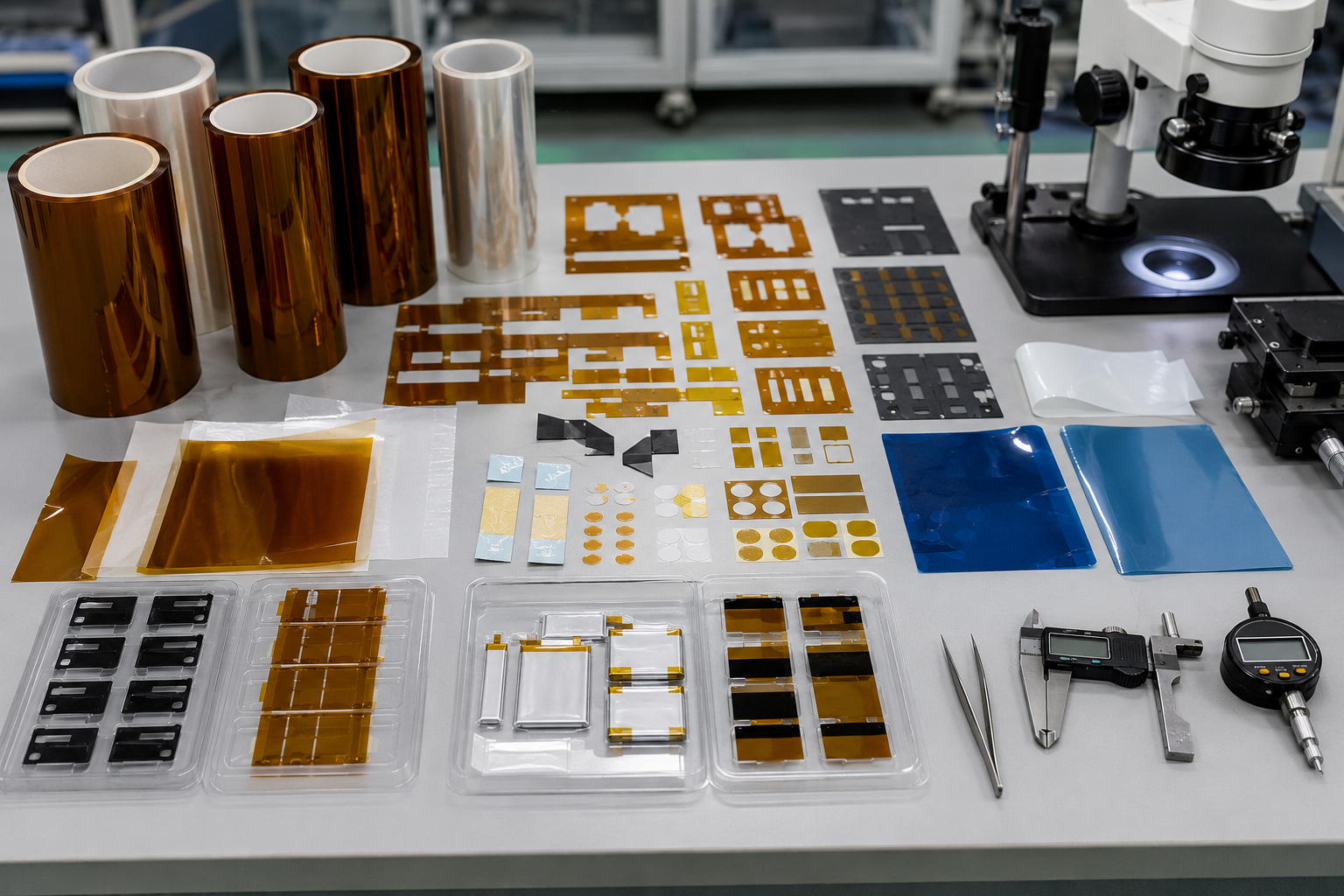
What Are PET and PI Insulation Films?
PET film is a polyester film commonly used for electrical insulation, separation, surface protection and structural support in electronic products.
PI film, often recognized by its amber color, is used where higher heat resistance and stronger insulation performance are required.
Both materials can be die cut into custom shapes.
They can also be laminated with adhesive, release liner, protective film or other functional layers.
| Material | Common Role in Electronics |
|---|---|
| PET film | General electrical insulation, protection and separation |
| PI film | Heat-resistant insulation and high-temperature protection |
| Adhesive-backed PET film | Easy placement and bonding during assembly |
| Adhesive-backed PI film | Heat-resistant insulation with stable positioning |
| Protective film | Surface protection during manufacturing |
| Laminated film structure | Combined insulation, bonding and protection |
For OEM electronics, these films are often used as hidden functional parts.
They are small.
But they help the product stay safe, stable and easier to assemble.
PET Film vs PI Film: Main Differences
PET and PI are both useful, but they are not selected for the same reason.
PET film is often chosen when the part needs general insulation, cost control, clean cutting and stable dimensional performance.
PI film is often chosen when the part needs better heat resistance or more demanding insulation performance.
| Factor | PET Film | PI Film |
|---|---|---|
| Main advantage | Cost-effective general insulation | Better heat resistance |
| Common color | Clear, milky, white, black or transparent | Amber or brown |
| Typical use | PCBs, batteries, connectors, displays | High-temperature areas, batteries, motors, heat-sensitive electronics |
| Die cutting difficulty | Usually easier to process | Requires careful tool and edge control |
| Adhesive lamination | Common | Common, but adhesive must match heat requirement |
| Best for | General electronic insulation | Higher reliability or heat-related insulation |
The right choice depends on the real application.
If the part only needs general insulation, PET may be enough.
If the part is near heat, battery modules or power components, PI may be the safer choice.
Where PET and PI Films Are Used in OEM Electronics
PET and PI insulation films are used in many electronic assemblies.
They may protect PCBs, batteries, connectors, sensors, displays, control panels and internal modules.
Common applications include:
| Application Area | Film Part Function |
|---|---|
| PCB areas | Electrical insulation and surface protection |
| Battery packs | Cell, busbar and module insulation |
| Connectors | Contact protection and separation |
| Sensors | Dust protection and insulation support |
| Displays | Insulation, light blocking and bonding support |
| Control panels | Protection and electrical separation |
| Motors and power modules | Heat-resistant insulation |
| Housing assemblies | Surface protection and gap separation |
For electronics and display applications, custom die cut parts often include PET films, PI films, foam gaskets, adhesive tape frames and protective films working together in one assembly.
A film part rarely works alone.
It usually supports a larger product structure.
Battery and Power Module Insulation
Battery areas and power modules often need PET and PI films for insulation and protection.
These films may be used around cells, busbars, covers, tabs, connectors and module housings.
Common battery-related parts include:
- Die cut PET insulation films
- Die cut PI insulation films
- Adhesive-backed battery insulation pieces
- Busbar protection films
- Connector insulation films
- Battery module protective layers
- Laminated insulation structures
For electrical and electronics applications, custom die-cut PET insulation films for electronics assembly are commonly used because PET film is thin, dimensionally stable, and suitable for custom shapes.
PI film may be selected when the area requires better heat resistance.
For battery projects, we usually review insulation coverage, temperature range, adhesive structure, tolerance, liner release, surface cleanliness and annual volume before production.
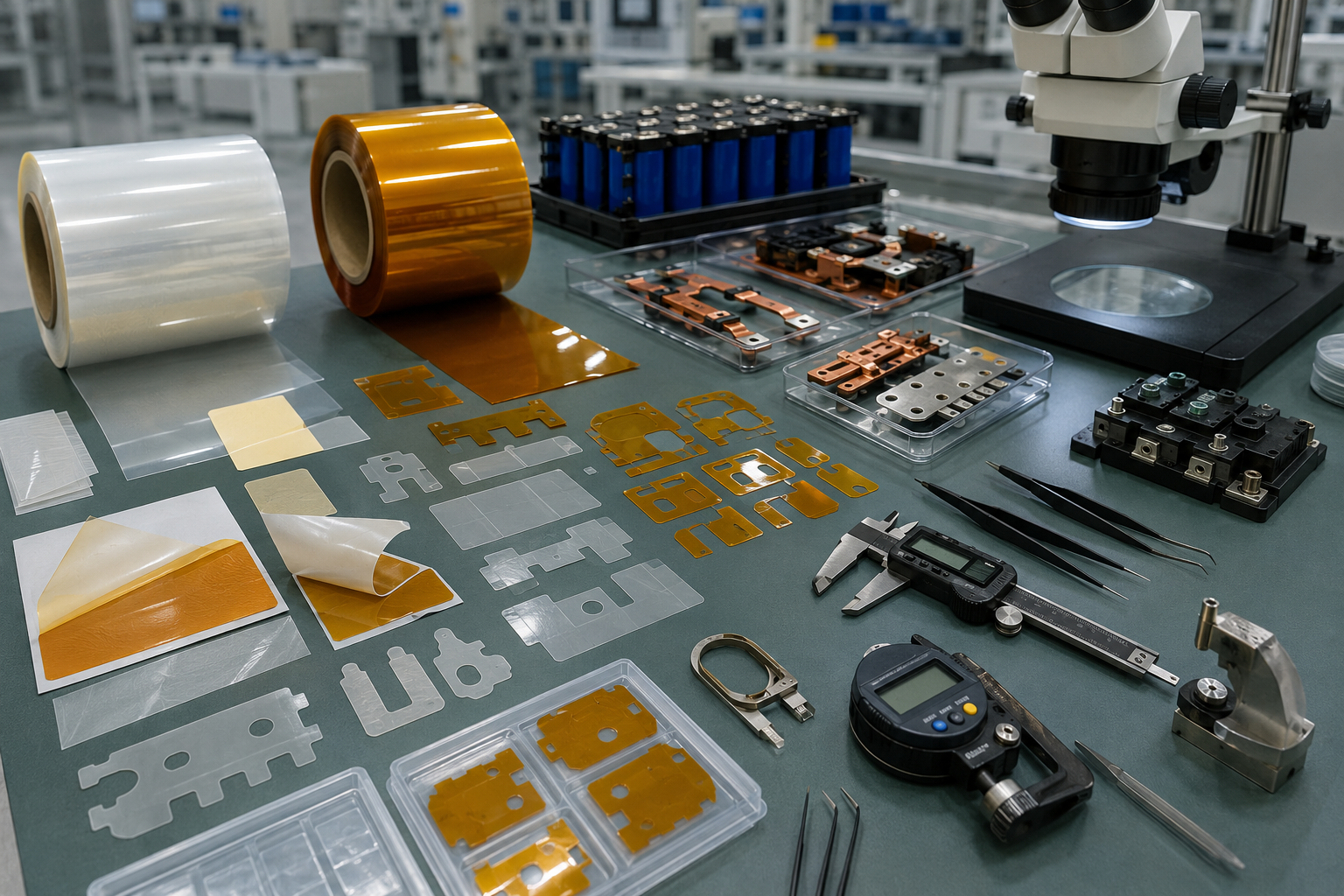
PCB, Connector and Sensor Protection
PCBs, connectors and sensors often have limited space.
That means insulation films must be thin, accurate and clean.
If the film is too large, it may interfere with assembly.
If it is too small, it may not protect the required area.
If the hole position is wrong, the part may shift.
If the edge is dirty, particles may affect the electronics.
Common control points include:
| Control Point | Why It Matters |
|---|---|
| Thickness | Controls fit inside compact assemblies |
| Hole position | Supports accurate placement |
| Edge quality | Reduces particles and burrs |
| Surface cleanliness | Protects electronic areas |
| Adhesive position | Prevents shifting or lifting |
| Liner release | Improves operator handling |
| Packaging | Prevents scratches and curling |
For electronics projects, clean cutting is only one part of the job.
Clean handling and packaging matter just as much.
A perfect part with dust on it is no longer perfect.
It is just a very accurate problem.
Display and Optical Module Applications
PET and PI films are also used in display and optical-related electronic assemblies.
These applications often require very clean surfaces and accurate shapes.
Typical parts include:
- PET insulation films
- PI insulation films
- Protective films
- Black PET light-blocking films
- Adhesive tape frames
- Foam spacers
- OCA-related adhesive structures
- Dustproof films
For display and protective film projects, optical film die cut components must be controlled carefully.
Dust, scratches, bubbles, film curling, adhesive residue and poor liner release can create visible defects.
In display assembly, the defect may be tiny.
But the customer will still see it.
That is why material handling, cleanliness and packaging are critical.
Adhesive-Backed PET and PI Films
Many PET and PI insulation films are supplied with adhesive backing.
This helps operators apply the film quickly and keep it in the correct position.
Common structures include:
| Structure | Common Use |
|---|---|
| PET film with PSA | General insulation and positioning |
| PI film with PSA | Heat-resistant insulation and bonding |
| PET film with release liner | Easy peeling and assembly |
| PI film with release liner | Controlled placement in heat-related areas |
| Film with pull tab | Easier manual handling |
| Multilayer laminated film | Combined insulation, bonding and protection |
Adhesive selection must match the bonding surface and the working environment.
Plastic, metal, film, glass and coated surfaces do not bond the same way.
A film that passes a quick sample test may still lift after heat aging, vibration or long-term use.
So we check surface material, temperature range, peel strength requirement, liner release and assembly method before recommending an adhesive structure.
Manufacturing Process for Die Cut Insulation Films
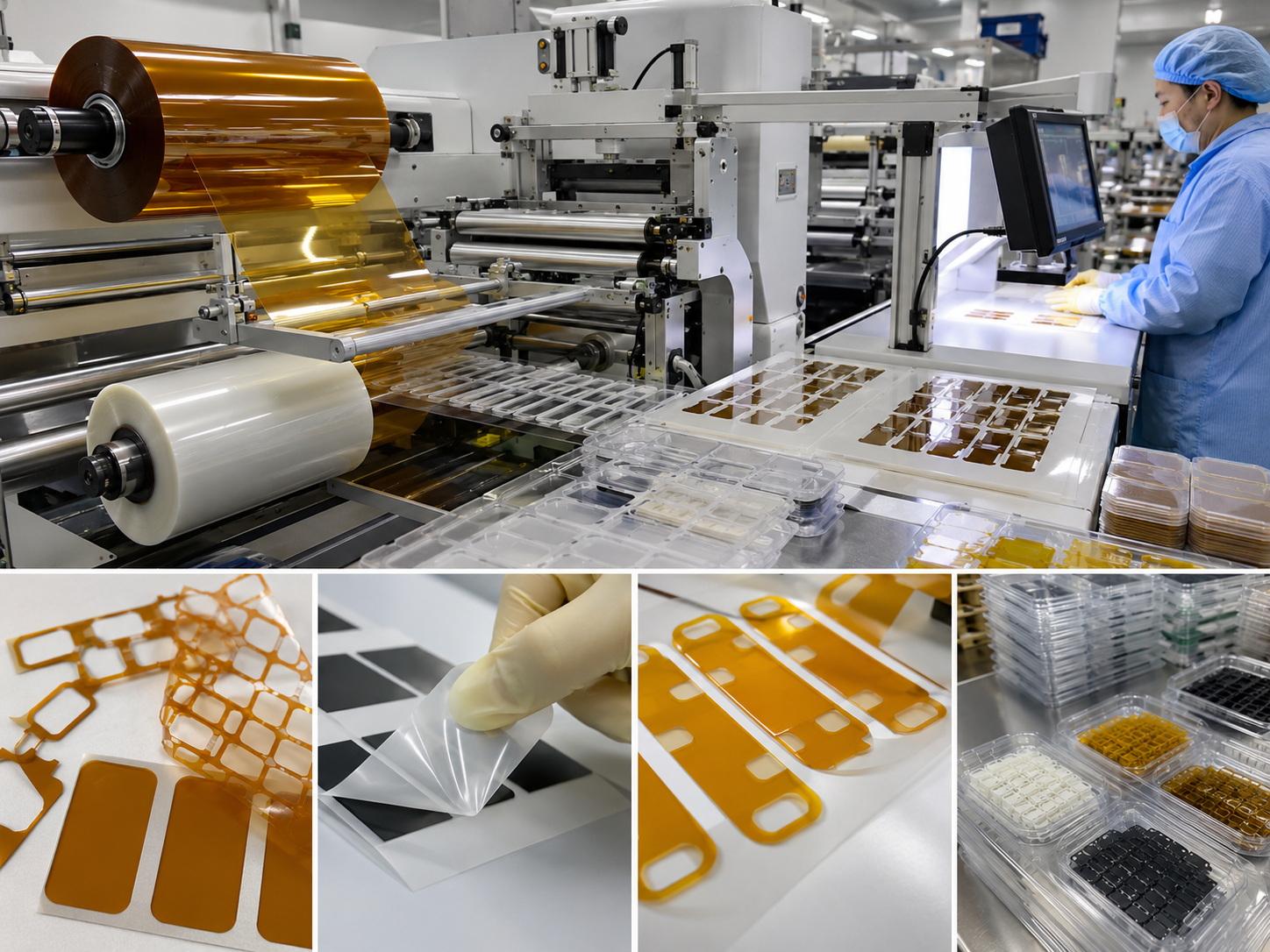
PET and PI insulation films are usually manufactured through material converting, lamination, die cutting, waste removal, inspection and packaging.
A typical process includes:
| Step | Purpose |
|---|---|
| Application review | Confirm insulation area, temperature and assembly method |
| Material selection | Choose PET, PI, adhesive or laminated structure |
| Lamination | Add adhesive, liner or protective layer if required |
| Tooling design | Prepare die cutting tool based on drawing |
| Die cutting | Cut film shapes, holes, slots or frames |
| Kiss cutting | Keep adhesive-backed parts on release liner |
| Waste removal | Remove unused film cleanly |
| Inspection | Check size, edge, adhesive and surface quality |
| Packaging | Prevent dust, scratches, curling and deformation |
For process background, buyers can review how die cutting transforms raw materials into precision components.
For roll materials and high-volume film parts, roll-to-roll die cutting can improve repeatability and production efficiency.
How to Select PET or PI Insulation Films
The selection should start with the application, not only the material name.
Useful questions include:
- What area needs insulation?
- Is the part close to heat?
- Does the film need adhesive backing?
- What surface will it bond to?
- What thickness is allowed?
- What tolerance is required?
- Does the film need to resist curling?
- Is the part used near a display or visible surface?
- Should it be supplied in sheets, rolls or kits?
- What inspection standard is required?
| Requirement | Better Material Choice |
|---|---|
| General insulation | PET film |
| Heat-resistant insulation | PI film |
| Cost-sensitive protection | PET film |
| Battery or power area | PET or PI, depending on heat and insulation requirement |
| Display protection | PET protective film or laminated structure |
| High-cleanliness area | PET or PI with controlled handling and packaging |
| Adhesive positioning | PET or PI with matched PSA and liner |
For assembly planning, buyers can review how die cut parts are supplied in sheets, rolls, or kits to choose a delivery format that fits their production line.
What Buyers Should Provide Before Quotation
To recommend the right PET or PI insulation film, we usually need clear project details.
Helpful information includes:
- Drawing or sample
- PET or PI material preference
- Film thickness
- Adhesive requirement
- Bonding surface
- Application location
- Temperature range
- Electrical insulation requirement
- Tolerance
- Cleanliness requirement
- Annual volume
- Delivery format
- Packaging preference
- Validation standard
If the material is not confirmed, we can help compare PET film, PI film, adhesive-backed films, protective films and laminated structures.
For new OEM projects, buyers can also review how to choose the right die cutting manufacturer before moving from sample approval to mass production.
Need PET or PI Insulation Films for OEM Electronics?
PET and PI insulation films help OEM electronics improve insulation, protection, heat resistance, assembly accuracy and long-term reliability.
But the final result depends on material selection, adhesive backing, die cutting accuracy, cleanliness control, inspection and packaging.
If you need custom die cut parts for OEM assembly, send us your drawing, sample, film requirement, adhesive structure, tolerance, application location, temperature range, annual volume and packaging preference.
Sanken can help review material selection, lamination structure, die cutting method, inspection points and delivery format before mass production.
Related Articles
You may also find these articles helpful:
- Why Is PET Film Commonly Used in Electronics?
- Can PET Film Be Laminated With Adhesives?
- Custom Die-Cut PET Insulation Films for Electronics Assembly
- Why Insulation Films Must Be Precision Die Cut for Electronics
- Why Is Precision Film Die Cutting Important for Consumer Electronics Screens?
- What Industries Use Custom PET Film Die Cutting?
- What Die Cut Films, Foams, and Adhesive Parts Are Used in Electronic Products?
Conclusion
PET and PI insulation films are important materials for OEM electronics because they provide thin, accurate and reliable insulation protection. PET is often used for general insulation and protection. PI is preferred for higher heat resistance. The best choice depends on application location, temperature, adhesive structure, tolerance, cleanliness and delivery format.