
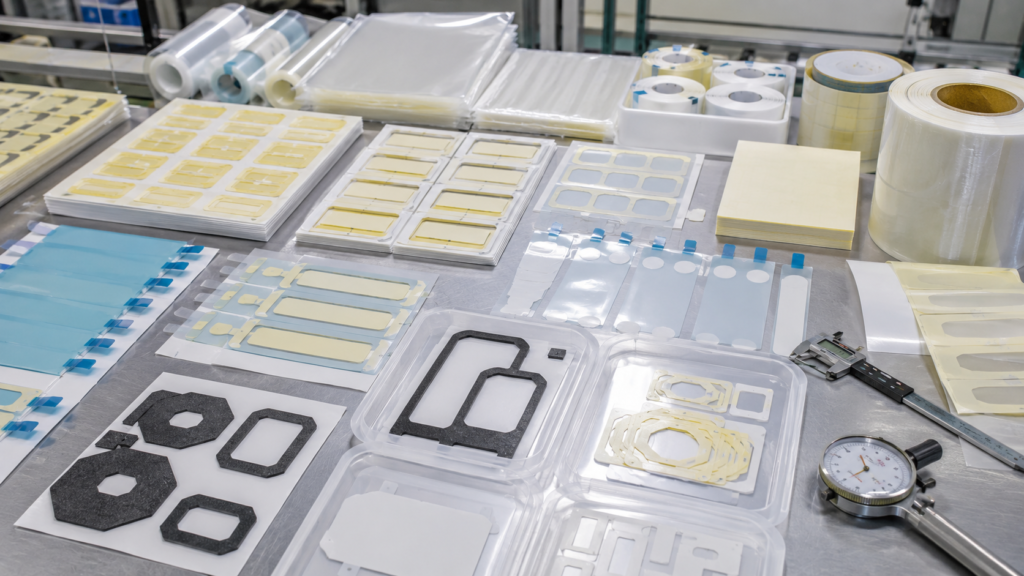
Semiconductor and electronics equipment contain many panels, modules, sensors, fixtures, housings, control interfaces, and internal electronic assemblies.
Inside these products, adhesive tape components are used to bond, mount, seal, cushion, protect, insulate, position, and simplify assembly.
At Sanken, we use precision die cutting and material converting to manufacture custom adhesive tape frames, foam tape gaskets, PET-backed adhesive parts, transfer adhesive films, protective films with pull tabs, adhesive-backed PET insulation films, and laminated tape structures for OEM assembly.
These parts are usually small.
But if the adhesive, liner, shape, thickness, or bonding surface is wrong, the final equipment may face lifting, shifting, glue overflow, poor fit, residue, or assembly delays.
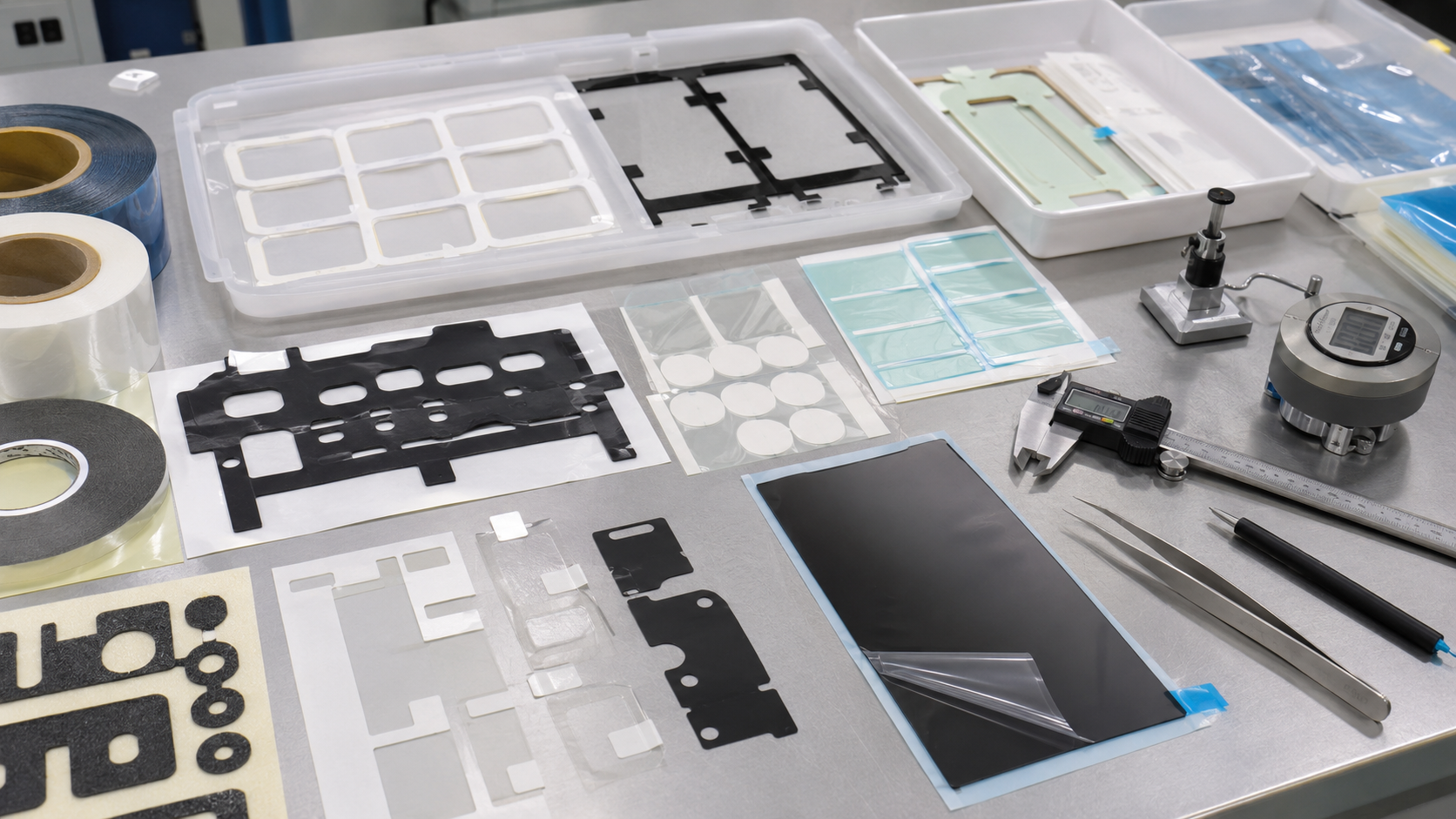
Why Adhesive Tape Components Are Used in Equipment Assembly
Adhesive tape components are used because they make assembly cleaner and more repeatable.
Compared with liquid glue, adhesive tape can provide controlled thickness, cleaner handling, faster placement, and more accurate bonding area.
Common functions include:
| Function | Adhesive Tape Component |
|---|---|
| Bonding | Double-sided tape frames, transfer adhesive parts |
| Mounting | PET-backed adhesive tape, foam tape pads |
| Sealing | Foam tape gaskets, adhesive-backed foam strips |
| Cushioning | Foam tape pads, adhesive-backed foam parts |
| Electrical insulation support | Adhesive-backed PET insulation films |
| Surface protection | Protective films with pull tabs |
| Light blocking | Black PET adhesive films |
| Assembly positioning | Kiss-cut adhesive parts on release liner |
For OEM projects, custom die cut parts allow adhesive tape components to match the exact equipment shape, hole position, window area, connector location, and assembly method.
The tape is not just tape anymore.
It becomes a functional part.
Double-Sided Tape Frames
Double-sided tape frames are widely used for bonding panels, covers, display windows, control interfaces, plastic housings, and metal parts.
They can be die cut into frames, rings, strips, pads, or custom shapes.
Common applications include:
- Control panel bonding
- Display window mounting
- Plastic cover bonding
- Metal housing attachment
- Sensor cover positioning
- Equipment label or overlay bonding
- Decorative panel assembly
Double-sided tape frames must be designed with the correct width, corner radius, adhesive strength, liner release, and part spacing.
If the tape frame is too narrow, it may stretch or lift.
If the adhesive is too aggressive, it may create residue or difficult rework.
If the liner release is poor, workers may deform the tape during peeling.
A good tape frame should be easy to peel, easy to place, and stable after bonding.
PET-Backed Adhesive Parts
PET-backed adhesive tape components are useful when the adhesive part needs better dimensional stability and cleaner handling.
The PET carrier helps the part stay flat and stable during die cutting, peeling, and placement.
Common uses include:
| Application Area | PET-Backed Adhesive Function |
|---|---|
| Electronic module assembly | Stable bonding and positioning |
| Control panels | Thin bonding with shape stability |
| Sensor housings | Accurate adhesive placement |
| Equipment covers | Mounting and surface separation |
| Internal fixtures | Controlled adhesive area |
| Display-related areas | Clean handling and accurate placement |
PET-backed adhesive parts are often easier to handle than unsupported transfer adhesive in narrow or complex shapes.
They are also useful when the part needs both bonding and a thin stable carrier layer.
For electrical separation applications, adhesive-backed PET insulation films can support insulation and placement in one part.
Transfer Adhesive Films
Transfer adhesive films are thin adhesive layers supplied on a liner without a thick carrier.
They are used when the bonding area must remain very thin.
Common applications include:
- Thin panel bonding
- Film-to-film bonding
- Overlay bonding
- Small adhesive pads
- Thin gasket bonding support
- Low-profile electronic module assembly
Transfer adhesive can be useful, but it also requires careful handling.
Narrow transfer adhesive parts may stretch during peeling.
Unsupported adhesive may be more sensitive to deformation, glue overflow, and liner release problems.
For complex shapes, PET-backed adhesive may be a better option.
The thinnest structure is not always the easiest one to assemble.
Foam Tape Gaskets and Adhesive-Backed Foam Parts
Foam tape components are used when the part needs bonding plus cushioning, sealing, gap filling, or vibration control.
Common foam tape parts include:
- Foam tape gaskets
- Adhesive-backed foam strips
- Foam sealing frames
- Foam cushioning pads
- Dustproof foam gaskets
- Foam spacers
- Adhesive-backed anti-rattle pads
For sealing and cushioning applications, foam gaskets and sealing components can support equipment covers, control boxes, sensor housings, electronic modules, and panel gaps.
Foam tape selection depends on thickness, density, compression recovery, adhesive type, and bonding surface.
If the foam is too soft, it may collapse.
If it is too hard, it may not seal well.
If the adhesive does not match the surface, the gasket may shift or lift after assembly.
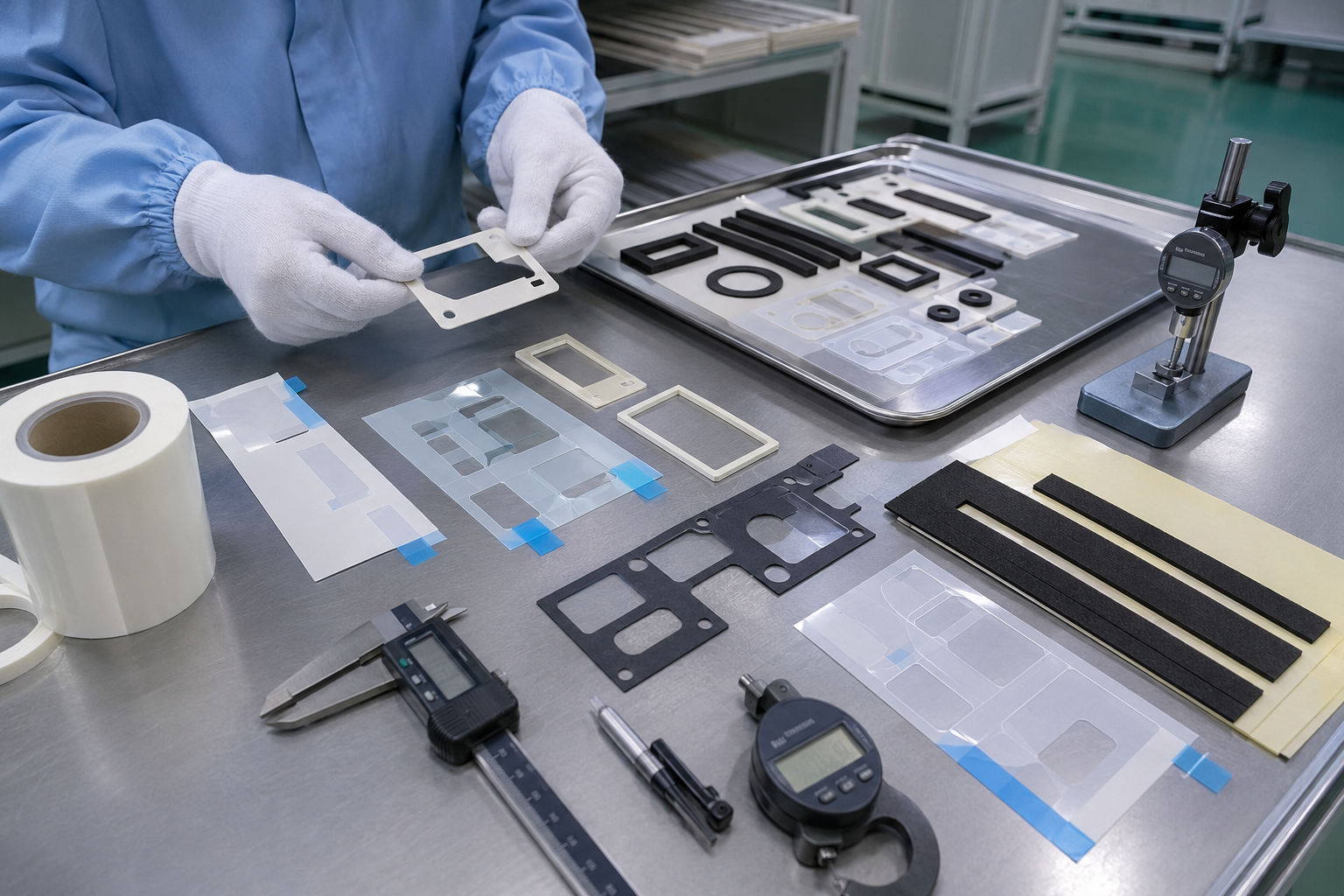
Adhesive-Backed PET Insulation Films
Electronic and semiconductor equipment often need thin insulation films around modules, connectors, panels, sensors, and internal housing areas.
Adhesive-backed PET insulation films help keep the insulation part in the correct location during assembly.
Common applications include:
| Equipment Area | Adhesive-Backed PET Film Function |
|---|---|
| PCB support areas | Electrical separation and protection |
| Connector areas | Contact protection and positioning |
| Sensor housings | Insulation and dust protection support |
| Control modules | Internal surface separation |
| Metal housings | Insulation between surfaces |
| Display interfaces | Thin separation and protection |
PET film is commonly used because it is thin, stable, and suitable for custom die cutting.
For more details, buyers can review custom die-cut PET insulation films for electronics assembly.
The adhesive structure should be selected carefully to avoid lifting, residue, curling, or glue overflow.
Protective Films With Pull Tabs
Protective films are used to prevent scratches, fingerprints, dust, and handling damage during manufacturing, shipping, fixture use, or final assembly.
Common protective film applications include:
- Control panel surfaces
- Display windows
- Sensor windows
- Fixture contact surfaces
- Metal housings
- Plastic covers
- Decorative panels
- Assembly handling areas
Pull tabs make removal easier and reduce finger contact on the protected surface.
For display and control panel areas, optical film die cut components may include protective films, black PET films, adhesive frames, PET insulation films, and foam spacers.
Protective films must be selected with the correct adhesive behavior.
They need to stay in place.
They also need to leave cleanly.
A protective film that leaves residue is protecting yesterday and creating today’s problem.
Black PET Adhesive Films
Black PET adhesive films may be used around indicator windows, display borders, sensor openings, control panels, and light-sensitive areas.
Common functions include:
- Light blocking
- Visual border control
- Surface coverage
- Thin spacing
- Adhesive positioning
- Appearance support
Black PET films need clean edges and accurate positioning.
If the part shifts, light leakage or appearance defects may appear.
If the adhesive overflows, nearby visible surfaces may be contaminated.
For electronic equipment, black PET adhesive parts often work together with protective films, PET insulation films, adhesive tape frames, and foam spacers.
Laminated Adhesive Tape Structures
Some applications need more than one function in the same part.
A laminated adhesive structure may combine bonding, insulation, protection, cushioning, or light blocking.
Common laminated structures include:
| Laminated Structure | Common Function |
|---|---|
| Foam + adhesive + liner | Sealing, cushioning, easy placement |
| PET film + adhesive + liner | Insulation and positioning |
| Protective film + pull tab | Surface protection and easy removal |
| Black PET + adhesive | Light blocking and bonding |
| Foam + PET film + adhesive | Cushioning, spacing, and support |
| Felt + adhesive + liner | Anti-squeak and surface protection |
Laminated structures require careful process control.
Adhesive alignment, total thickness, flatness, liner release, edge quality, and packaging all affect final assembly performance.
Where These Components Are Used
Adhesive tape components can be used in many semiconductor and electronics equipment areas.
| Equipment Area | Common Adhesive Tape Components |
|---|---|
| Control panels | Double-sided tape frames, protective films |
| Electronic modules | PET-backed adhesive parts, PET insulation films |
| Sensor housings | Foam tape gaskets, adhesive pads, protective films |
| Fixtures | Protective films, replaceable adhesive films |
| Equipment covers | Foam tape seals, adhesive-backed foam strips |
| Display windows | Tape frames, pull-tab protective films, black PET films |
| Connector areas | PET insulation films, adhesive-backed films |
| Cable routing areas | Foam pads, felt pads with adhesive backing |
Not every equipment area needs the same tape.
The correct design depends on bonding surface, thickness limit, temperature exposure, cleanliness requirement, and assembly method.
Manufacturing Process for Adhesive Tape Components
Custom adhesive tape components are usually made through material selection, lamination, die cutting, kiss cutting, waste removal, inspection, and packaging.
A typical process includes:
| Step | Purpose |
|---|---|
| Application review | Confirm bonding surface, function, and assembly method |
| Material selection | Choose tape, film, foam, adhesive, liner, or laminated structure |
| Lamination | Combine adhesive, carrier, foam, film, liner, or protective layer |
| Tooling design | Prepare die cutting tool based on drawing |
| Die cutting | Cut frames, pads, strips, gaskets, films, or custom shapes |
| Kiss cutting | Keep adhesive-backed parts on release liner |
| Waste removal | Remove unwanted material cleanly |
| Inspection | Check size, edge, adhesive position, and liner release |
| Packaging | Prevent dust, scratches, sticking, curling, and deformation |
For process background, buyers can review Die Cut vs Kiss Cut: What OEM Buyers Should Know for Adhesive Parts and Protective Films.
For high-volume tape parts, roll-to-roll die cutting can improve part spacing, liner control, waste removal, and production consistency.
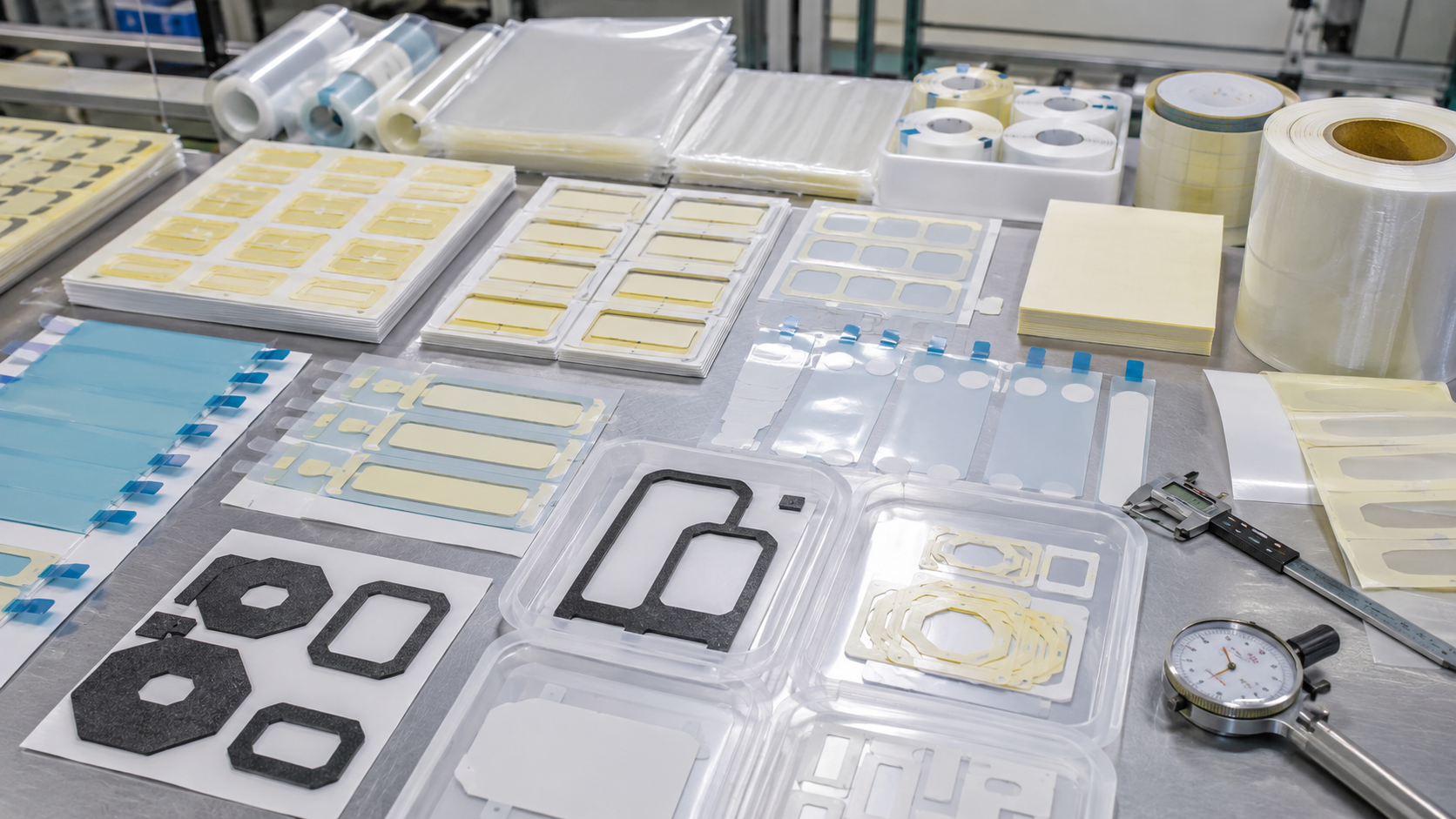
Design Tips for Adhesive Tape Components
Good adhesive tape design improves both bonding and assembly efficiency.
Important design points include:
| Design Point | Why It Matters |
|---|---|
| Bonding surface | Determines adhesive compatibility |
| Tape thickness | Controls fit and stack height |
| Corner radius | Reduces edge lifting and tearing |
| Minimum width | Prevents stretching and weak bonding |
| Pull tab design | Improves manual peeling |
| Liner release | Affects assembly speed |
| Part spacing | Improves picking and placement |
| Packaging method | Prevents dust, curling, and sticking |
For adhesive tape parts, sharp corners often increase lifting risk.
For narrow tape frames, minimum width is important.
For protective films, pull-tab position can affect worker efficiency.
For PET-backed parts, flatness and edge quality matter.
Good design is not only about whether the part fits the drawing.
It is about whether the part can be peeled, placed, bonded, and used reliably.
Quality Checks Before Mass Production
A sample may look correct, but mass production requires repeatability.
Important quality checks include:
| Inspection Item | Why It Matters |
|---|---|
| Dimensions | Ensures correct fit and coverage |
| Thickness | Controls assembly stack-up |
| Adhesive position | Prevents shifting and overflow |
| Edge quality | Reduces burrs, particles, and lifting |
| Liner release | Improves peeling and placement |
| Peel performance | Confirms bonding behavior |
| Surface cleanliness | Protects equipment and modules |
| Flatness | Supports accurate placement |
| Packaging condition | Prevents deformation before use |
For semiconductor and electronics equipment, cleanliness and packaging are especially important.
Dust, scratches, curled film, or adhesive contamination can create unnecessary inspection problems.
What Buyers Should Provide Before Quotation
To recommend the right adhesive tape component, we usually need clear project details.
Helpful information includes:
- Drawing or sample
- Equipment application area
- Main function
- Bonding surface
- Tape material preference
- Adhesive requirement
- Thickness and tolerance
- Liner requirement
- Pull tab requirement
- Cleanliness requirement
- Temperature exposure
- Manual or automated assembly
- Annual volume
- Delivery format
- Packaging preference
If the material is not confirmed, Sanken can help compare double-sided tape, transfer adhesive, foam tape, PET-backed adhesive tape, adhesive-backed PET insulation film, protective film, black PET film, release liner, and laminated adhesive structures.
For supplier selection, buyers can also review how to choose the right die cutting manufacturer before moving from sampling to mass production.
Need Adhesive Tape Components for Semiconductor or Electronics Equipment?
Adhesive tape components help semiconductor and electronics equipment improve bonding, sealing, cushioning, insulation, protection, light blocking, positioning, and assembly efficiency.
But the final result depends on adhesive selection, bonding surface, tape structure, die cutting accuracy, liner release, cleanliness, inspection, and packaging.
If you need double-sided tape frames, PET-backed adhesive parts, transfer adhesive films, foam tape gaskets, adhesive-backed PET insulation films, protective films with pull tabs, black PET adhesive films, or laminated tape structures, send us your drawing, sample, bonding surface, material requirement, tolerance, annual volume, and packaging preference.
Sanken can help review material selection, lamination structure, die cutting method, quality control points, and delivery format before mass production.
Related Articles
You may also find these articles helpful:
- What Is Pressure Sensitive Adhesive Tape and Where Is It Used in OEM Assembly?
- How to Design Custom Adhesive Tape Parts for Easier Assembly and Better Bonding
- What Information Should You Provide for a Custom Adhesive Tape Die-Cut Part Quotation?
- Why Do Die Cut Adhesive Parts Fail After Assembly?
- How to Avoid Edge Lift, Glue Overflow, and Adhesive Failure in Die-Cut Tape Parts
- Precision Die-Cut Parts for Semiconductor Equipment: Materials, Applications, and Design Tips
Conclusion
Adhesive tape components are used in semiconductor and electronics equipment for bonding, sealing, cushioning, insulation, protection, light blocking, positioning, and cleaner OEM assembly. Common components include double-sided tape frames, PET-backed adhesive parts, transfer adhesive films, foam tape gaskets, protective films, adhesive-backed PET films, and laminated tape structures. The best result comes from matching the tape design to the real bonding surface, function, and assembly process.