
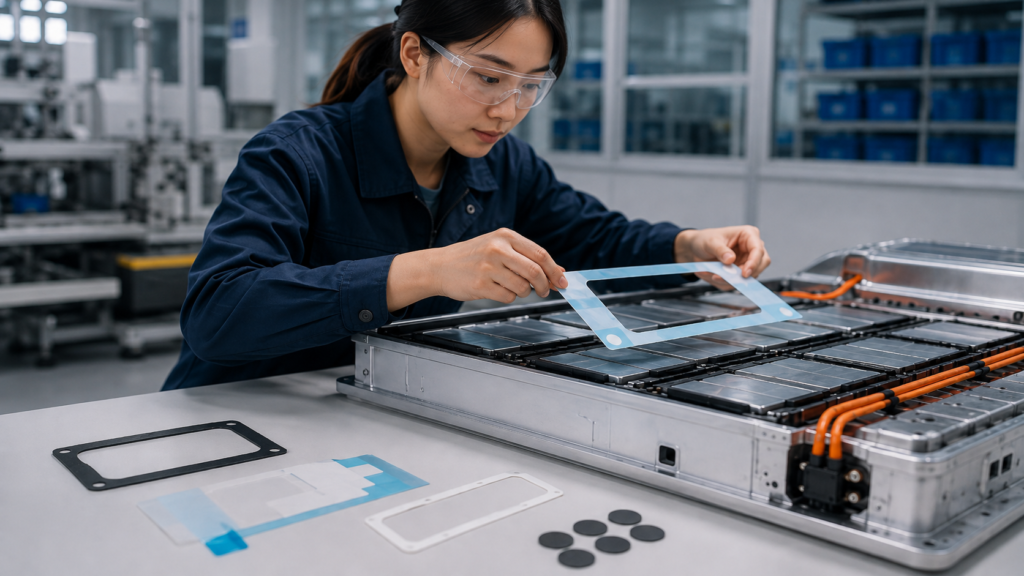
EV battery systems contain many areas where flexible materials are needed for sealing, cushioning, bonding, insulation support, surface protection, vibration control, and assembly positioning.
These parts are usually small.
They are often hidden after assembly.
But they can affect sealing quality, electrical protection, assembly speed, and long-term stability.
At Sanken, we use precision die cutting to manufacture custom foam gaskets, adhesive tape components, PET insulation films, rubber pads, protective films, and laminated die-cut parts for EV battery, energy storage, automotive electronics, and OEM assembly projects.
This article focuses on flexible die-cut components used around EV battery packs, covers, housings, electrical enclosures, cable channels, sensors, and related assembly interfaces.
It does not refer to battery cells or electrochemical cell components.
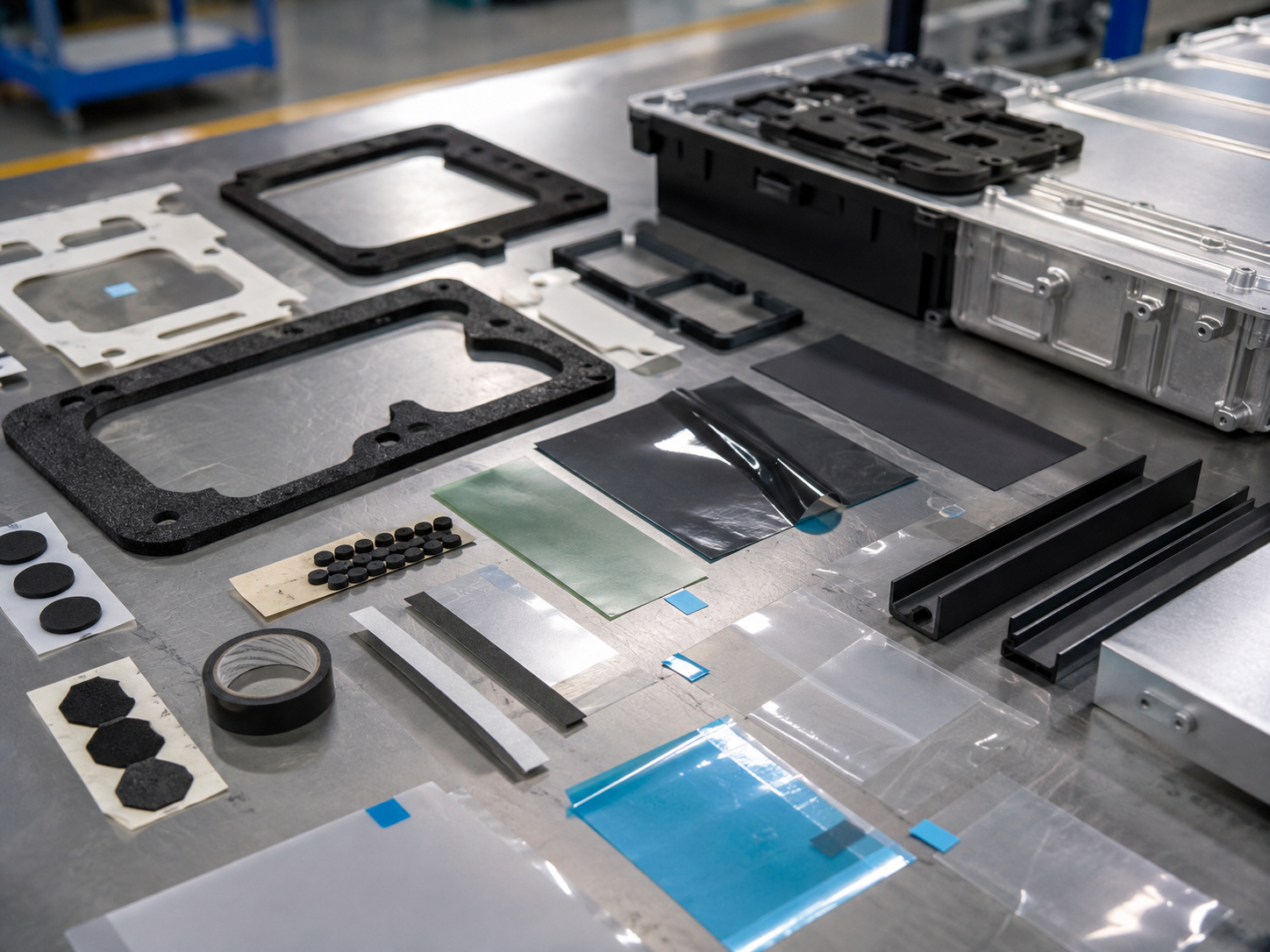
Main Types of Die-Cut Components Used in EV Battery Assembly
Die-cut parts used in EV battery projects can be grouped by function.
| Die-Cut Component Type | Main Function | Typical Application Area |
|---|---|---|
| Foam gaskets | Sealing, dust protection, gap filling | Covers, housings, interfaces |
| Adhesive tape parts | Bonding and positioning | Panels, films, pads, small parts |
| PET insulation films | Electrical insulation support | Electronics, covers, protective areas |
| Protective films | Scratch and handling protection | Covers, panels, visible surfaces |
| Rubber pads | Damping and contact protection | Brackets, covers, support points |
| Foam cushioning pads | Shock absorption and vibration reduction | Contact points and housing areas |
| Conductive foam parts | EMI shielding or grounding support where required | Electronic control or metal interface areas |
| Laminated components | Combined sealing, bonding, insulation, or protection | Custom OEM assembly zones |
For OEM production, custom die cut parts help these materials match the real product drawing instead of relying on manual trimming.
The right part type depends on the function.
Not every area needs foam.
Not every area needs tape.
Not every area needs PET film.
Foam Gaskets for Sealing and Gap Filling
Foam gaskets are commonly used around covers, housings, enclosure interfaces, and assembly gaps.
They help compensate for tolerance variation and improve contact between parts.
Common foam gasket materials include PE foam, EVA foam, PU foam, EPDM foam, and silicone foam depending on the application requirement.
Foam gaskets can support:
- Dust protection
- Gap filling
- Cushioning
- Light sealing
- Cover interface sealing
- Anti-rattle support
- Assembly variation control
For sealing applications, foam gaskets and sealing components should be selected based on thickness, density, compression gap, recovery, adhesive backing, and working environment.
A foam gasket does not seal because it is soft.
It seals because it compresses correctly.
PET Insulation Films for Electrical Protection Support
PET insulation films are widely used in electrical and electronic assembly areas where a thin insulating layer is required.
In EV battery-related assemblies, PET film parts may be used around electronic covers, insulation areas, control boxes, cable routing zones, and protective surfaces.
Common forms include:
| PET Film Part | Function |
|---|---|
| Die-cut PET insulation film | Electrical insulation support |
| Adhesive-backed PET film | Easier positioning during assembly |
| PET film cover piece | Local protection and separation |
| PET film spacer | Thin spacing and isolation support |
| Kiss-cut PET film on liner | Cleaner handling and placement |
For more details, buyers can review Custom Die-Cut PET Insulation Films for Electronics Assembly
PET insulation film selection should consider thickness, dielectric requirement, adhesive backing, hole alignment, edge quality, cleanliness, and final assembly location.
If the film curls, shifts, or has poor hole alignment, it can create assembly risk.
Adhesive Tape Components for Bonding and Positioning
Adhesive tape components are used when parts need to be bonded, positioned, or held during assembly.
Common options include double-sided tape, foam tape, PET-backed tape, transfer adhesive, and laminated adhesive structures.
Typical EV battery and energy storage uses include:
- Cover bonding support
- Film positioning
- Foam gasket placement
- Protective film attachment
- Cable channel support
- Small pad positioning
- Sensor or electronics assembly support
For adhesive tape converting, buyers can review custom adhesive tape components for EV battery and energy storage assembly.
Adhesive tape selection should start with the bonding surface.
Metal, plastic, PET film, coated panels, painted surfaces, rubber, and textured housings do not bond the same way.
The strongest adhesive is not always the right adhesive.
The correct adhesive is the one that matches the surface and assembly condition.
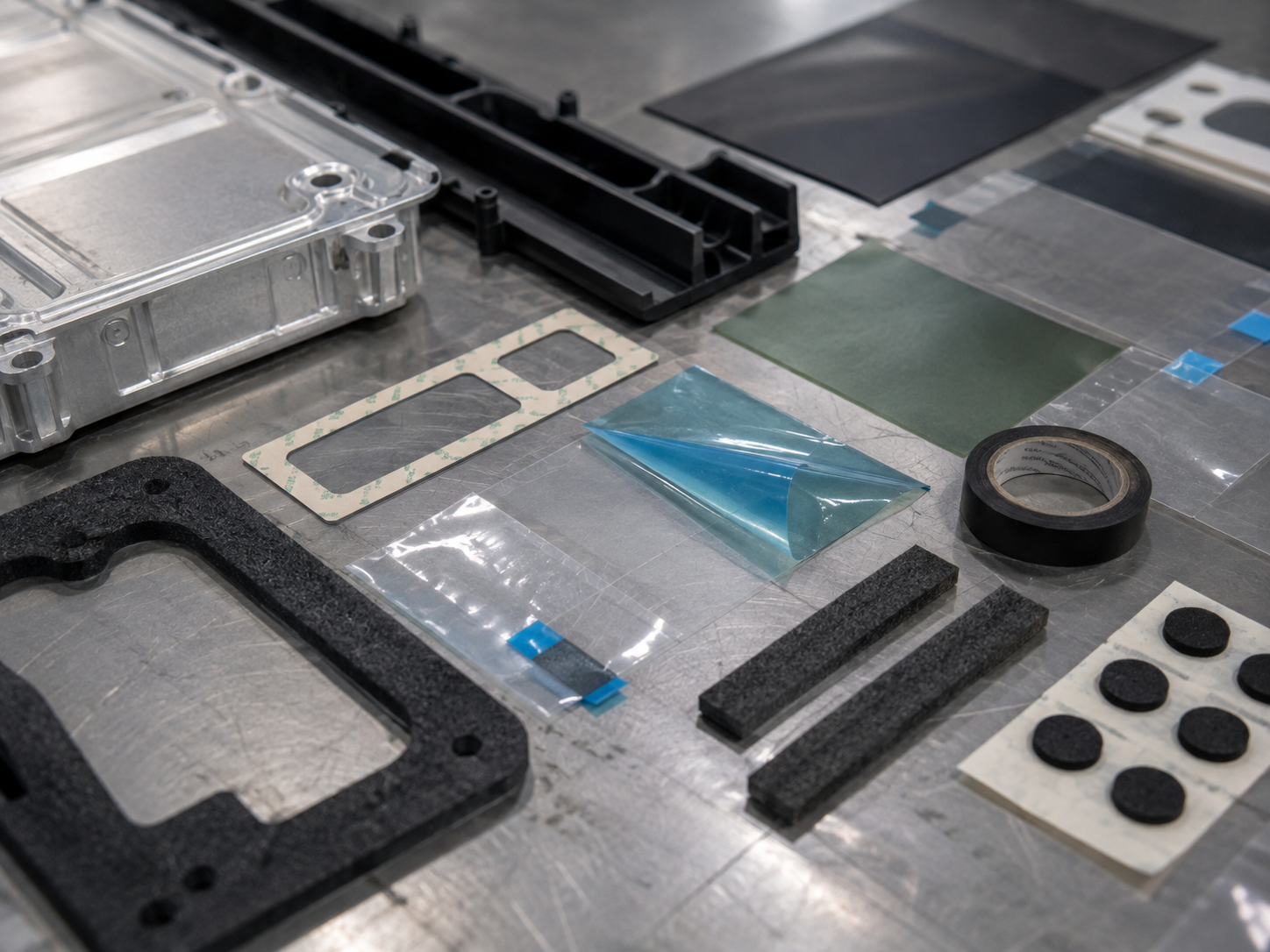
Protective Films for Handling and Surface Protection
EV battery and energy storage components may pass through many production, inspection, transport, and installation steps.
Protective films help reduce surface damage before final assembly.
They may protect:
- Metal covers
- Painted panels
- Plastic housings
- Display or indicator windows
- Sensor cover areas
- Decorative or visible surfaces
- Temporary handling surfaces
Protective films can be die cut with pull tabs for easier removal.
For surface protection design, buyers can review when OEM products need custom die-cut surface protection films.
A protective film should be easy to apply, stay clean, and remove without residue when required.
If it scratches the surface or leaves adhesive behind, it has failed its purpose.
Rubber and Foam Pads for Cushioning and Vibration Control
EV battery systems and related enclosures may experience vibration, shock, movement, and repeated contact during use.
Rubber and foam pads can help reduce hard contact and protect local areas.
Common die-cut parts include:
| Component | Main Use |
|---|---|
| Rubber pads | Damping and contact protection |
| Foam cushioning pads | Shock absorption and soft support |
| Adhesive-backed foam pads | Easy placement and anti-rattle support |
| Rubber spacers | Controlled separation |
| Foam strips | Gap filling and vibration reduction |
For vibration-related material selection, buyers can review how to choose die cut foam materials for noise, vibration, and impact control.
Foam and rubber should be selected based on compression, hardness, density, thickness, contact area, and long-term recovery.
The part should cushion the assembly without creating unwanted stress.
Conductive Foam for EMI Shielding or Grounding Interfaces
In some EV battery-related electronic assemblies, conductive foam may be used where EMI shielding or grounding contact is required.
This is usually related to electronic control areas, metal housing interfaces, or module enclosure contact points rather than general sealing.
Conductive foam should only be selected when the design actually requires conductivity.
Important checks include:
- Contact surface
- Compression gap
- Conductive path requirement
- Foam thickness
- Adhesive backing
- Placement accuracy
- Long-term contact stability
Conductive foam is not a replacement for ordinary foam gasket material.
It is a functional shielding or grounding component and should be reviewed according to the electrical design requirement.
Die-Cut Design Factors That Matter
EV battery die-cut components often include holes, windows, slots, narrow strips, frames, pads, and adhesive-backed parts.
Design must support both function and manufacturability.
| Design Factor | Why It Matters |
|---|---|
| Minimum width | Prevents tearing, stretching, and weak sealing paths |
| Corner radius | Reduces lifting and stress concentration |
| Hole-to-edge distance | Improves cutting stability |
| Thickness tolerance | Controls fit, compression, and assembly height |
| Adhesive coverage | Prevents shifting or glue overflow |
| Liner release | Supports smooth peeling and placement |
| Part spacing | Improves assembly efficiency |
| Packaging method | Prevents dust, curling, or compression marks |
For design guidance, buyers can review what engineers should know about minimum width in die cut parts.
A die-cut part should work in CAD, in production, and in final assembly.
All three matter.
Manufacturing and Quality Control
Most EV battery-related flexible die-cut parts are produced through material review, lamination, die cutting, kiss cutting, inspection, and packaging.
| Step | Main Purpose |
|---|---|
| Application review | Confirm sealing, insulation, bonding, protection, or cushioning function |
| Material selection | Choose foam, rubber, PET film, adhesive tape, protective film, or conductive foam |
| Lamination | Add adhesive backing, release liner, pull tab, or support layer if needed |
| Die cutting | Cut frames, pads, strips, holes, slots, and custom shapes |
| Kiss cutting | Keep adhesive-backed parts on liner |
| Inspection | Check dimensions, thickness, edges, adhesive position, and surface quality |
| Packaging | Prevent dust, sticking, deformation, compression, and scratches |
For process background, buyers can review from foam rolls to finished parts: how die cutting works.
Key inspection points usually include dimensions, thickness, edge quality, cleanliness, adhesive position, liner release, compression behavior, film flatness, and packaging condition.
Stable production is more important than one perfect sample.
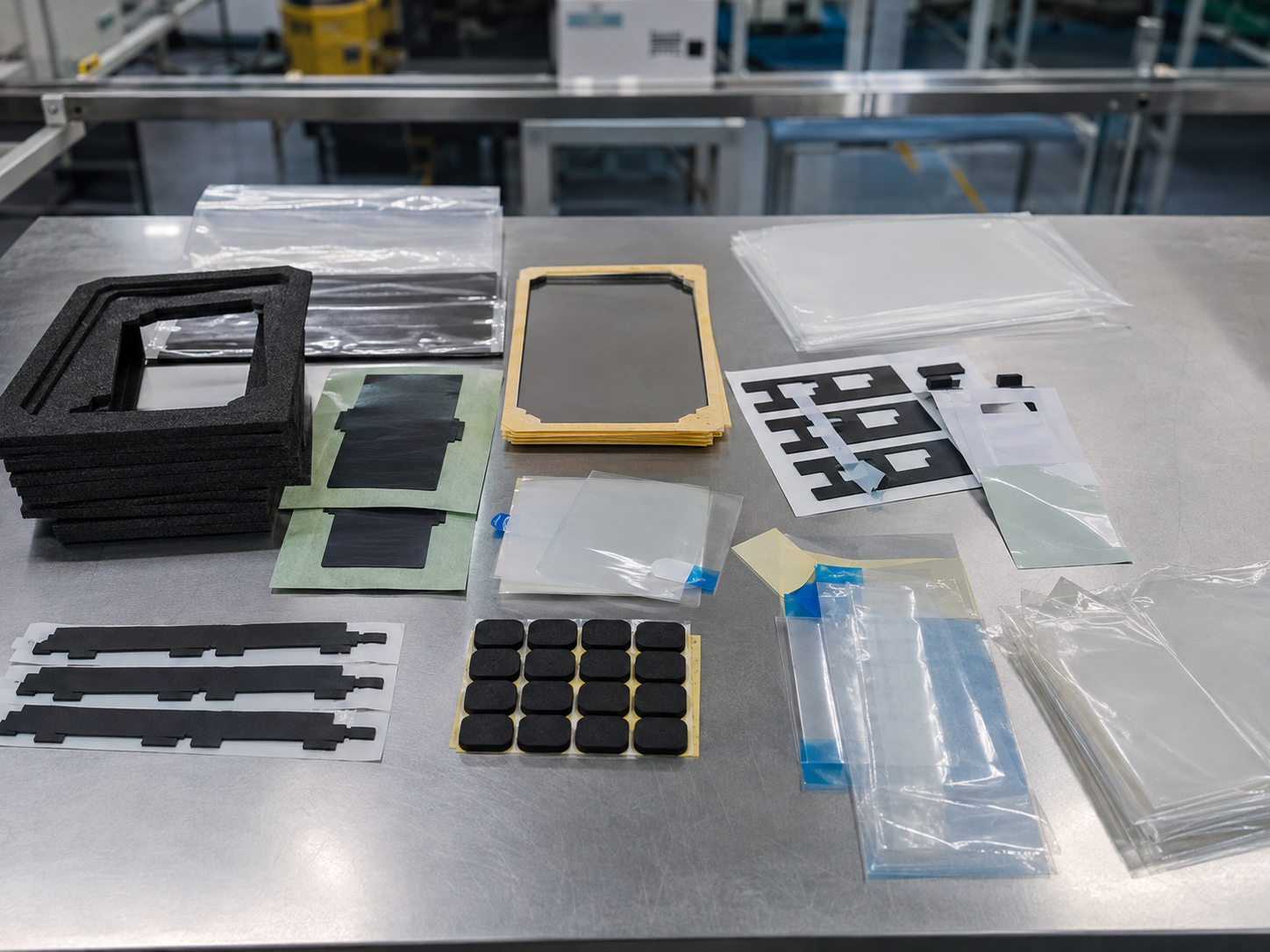
Quick Selection Checklist
Before choosing die-cut components for EV battery assembly, check these points:
| Key Question | Why It Matters |
|---|---|
| What function must the part provide? | Defines material direction |
| Is sealing, insulation, bonding, protection, or cushioning required? | Prevents wrong material selection |
| What surface will the part contact? | Affects adhesive and sealing choice |
| Is compression involved? | Determines foam or rubber thickness |
| Is the part adhesive-backed? | Affects liner, peeling, and placement |
| Is the shape narrow or complex? | Affects die-cut feasibility |
| What supply format is needed? | Affects assembly efficiency |
This keeps the selection practical.
The best die-cut component is the one that solves the real assembly problem.
Need Custom Die-Cut Components for EV Battery Assembly?
If you need foam gaskets, PET insulation films, adhesive tape parts, protective films, rubber pads, conductive foam parts, or laminated flexible components for EV battery and energy storage assembly, Sanken can help review material direction, die-cut feasibility, adhesive backing, compression design, inspection points, and packaging format.
For quotation, please send the drawing, application location, material requirement, thickness, bonding surface, annual volume, and packaging preference.
Sanken can support custom die-cut component development from sample review to mass production.
You May Also Find These Articles Helpful
Custom Adhesive Tape Components for EV Battery and Energy Storage Assembly
Custom Die-Cut PET Insulation Films for Electronics Assembly
How to Choose Die Cut PET Insulation Films for EV Battery Packs and Modules
How to Choose Die Cut Foam Gaskets for EV Battery Pack Sealing and Cushioning
Adhesive Tape Converting for Sealing, Bonding, Insulation, Cushioning, and Protection
How Die Cut Foam, Felt, and Rubber Parts Reduce Vibration in Automotive Interiors
Conclusion
EV battery systems use many flexible die-cut components around covers, housings, electronics, cable channels, sensors, and assembly interfaces. Common parts include foam gaskets, PET insulation films, adhesive tape components, protective films, rubber pads, cushioning foams, conductive foam parts, and laminated structures. The right component depends on the actual function: sealing, insulation, bonding, protection, cushioning, vibration control, or EMI shielding. Good material selection, die-cut design, adhesive control, inspection, and packaging help these small parts perform reliably in OEM production.